
We Run Our Business on Referrals
Fresh Projects is a UK-based software platform designed for architects, engineers, and other built-environment professionals to manage financial aspects of their projects. It helps teams track fees, timesheets, expenses, billing, and overall profitability to keep projects on budget and profitable. The platform also centralises project data, streamlines administrative tasks, and offers mobile app support for easy access and updates.
1a Colinette Road
London
SW15 6QG
© 2026 Fresh Projects
Product
We Run Our Business on Referrals
Fresh Projects is a UK-based software platform designed for architects, engineers, and other built-environment professionals to manage financial aspects of their projects. It helps teams track fees, timesheets, expenses, billing, and overall profitability to keep projects on budget and profitable. The platform also centralises project data, streamlines administrative tasks, and offers mobile app support for easy access and updates.
1a Colinette Road
London
SW15 6QG
© 2026 Fresh Projects
Product
Practice Performance Management & Project Information Management: Why Growing AEC Firms Need Both
Practice Performance Management & Project Information Management: Why Growing AEC Firms Need Both
Practice Performance Management & Project Information Management: Why Growing AEC Firms Need Both
Reading Time:
Reading Time:
12
12
minute(s)
minute(s)

There comes a point in every single architecture or engineering firm when ways of working suddenly change. For some practices it happens earlier, for others later, but once a business has moved beyond a small founder-led team and is growing through 20, 30, 50 people and beyond, familiar operating practices start to come under pressure.
Directors are no longer involved in every project. Project leaders take on more responsibility. Finance, operations and delivery begin to develop their own processes. Work may be spread across teams, disciplines or offices, and recruitment decisions need to be made months before the extra capacity is required.
At the same time, the amount of information being created grows with the firm.
That creates two related management challenges:
Do we really understand how the practice is performing? Are projects profitable? Where is resource tight? What work is coming next? Are fees being used at the rate the business expected?
Do we have a consistent, collective memory of what happened in projects? Why was a decision made? What did the client agree to? Where is the correspondence that explains a change made eight months ago?
Both rely on good information, although they require different kinds of information and solve different problems. Progressive projects have identified this and are increasingly investing in two types of systems: Practice Performance Management and Project Information Management. Let’s start with Practice Performance Management.
What changes when a practice grows beyond the founder-led stage?
In a smaller practice, management information can remain surprisingly informal because the people running the business are close to the work.
A director may know which project is struggling because they attended the last client meeting. They know who has capacity because they speak to everyone most days. If there is a question about an old decision, somebody in the room probably remembers the conversation.
As more project leaders take responsibility for delivery, directors need to delegate without losing sight of what is happening. The team working on a project may understand its day-to-day position well, while Finance sees a different view of the fee and management receives another version through monthly reporting.
Resource planning also becomes harder to do by feel. A decision to recruit now may be based on work expected to begin three or six months later, while a delay on one large project can change the picture again.
The work itself also tends to become more varied as practices grow. RIBA’s research shows that firms with 20 to 49 staff have a particularly high share of public and infrastructure work, while practices with 50 or more staff tend to have a broader mix of larger and more complex project types.
None of that means a 20-person firm needs the same management structure as a 100-person business. It does mean that systems which relied heavily on a few people knowing everything become harder to maintain.
That is where better practice information starts to matter.
What does Practice Performance Management mean in an AEC firm?
Practice Performance Management covers the business around the work being delivered to clients. That includes project financial performance, fees, time, workload, resource, pipeline, forecasting, cash flow and profitability.
RIBA’s research into the future of practice management describes profitability, staff and business development as closely connected parts of running a practice. It also points to the need for firms to understand their current financial position, market, workload and future staffing requirements.
At Fresh Projects, we use Practice Performance Management to describe the part of practice management concerned specifically with how the firm and its projects are performing.
For a firm growing through 20, 30 or 50 people, the questions are usually quite practical.
A director may need to know whether a project is consuming its fee faster than planned before the margin has disappeared. Operations may need to understand which teams have capacity and which are likely to be stretched next quarter. Finance may need a reliable forecast without waiting until month-end to assemble it. The leadership team may want to know which clients, sectors or types of work are actually contributing to profit.
Those answers become more important when trading conditions change.
A strong year does not remove the need for current visibility
The latest annual RIBA benchmarking showed a much stronger financial picture in 2025 than the profession had seen in the preceding years.
Revenue across RIBA Chartered Practices increased by 24% to almost £5 billion, while profitability improved after a long period in which rising revenue had struggled to translate into stronger profits.
For practices with 20 or more staff, international work also accounted for an average 10% of revenue in the 2025 benchmark, another indication that growth can bring a broader mix of markets and commercial considerations.
The picture during 2026 has become less settled.
By August, the RIBA Future Trends Workload Index had fallen to +1, down from +4 in July. A positive figure still indicates expected workload growth overall, but only by a narrow margin. Expectations for both permanent and temporary staffing had moved into negative territory, while practices continued to report fee pressure, planning delays and slower client decision-making.
Construction output also fell 0.5% in the three months to July 2026, according to the ONS, with both new work and repair and maintenance declining over the period.
We do not yet have the annual data to say what those conditions will mean for practice profitability in 2026. What we can see is how quickly the context around a firm can change.
A healthy result last year cannot tell a director whether one large project is currently consuming too much resource, whether the next quarter’s pipeline will convert, or whether a team will have enough work six months from now.
For a growing practice, those are current management questions.

Sources: RIBA Business Benchmarking 2025 and RIBA Future Trends, August 2026.
The 20-to-50 growth stage creates a reporting problem
One of the difficult parts of growth is that responsibility has to move through the business.
A director cannot review every fee proposal, monitor every project’s hours, allocate every person and remain involved in every client conversation once the firm reaches a certain size.
Project leaders need enough information to manage their work, while directors need enough visibility to know when something needs their attention.
The reporting problem appears when those two things develop separately.
Project teams maintain one set of information. Finance builds another. Management receives a board pack later in the month. Someone maintains a resource spreadsheet because the existing system does not quite answer the question they need it to answer.
Each process may have started for a sensible reason, but over time the business can end up spending more effort reconciling information before it can use it.
RIBA’s longer-term productivity research is relevant here. Between 2015 and 2024, inflation-adjusted revenue per staff member increased by 14% in practices with 20 to 49 staff, while practices with 50 or more staff recorded growth of less than 1%. RIBA cautions that technology alone has not produced the productivity gains once expected.
Those figures do not tell us why an individual firm is more or less productive. They do show that adding people and technology does not automatically make a growing practice easier to run.
The management processes around them matter too.
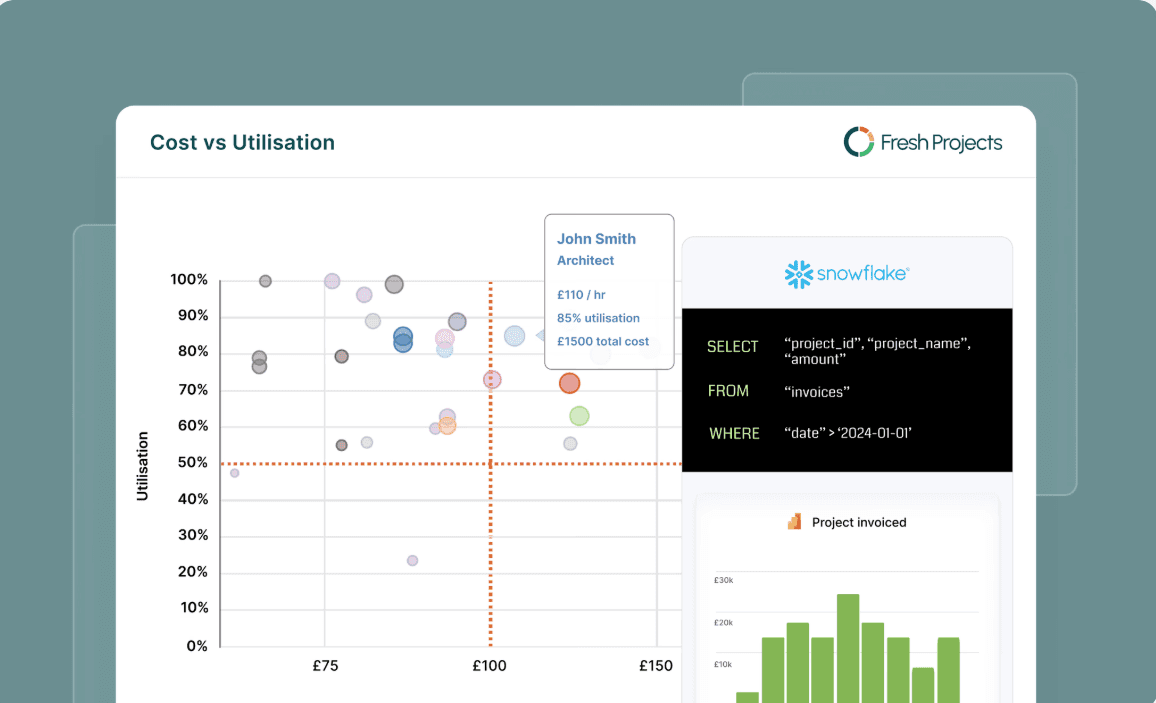
As responsibility spreads through a growing firm, directors and project leaders need a shared view of current project and business performance.
Fresh Projects brings project, financial and operational data into one view, helping firms see profitability, team performance and financial trends without having to piece the picture together from separate reports.
The other growth problem is project knowledge
Commercial visibility is only one side of what becomes harder as the team expands.
More people also means more project communication.
A 10-person practice may have a relatively good collective memory. At 30 or 50 people, the person who needs an answer may not have been involved in the original conversation. They may work in another team, another office or on another discipline within the same project.
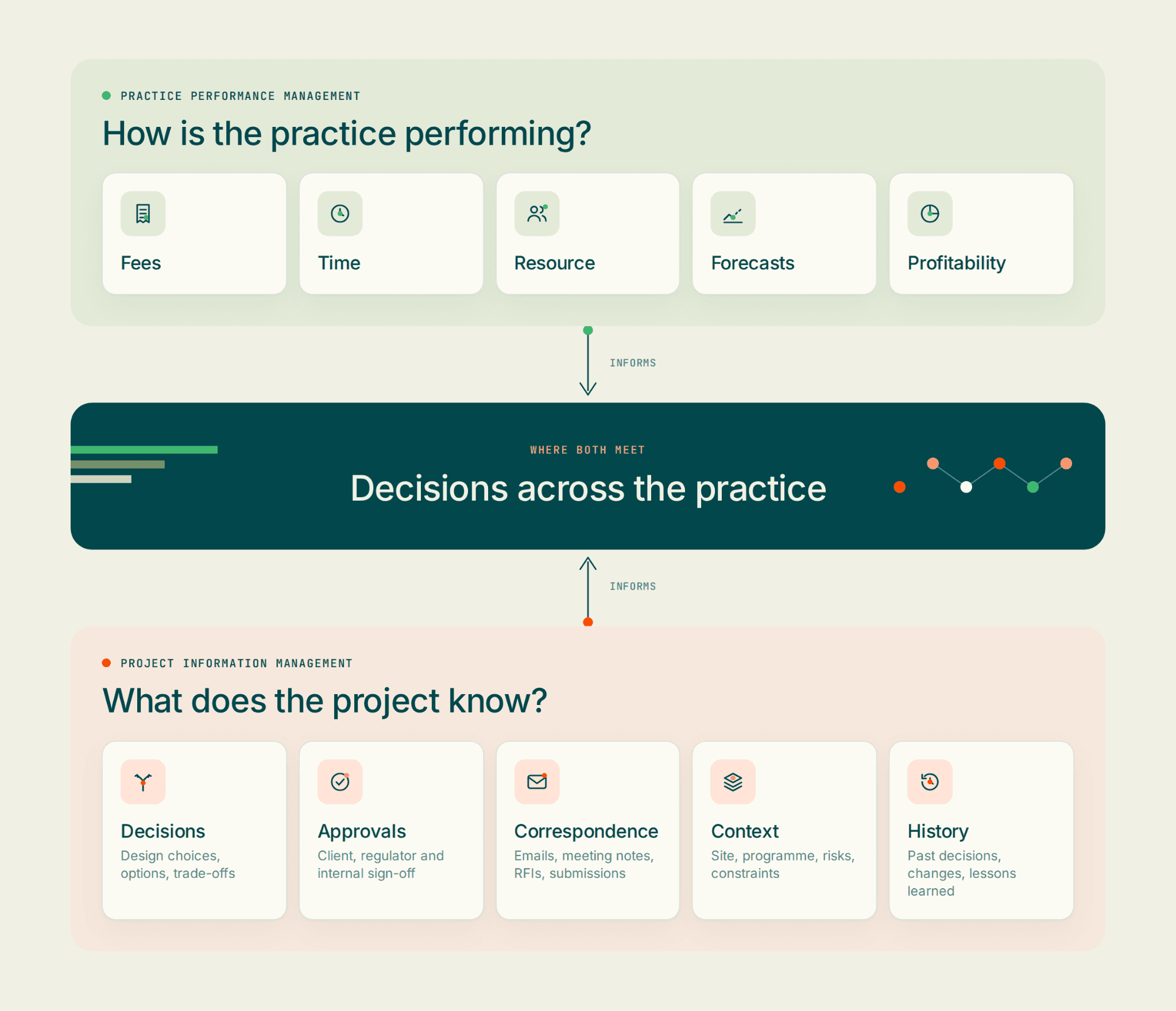
This is where Project Information Management becomes relevant.
The Association for Project Management defines information management as the collection, storage, curation, dissemination, archiving and destruction of documents, images, drawings and other information. It says project-based work relies on accurate and timely information so teams and stakeholders can make informed decisions and fulfil their roles effectively.
For architecture and engineering firms, some of that information is formal: drawings, documents and structured project data.
A great deal of project context is also created through ordinary communication.
A client confirms a change in an email. A consultant explains why an option was rejected. A project leader records what was agreed after a meeting. Somebody confirms the scope of an additional piece of work.
The difficulty often appears later, when another person needs that context.
Information can exist without being easy to use
As a practice grows, project knowledge can become distributed across more individual inboxes, people and filing habits.
Finding something recent is rarely the problem. Finding the conversation that explains an old decision becomes more dependent on knowing who was involved, when it happened and how they described it at the time.
Microsoft’s wider workplace research gives some useful context for that information volume. Its 2025 telemetry found the average worker in its dataset received 117 emails a day, while an earlier global Work Trend Index found 62% of respondents felt they spent too much of their working day searching for information. (Microsoft Work Trend Index: Microsoft, Breaking down the infinite workday (2025) and Will AI Fix Work? (2023): 2025 report | 2023 report) These figures cover general knowledge workers rather than AEC firms specifically, but they illustrate the environment in which project teams are trying to retrieve information.
The weakness becomes particularly obvious when people change roles or leave the firm. If useful project context can only be found by asking the person who remembers it, part of the firm’s project knowledge effectively sits with individuals rather than the practice.
For a growing business, that creates a continuity problem as well as a search problem.
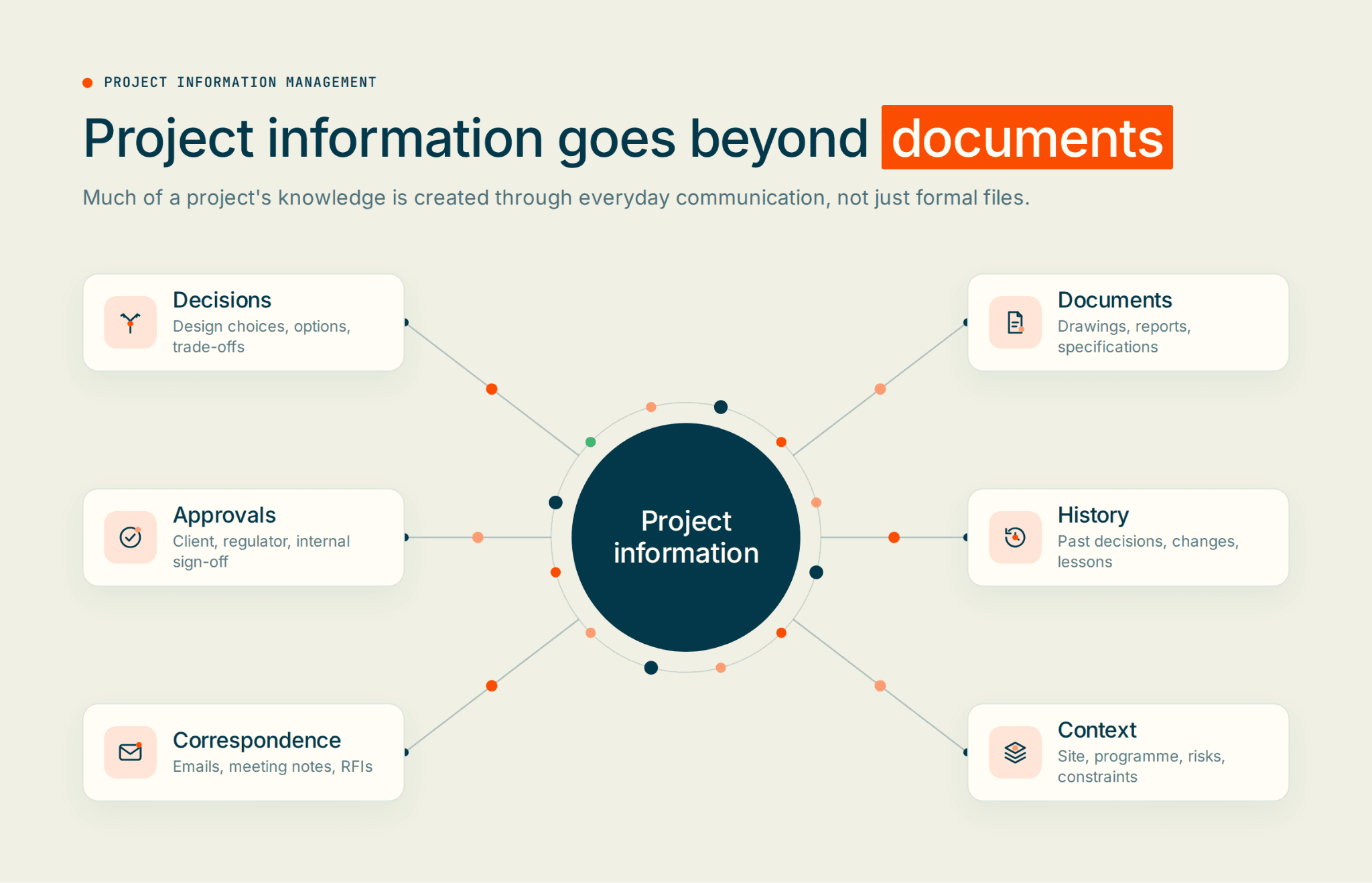
Practice performance and project knowledge meet on the same job
The difference between the two areas is easier to see in a situation that will be familiar to many growing firms.
Imagine a project whose expected margin has started to fall.
Current practice-performance information might show that more hours have been used than planned and that the remaining fee no longer looks sufficient for the work left to complete.
That tells the project lead and management what is happening commercially.
Finding the cause may require another set of information. The client may have requested additional work. A programme change may have created more iterations. Someone may have agreed to progress work before a variation was approved.
The project correspondence can provide context that the financial figures themselves cannot.
The reverse also happens. A project leader may be fully aware that the scope has moved because they have been involved in every conversation, but Finance and management may not see the commercial effect until extra hours begin appearing later.
As the firm grows, the problem is increasingly about making useful information travel beyond the person who first knew it.
Neither system works properly without adoption
Growing firms often reach the point where an existing spreadsheet, finance system or filing process is technically still functioning, but only because people have built workarounds around it.
Changing technology does not automatically solve that.
A peer-reviewed study examined 167 cases of organisation-wide technology change across architecture, engineering and construction firms in the US and Canada. The practices most closely associated with successful adoption included effective change agents, measured benchmarks, realistic implementation timeframes and communicating the benefits of the change clearly.
This matters particularly at the growth stage because information increasingly depends on people beyond the founders.
If project teams do not submit time consistently, directors cannot trust a live profitability view. If forecasts are rarely updated, resource planning becomes less useful. If important correspondence is not captured, later searches will still contain gaps.
Adoption affects the quality of the management information the firm eventually gets back.
That is why the right question for a growing practice is not only whether a system can perform a particular task. It also needs to fit closely enough with everyday work that project teams, Finance and leadership will all use it consistently.
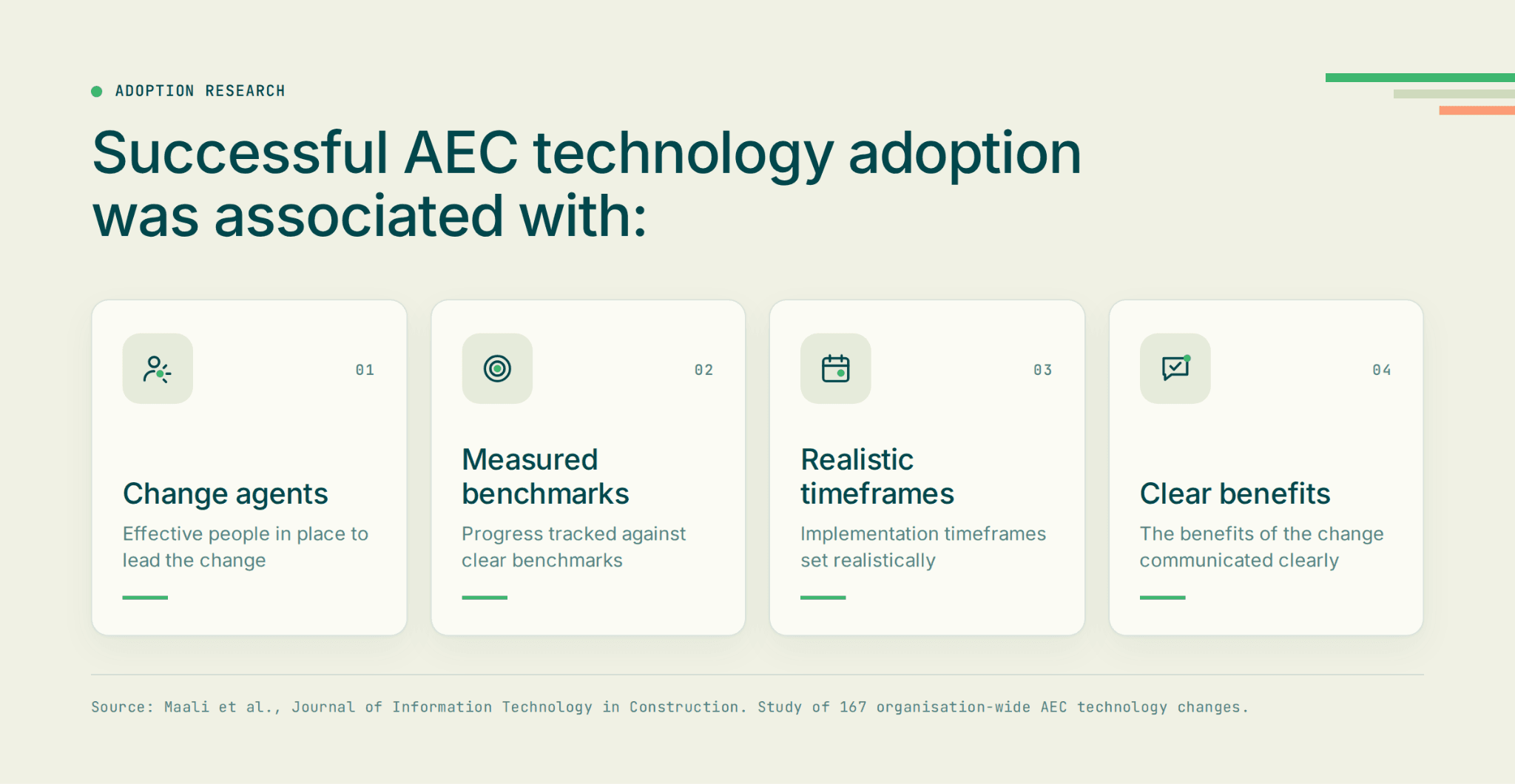
Source: AEC technology adoption study: Maali et al., Change management practices for adopting new technologies in the design and construction industry, Journal of Information Technology in Construction (2020): ITcon article
Where Fresh Projects fits
Fresh Projects provides solutions to both Practice Performance Management (Fresh Projects) and Project Information Management (Fresh Memory). Fresh Projects brings project, financial and operational information together so that project leaders, Finance and management can work from the same current data. Its Business Insights functionality covers areas including profitability, team performance and financial trends, while resource planning and forecasting support decisions about future capacity.
The point for a growing firm is not simply having another dashboard.
As responsibility moves beyond the directors, the people running projects need useful commercial information at their level, while leadership needs enough visibility across the firm to identify where intervention is required.
Pulse Consult provides an example at a later stage of that growth journey. As the multidisciplinary consultancy expanded, project, resource and financial information had become spread across spreadsheets and systems. Reporting required manual work and management had limited visibility across hundreds of live projects. Fresh Projects brought project budgets, resource planning, timesheets, profitability reporting and forecasting into a shared source of current information.
For firms earlier in the journey, the same principle applies before the complexity reaches that scale: put the management information in place while the business is still manageable enough to establish good habits.
Read More: 7 Signs Your A&E Practice Management Software Isn’t Fully Adopted
Read More: Five Ways to Build Commercial Confidence Across Your Project Teams
Where Fresh Memory fits
Fresh Memory addresses a different part of the growth problem.
Project Information Management is a broad discipline, and Fresh Memory currently focuses on project correspondence and the knowledge contained within it.
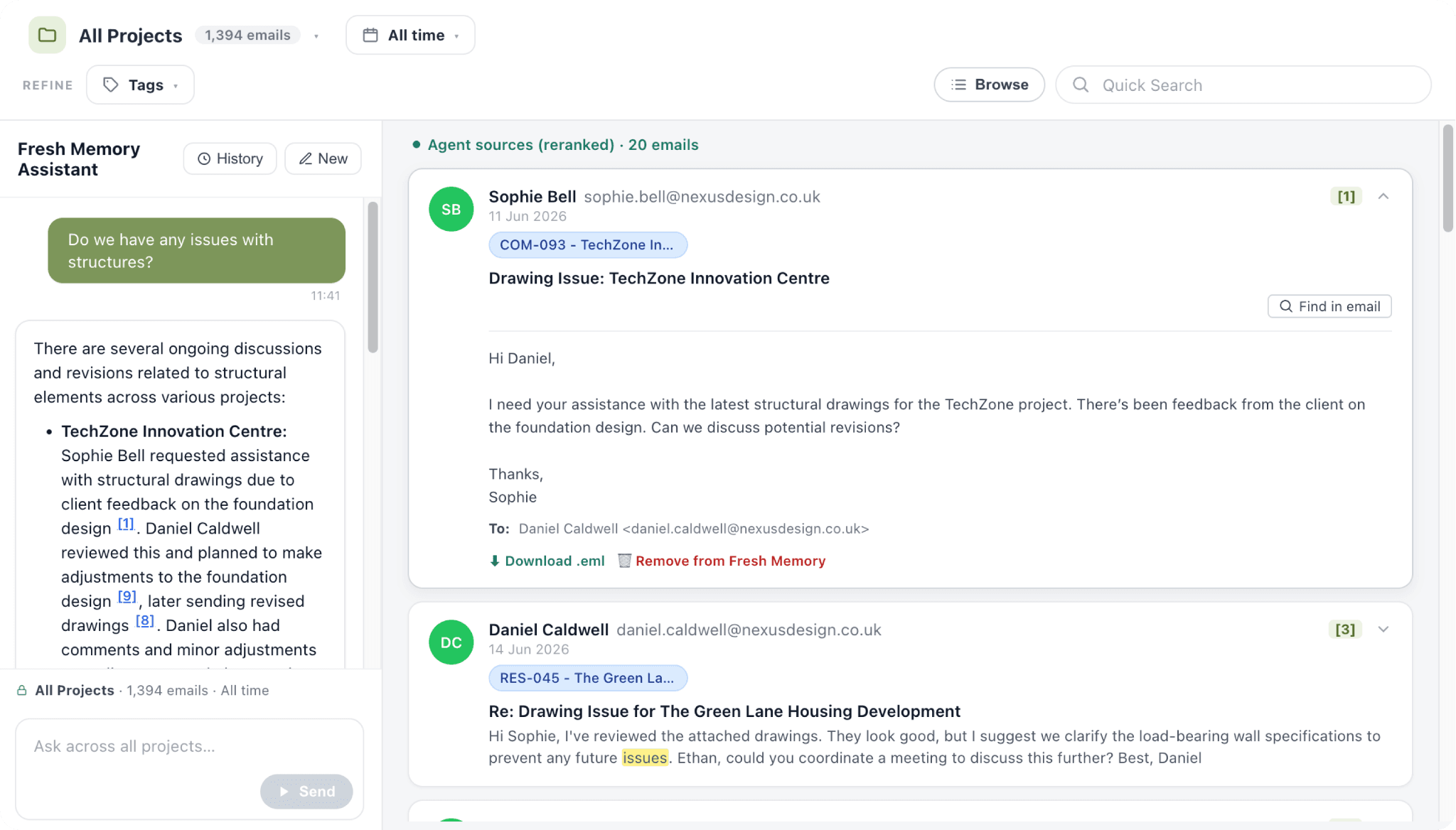
Fresh Memory begins with email. It is designed to help firms capture project correspondence and retrieve the context inside it using natural-language search, reducing the dependence on knowing who sent something or where an individual filed it.
For a growing practice, that becomes more relevant as project knowledge has to move between more people.
A project lead should not need to be present for every historic conversation to understand what was agreed, and a director should not need to search another person’s inbox to establish the background to a project issue.
Fresh Memory does not replace BIM processes, document-management platforms or a Common Data Environment. Its current role sits within the wider information management picture by addressing correspondence and project knowledge.
It can also operate independently of Fresh Projects, so the practice performance and project information problems do not have to be solved through one software ecosystem.
Build the information habits before complexity forces the issue
So, in summary, no matter what your firm size, there will likely come the need for both Practice Performance Management and Project Information Management.
This is where Fresh Projects and Fresh Memory become increasingly valuable, establishing good information habits. Together, they help a growing firm answer everyday management and project questions without relying on one person, one spreadsheet or one inbox - creating an information foundation that can scale with the practice rather than becoming harder to manage as it grows.
Frequently asked questions
Why does practice management become more important as an AEC firm grows?
As more project leaders, staff and projects are added, directors become less able to manage the firm through direct involvement in every job. Practice management provides the financial and operational information needed to delegate responsibility while retaining visibility of project performance, workload, resources, and profitability.
What is Project Information Management in architecture and engineering?
Project Information Management covers the processes used to collect, organise, store, distribute, retrieve and retain information created during project delivery. APM describes information management as supporting project teams with accurate and timely information for effective decision-making.
What is the difference between practice management and Project Information Management?
Practice management deals with running and understanding the business around project delivery, including areas such as financial performance, workload, resources, and forecasting.
Project Information Management deals with how the information created during the work is captured, retained and made available to the people who need it.
The two often meet when a project decision affects scope, time, resource or fee.
At what size should an AEC firm introduce practice-management software?
There is no universal headcount because project complexity, disciplines, offices and management structure vary considerably between firms. A more useful trigger is whether directors and project leaders can still obtain reliable answers about profitability, workload, resources, and future demand without assembling information manually.
For firms growing beyond a small founder-led team, those questions often become harder before the firm considers itself “large”.
Is Project Information Management the same as project management?
Project management concerns planning and delivering the project itself. Project Information Management concerns the information used and created during that work, including how it is captured, organised, shared and retrieved.
Is Project Information Management the same as BIM or a Common Data Environment?
Project Information Management is broader than an individual BIM process or software platform. BIM, Common Data Environments, document systems and correspondence processes can all form part of how a firm manages project information.
What does PIM mean in construction?
Within ISO 19650 terminology, PIM commonly means Project Information Model. Because the same abbreviation can also be used for Project Information Management elsewhere, writing Project Information Management in full avoids ambiguity.
There comes a point in every single architecture or engineering firm when ways of working suddenly change. For some practices it happens earlier, for others later, but once a business has moved beyond a small founder-led team and is growing through 20, 30, 50 people and beyond, familiar operating practices start to come under pressure.
Directors are no longer involved in every project. Project leaders take on more responsibility. Finance, operations and delivery begin to develop their own processes. Work may be spread across teams, disciplines or offices, and recruitment decisions need to be made months before the extra capacity is required.
At the same time, the amount of information being created grows with the firm.
That creates two related management challenges:
Do we really understand how the practice is performing? Are projects profitable? Where is resource tight? What work is coming next? Are fees being used at the rate the business expected?
Do we have a consistent, collective memory of what happened in projects? Why was a decision made? What did the client agree to? Where is the correspondence that explains a change made eight months ago?
Both rely on good information, although they require different kinds of information and solve different problems. Progressive projects have identified this and are increasingly investing in two types of systems: Practice Performance Management and Project Information Management. Let’s start with Practice Performance Management.
What changes when a practice grows beyond the founder-led stage?
In a smaller practice, management information can remain surprisingly informal because the people running the business are close to the work.
A director may know which project is struggling because they attended the last client meeting. They know who has capacity because they speak to everyone most days. If there is a question about an old decision, somebody in the room probably remembers the conversation.
As more project leaders take responsibility for delivery, directors need to delegate without losing sight of what is happening. The team working on a project may understand its day-to-day position well, while Finance sees a different view of the fee and management receives another version through monthly reporting.
Resource planning also becomes harder to do by feel. A decision to recruit now may be based on work expected to begin three or six months later, while a delay on one large project can change the picture again.
The work itself also tends to become more varied as practices grow. RIBA’s research shows that firms with 20 to 49 staff have a particularly high share of public and infrastructure work, while practices with 50 or more staff tend to have a broader mix of larger and more complex project types.
None of that means a 20-person firm needs the same management structure as a 100-person business. It does mean that systems which relied heavily on a few people knowing everything become harder to maintain.
That is where better practice information starts to matter.
What does Practice Performance Management mean in an AEC firm?
Practice Performance Management covers the business around the work being delivered to clients. That includes project financial performance, fees, time, workload, resource, pipeline, forecasting, cash flow and profitability.
RIBA’s research into the future of practice management describes profitability, staff and business development as closely connected parts of running a practice. It also points to the need for firms to understand their current financial position, market, workload and future staffing requirements.
At Fresh Projects, we use Practice Performance Management to describe the part of practice management concerned specifically with how the firm and its projects are performing.
For a firm growing through 20, 30 or 50 people, the questions are usually quite practical.
A director may need to know whether a project is consuming its fee faster than planned before the margin has disappeared. Operations may need to understand which teams have capacity and which are likely to be stretched next quarter. Finance may need a reliable forecast without waiting until month-end to assemble it. The leadership team may want to know which clients, sectors or types of work are actually contributing to profit.
Those answers become more important when trading conditions change.
A strong year does not remove the need for current visibility
The latest annual RIBA benchmarking showed a much stronger financial picture in 2025 than the profession had seen in the preceding years.
Revenue across RIBA Chartered Practices increased by 24% to almost £5 billion, while profitability improved after a long period in which rising revenue had struggled to translate into stronger profits.
For practices with 20 or more staff, international work also accounted for an average 10% of revenue in the 2025 benchmark, another indication that growth can bring a broader mix of markets and commercial considerations.
The picture during 2026 has become less settled.
By August, the RIBA Future Trends Workload Index had fallen to +1, down from +4 in July. A positive figure still indicates expected workload growth overall, but only by a narrow margin. Expectations for both permanent and temporary staffing had moved into negative territory, while practices continued to report fee pressure, planning delays and slower client decision-making.
Construction output also fell 0.5% in the three months to July 2026, according to the ONS, with both new work and repair and maintenance declining over the period.
We do not yet have the annual data to say what those conditions will mean for practice profitability in 2026. What we can see is how quickly the context around a firm can change.
A healthy result last year cannot tell a director whether one large project is currently consuming too much resource, whether the next quarter’s pipeline will convert, or whether a team will have enough work six months from now.
For a growing practice, those are current management questions.
Sources: RIBA Business Benchmarking 2025 and RIBA Future Trends, August 2026.
The 20-to-50 growth stage creates a reporting problem
One of the difficult parts of growth is that responsibility has to move through the business.
A director cannot review every fee proposal, monitor every project’s hours, allocate every person and remain involved in every client conversation once the firm reaches a certain size.
Project leaders need enough information to manage their work, while directors need enough visibility to know when something needs their attention.
The reporting problem appears when those two things develop separately.
Project teams maintain one set of information. Finance builds another. Management receives a board pack later in the month. Someone maintains a resource spreadsheet because the existing system does not quite answer the question they need it to answer.
Each process may have started for a sensible reason, but over time the business can end up spending more effort reconciling information before it can use it.
RIBA’s longer-term productivity research is relevant here. Between 2015 and 2024, inflation-adjusted revenue per staff member increased by 14% in practices with 20 to 49 staff, while practices with 50 or more staff recorded growth of less than 1%. RIBA cautions that technology alone has not produced the productivity gains once expected.
Those figures do not tell us why an individual firm is more or less productive. They do show that adding people and technology does not automatically make a growing practice easier to run.
The management processes around them matter too.
As responsibility spreads through a growing firm, directors and project leaders need a shared view of current project and business performance.
Fresh Projects brings project, financial and operational data into one view, helping firms see profitability, team performance and financial trends without having to piece the picture together from separate reports.
The other growth problem is project knowledge
Commercial visibility is only one side of what becomes harder as the team expands.
More people also means more project communication.
A 10-person practice may have a relatively good collective memory. At 30 or 50 people, the person who needs an answer may not have been involved in the original conversation. They may work in another team, another office or on another discipline within the same project.
This is where Project Information Management becomes relevant.
The Association for Project Management defines information management as the collection, storage, curation, dissemination, archiving and destruction of documents, images, drawings and other information. It says project-based work relies on accurate and timely information so teams and stakeholders can make informed decisions and fulfil their roles effectively.
For architecture and engineering firms, some of that information is formal: drawings, documents and structured project data.
A great deal of project context is also created through ordinary communication.
A client confirms a change in an email. A consultant explains why an option was rejected. A project leader records what was agreed after a meeting. Somebody confirms the scope of an additional piece of work.
The difficulty often appears later, when another person needs that context.
Information can exist without being easy to use
As a practice grows, project knowledge can become distributed across more individual inboxes, people and filing habits.
Finding something recent is rarely the problem. Finding the conversation that explains an old decision becomes more dependent on knowing who was involved, when it happened and how they described it at the time.
Microsoft’s wider workplace research gives some useful context for that information volume. Its 2025 telemetry found the average worker in its dataset received 117 emails a day, while an earlier global Work Trend Index found 62% of respondents felt they spent too much of their working day searching for information. (Microsoft Work Trend Index: Microsoft, Breaking down the infinite workday (2025) and Will AI Fix Work? (2023): 2025 report | 2023 report) These figures cover general knowledge workers rather than AEC firms specifically, but they illustrate the environment in which project teams are trying to retrieve information.
The weakness becomes particularly obvious when people change roles or leave the firm. If useful project context can only be found by asking the person who remembers it, part of the firm’s project knowledge effectively sits with individuals rather than the practice.
For a growing business, that creates a continuity problem as well as a search problem.
Practice performance and project knowledge meet on the same job
The difference between the two areas is easier to see in a situation that will be familiar to many growing firms.
Imagine a project whose expected margin has started to fall.
Current practice-performance information might show that more hours have been used than planned and that the remaining fee no longer looks sufficient for the work left to complete.
That tells the project lead and management what is happening commercially.
Finding the cause may require another set of information. The client may have requested additional work. A programme change may have created more iterations. Someone may have agreed to progress work before a variation was approved.
The project correspondence can provide context that the financial figures themselves cannot.
The reverse also happens. A project leader may be fully aware that the scope has moved because they have been involved in every conversation, but Finance and management may not see the commercial effect until extra hours begin appearing later.
As the firm grows, the problem is increasingly about making useful information travel beyond the person who first knew it.
Neither system works properly without adoption
Growing firms often reach the point where an existing spreadsheet, finance system or filing process is technically still functioning, but only because people have built workarounds around it.
Changing technology does not automatically solve that.
A peer-reviewed study examined 167 cases of organisation-wide technology change across architecture, engineering and construction firms in the US and Canada. The practices most closely associated with successful adoption included effective change agents, measured benchmarks, realistic implementation timeframes and communicating the benefits of the change clearly.
This matters particularly at the growth stage because information increasingly depends on people beyond the founders.
If project teams do not submit time consistently, directors cannot trust a live profitability view. If forecasts are rarely updated, resource planning becomes less useful. If important correspondence is not captured, later searches will still contain gaps.
Adoption affects the quality of the management information the firm eventually gets back.
That is why the right question for a growing practice is not only whether a system can perform a particular task. It also needs to fit closely enough with everyday work that project teams, Finance and leadership will all use it consistently.
Source: AEC technology adoption study: Maali et al., Change management practices for adopting new technologies in the design and construction industry, Journal of Information Technology in Construction (2020): ITcon article
Where Fresh Projects fits
Fresh Projects provides solutions to both Practice Performance Management (Fresh Projects) and Project Information Management (Fresh Memory). Fresh Projects brings project, financial and operational information together so that project leaders, Finance and management can work from the same current data. Its Business Insights functionality covers areas including profitability, team performance and financial trends, while resource planning and forecasting support decisions about future capacity.
The point for a growing firm is not simply having another dashboard.
As responsibility moves beyond the directors, the people running projects need useful commercial information at their level, while leadership needs enough visibility across the firm to identify where intervention is required.
Pulse Consult provides an example at a later stage of that growth journey. As the multidisciplinary consultancy expanded, project, resource and financial information had become spread across spreadsheets and systems. Reporting required manual work and management had limited visibility across hundreds of live projects. Fresh Projects brought project budgets, resource planning, timesheets, profitability reporting and forecasting into a shared source of current information.
For firms earlier in the journey, the same principle applies before the complexity reaches that scale: put the management information in place while the business is still manageable enough to establish good habits.
Read More: 7 Signs Your A&E Practice Management Software Isn’t Fully Adopted
Read More: Five Ways to Build Commercial Confidence Across Your Project Teams
Where Fresh Memory fits
Fresh Memory addresses a different part of the growth problem.
Project Information Management is a broad discipline, and Fresh Memory currently focuses on project correspondence and the knowledge contained within it.
Fresh Memory begins with email. It is designed to help firms capture project correspondence and retrieve the context inside it using natural-language search, reducing the dependence on knowing who sent something or where an individual filed it.
For a growing practice, that becomes more relevant as project knowledge has to move between more people.
A project lead should not need to be present for every historic conversation to understand what was agreed, and a director should not need to search another person’s inbox to establish the background to a project issue.
Fresh Memory does not replace BIM processes, document-management platforms or a Common Data Environment. Its current role sits within the wider information management picture by addressing correspondence and project knowledge.
It can also operate independently of Fresh Projects, so the practice performance and project information problems do not have to be solved through one software ecosystem.
Build the information habits before complexity forces the issue
So, in summary, no matter what your firm size, there will likely come the need for both Practice Performance Management and Project Information Management.
This is where Fresh Projects and Fresh Memory become increasingly valuable, establishing good information habits. Together, they help a growing firm answer everyday management and project questions without relying on one person, one spreadsheet or one inbox - creating an information foundation that can scale with the practice rather than becoming harder to manage as it grows.
Frequently asked questions
Why does practice management become more important as an AEC firm grows?
As more project leaders, staff and projects are added, directors become less able to manage the firm through direct involvement in every job. Practice management provides the financial and operational information needed to delegate responsibility while retaining visibility of project performance, workload, resources, and profitability.
What is Project Information Management in architecture and engineering?
Project Information Management covers the processes used to collect, organise, store, distribute, retrieve and retain information created during project delivery. APM describes information management as supporting project teams with accurate and timely information for effective decision-making.
What is the difference between practice management and Project Information Management?
Practice management deals with running and understanding the business around project delivery, including areas such as financial performance, workload, resources, and forecasting.
Project Information Management deals with how the information created during the work is captured, retained and made available to the people who need it.
The two often meet when a project decision affects scope, time, resource or fee.
At what size should an AEC firm introduce practice-management software?
There is no universal headcount because project complexity, disciplines, offices and management structure vary considerably between firms. A more useful trigger is whether directors and project leaders can still obtain reliable answers about profitability, workload, resources, and future demand without assembling information manually.
For firms growing beyond a small founder-led team, those questions often become harder before the firm considers itself “large”.
Is Project Information Management the same as project management?
Project management concerns planning and delivering the project itself. Project Information Management concerns the information used and created during that work, including how it is captured, organised, shared and retrieved.
Is Project Information Management the same as BIM or a Common Data Environment?
Project Information Management is broader than an individual BIM process or software platform. BIM, Common Data Environments, document systems and correspondence processes can all form part of how a firm manages project information.
What does PIM mean in construction?
Within ISO 19650 terminology, PIM commonly means Project Information Model. Because the same abbreviation can also be used for Project Information Management elsewhere, writing Project Information Management in full avoids ambiguity.
Published:
Published:

Practice Performance Management & Project Information Management: Why Growing AEC Firms Need Both
Practice Performance Management & Project Information Management: Why Growing AEC Firms Need Both
Practice Performance Management & Project Information Management: Why Growing AEC Firms Need Both
Growing architecture and engineering firms need two kinds of visibility: how the practice is performing, and what the project knows. This piece explores why both matter as teams, projects and complexity grow.
Growing architecture and engineering firms need two kinds of visibility: how the practice is performing, and what the project knows. This piece explores why both matter as teams, projects and complexity grow.

Five ways to build commercial confidence across your project teams
Five ways to build commercial confidence across your project teams
Five ways to build commercial confidence across your project teams
How architecture, engineering, quantity surveying and other built-environment firms can help project teams understand fees, time and performance without turning everyone into finance specialists.
How architecture, engineering, quantity surveying and other built-environment firms can help project teams understand fees, time and performance without turning everyone into finance specialists.

Can your project record stand up when it matters? 5 practical tests for AEC firms.
Can your project record stand up when it matters? 5 practical tests for AEC firms.
Can your project record stand up when it matters? 5 practical tests for AEC firms.
Five simple tests to uncover gaps in your project information before they become commercial, compliance or delivery risks.
Five simple tests to uncover gaps in your project information before they become commercial, compliance or delivery risks.

7 Signs Your A&E Practice Management Software Isn’t Fully Adopted
7 Signs Your A&E Practice Management Software Isn’t Fully Adopted
7 Signs Your A&E Practice Management Software Isn’t Fully Adopted
How growing A&E firms can close the gap between software implementation and whole-team commercial value
How growing A&E firms can close the gap between software implementation and whole-team commercial value

When Teams Stop Speaking The Same Operational Language
When Teams Stop Speaking The Same Operational Language
When Teams Stop Speaking The Same Operational Language
Why growing architecture practices often lose reporting confidence gradually, long before anyone formally identifies a systems problem.
Why growing architecture practices often lose reporting confidence gradually, long before anyone formally identifies a systems problem.

What It Really Means When a Client Recommends You
What It Really Means When a Client Recommends You
What It Really Means When a Client Recommends You
Why the built environment has always grown through trust, and what that means for the firms that do it well.
Why the built environment has always grown through trust, and what that means for the firms that do it well.

Why Reporting Leaves Firms Guessing
Why Reporting Leaves Firms Guessing
Why Reporting Leaves Firms Guessing
Inside many built environment firms, meetings meant for decisions quietly turn into debates about the numbers on the page.
Inside many built environment firms, meetings meant for decisions quietly turn into debates about the numbers on the page.

Why Multi-Office Firms Lack Visibility
Why Multi-Office Firms Lack Visibility
Why Multi-Office Firms Lack Visibility
In many built environment consultancies, reporting technically works. The challenge is that clarity often arrives after the moment when it would have influenced action.
In many built environment consultancies, reporting technically works. The challenge is that clarity often arrives after the moment when it would have influenced action.

Why Reporting Slows Firms Down
Why Reporting Slows Firms Down
Why Reporting Slows Firms Down
Even with reporting systems in place, many architecture, engineering and quantity surveying firms find that insight arrives too late to influence decisions during delivery.
Even with reporting systems in place, many architecture, engineering and quantity surveying firms find that insight arrives too late to influence decisions during delivery.

Compare A&E Management Tools
Compare A&E Management Tools
Compare A&E Management Tools
Choosing a practice management system is no longer about feature lists. This guide explains how architecture and engineering firms should compare tools in 2026, focusing on adoption, usability and decision-making rather than complexity.
Choosing a practice management system is no longer about feature lists. This guide explains how architecture and engineering firms should compare tools in 2026, focusing on adoption, usability and decision-making rather than complexity.


Spreadsheets in A&E Firms: What Works
Spreadsheets in A&E Firms: What Works
Spreadsheets in A&E Firms: What Works
A practical guide to using Excel and Sheets well, and knowing when to graduate to purpose-built systems without losing the flexibility you love.
A practical guide to using Excel and Sheets well, and knowing when to graduate to purpose-built systems without losing the flexibility you love.

Women in AEC at Fresh Projects
Women in AEC at Fresh Projects
Women in AEC at Fresh Projects
Why representation, visibility and better systems matter for the future of architecture and engineering
Why representation, visibility and better systems matter for the future of architecture and engineering

Architecture Leadership Challenges
Architecture Leadership Challenges
Architecture Leadership Challenges
How firm leaders can protect margin, prepare successors and modernise delivery without losing what made them successful
How firm leaders can protect margin, prepare successors and modernise delivery without losing what made them successful

5 Ways to Outgrow Spreadsheets Profitably
5 Ways to Outgrow Spreadsheets Profitably
5 Ways to Outgrow Spreadsheets Profitably
How architecture and engineering practices protect margin as teams and project complexity increase
How architecture and engineering practices protect margin as teams and project complexity increase

The Profitability Pyramid Explained
The Profitability Pyramid Explained
The Profitability Pyramid Explained
Understanding the real drivers of financial performance for medium and large practices over the past year
Understanding the real drivers of financial performance for medium and large practices over the past year

3 Lessons to Help You Run a More Profitable Practice
3 Lessons to Help You Run a More Profitable Practice
3 Lessons to Help You Run a More Profitable Practice
Practical insights from A&E leaders on spotting profit risks early, communicating value, and protecting margins
Practical insights from A&E leaders on spotting profit risks early, communicating value, and protecting margins

Embracing Neurodiversity in Architecture
Embracing Neurodiversity in Architecture
Embracing Neurodiversity in Architecture
How inclusive practice design can unlock creativity, innovation and operational clarity
How inclusive practice design can unlock creativity, innovation and operational clarity

Profitable Projects: Winning the Right Projects in AEC
Profitable Projects: Winning the Right Projects in AEC
Profitable Projects: Winning the Right Projects in AEC
How to qualify leads, focus your pipeline and forecast success more confidently
How to qualify leads, focus your pipeline and forecast success more confidently

Profitable Projects: The Art of Cashflow Alchemy in AEC
Profitable Projects: The Art of Cashflow Alchemy in AEC
Profitable Projects: The Art of Cashflow Alchemy in AEC
How architecture and engineering firms can turn unpredictable cash flow into a strategic advantage
How architecture and engineering firms can turn unpredictable cash flow into a strategic advantage

Setting Fees for Profitable Projects
Setting Fees for Profitable Projects
Setting Fees for Profitable Projects
Why bottom-up fee setting, clear scope and real-time cost visibility underpin profitable projects
Why bottom-up fee setting, clear scope and real-time cost visibility underpin profitable projects

Tools That Improve A&E Profitability
Tools That Improve A&E Profitability
Tools That Improve A&E Profitability
Why better visibility across projects, people and finances is now essential for sustainable practice performance
Why better visibility across projects, people and finances is now essential for sustainable practice performance

How to Manage Inflation on Architecture Projects
How to Manage Inflation on Architecture Projects
How to Manage Inflation on Architecture Projects
Practical ways to protect fees and margins when costs change mid-project
Practical ways to protect fees and margins when costs change mid-project

An Architect’s Guide to Project Budgeting
An Architect’s Guide to Project Budgeting
An Architect’s Guide to Project Budgeting
How to build realistic, profitable project budgets that support better pricing and delivery
How to build realistic, profitable project budgets that support better pricing and delivery


Improve Project Profitability: An Architect’s Guide
Improve Project Profitability: An Architect’s Guide
Improve Project Profitability: An Architect’s Guide
Practical ways architecture practices can protect margins and make better commercial decisions
Practical ways architecture practices can protect margins and make better commercial decisions


Calculate Your Cost Rate in 3 Simple Steps
Calculate Your Cost Rate in 3 Simple Steps
Calculate Your Cost Rate in 3 Simple Steps
Why understanding your true cost rate is the foundation of profitable fees, resourcing and decision-making
Why understanding your true cost rate is the foundation of profitable fees, resourcing and decision-making

When to Hire: Key Decisions
When to Hire: Key Decisions
When to Hire: Key Decisions
Why workload visibility and forecasting matter more than instinct in mid-sized architecture practices
Why workload visibility and forecasting matter more than instinct in mid-sized architecture practices

5 Basics to Improve Profitability
5 Basics to Improve Profitability
5 Basics to Improve Profitability
Five practical habits that help architecture practices improve profitability without adding complexity
Five practical habits that help architecture practices improve profitability without adding complexity

3 Questions for Profitable Firms
3 Questions for Profitable Firms
3 Questions for Profitable Firms
How clear insight into projects, clients and utilisation drives better decisions in mid-sized A&E firms
How clear insight into projects, clients and utilisation drives better decisions in mid-sized A&E firms

What Makes Firms More Profitable?
What Makes Firms More Profitable?
What Makes Firms More Profitable?
Why the most profitable firms spend less time on financial management and still make better decisions
Why the most profitable firms spend less time on financial management and still make better decisions

A-Team Approach to Profitability
A-Team Approach to Profitability
A-Team Approach to Profitability
Why reallocating work across roles can dramatically improve utilisation and margins in 50–100 person A&E practices
Why reallocating work across roles can dramatically improve utilisation and margins in 50–100 person A&E practices

I Love Excel. I Hate Excel.
I Love Excel. I Hate Excel.
I Love Excel. I Hate Excel.
Why spreadsheets break down in 50–100 person architecture and engineering practices, and what works better
Why spreadsheets break down in 50–100 person architecture and engineering practices, and what works better

Getting Project Fees Right
Getting Project Fees Right
Getting Project Fees Right
How accurate budgeting and disciplined scope control protect profitability in 50–100 person A&E practices
How accurate budgeting and disciplined scope control protect profitability in 50–100 person A&E practices

Working Capital Risks in A&E Firms
Working Capital Risks in A&E Firms
Working Capital Risks in A&E Firms
The financial blind spot that catches even well-run architecture and engineering practices
The financial blind spot that catches even well-run architecture and engineering practices

We Run Our Business on Referrals
Fresh Projects is a UK-based software platform designed for architects, engineers, and other built-environment professionals to manage financial aspects of their projects. It helps teams track fees, timesheets, expenses, billing, and overall profitability to keep projects on budget and profitable. The platform also centralises project data, streamlines administrative tasks, and offers mobile app support for easy access and updates.
1a Colinette Road
London
SW15 6QG
© 2026 Fresh Projects
Product
