
We Run Our Business on Referrals
Fresh Projects is a UK-based software platform designed for architects, engineers, and other built-environment professionals to manage financial aspects of their projects. It helps teams track fees, timesheets, expenses, billing, and overall profitability to keep projects on budget and profitable. The platform also centralises project data, streamlines administrative tasks, and offers mobile app support for easy access and updates.
1a Colinette Road
London
SW15 6QG
© 2026 Fresh Projects
Product
We Run Our Business on Referrals
Fresh Projects is a UK-based software platform designed for architects, engineers, and other built-environment professionals to manage financial aspects of their projects. It helps teams track fees, timesheets, expenses, billing, and overall profitability to keep projects on budget and profitable. The platform also centralises project data, streamlines administrative tasks, and offers mobile app support for easy access and updates.
1a Colinette Road
London
SW15 6QG
© 2026 Fresh Projects
Product
How A&E Firms Win Better Projects
How A&E Firms Win Better Projects
How A&E Firms Win Better Projects
Reading Time:
Reading Time:
7
7
minute(s)
minute(s)

For most 50–100 person architecture and engineering practices, growth doesn’t come from winning more work.
It comes from winning the right work.
Earlier in my career, I worked in the finance team of a large AEC firm. We had more than twenty people running accounting and reporting alone. Despite that scale, the practices that performed best didn’t rely on complex systems or heroic effort. They focused on three fundamentals:
Winning the right jobs
Making sure project fees covered delivery costs
Invoicing early and collecting debt quickly
This article focuses on the first, because if you get this wrong, the rest rarely works.
Why winning the right jobs matters in larger A&E firms
Not all projects are created equal. And as practices grow beyond 50 staff, this becomes harder to manage.
Different offices pursue different opportunities.
Partners have different views on what “good work” looks like.
Bid decisions are often made on instinct, not evidence.
The result is familiar:
Senior time spent chasing low-quality opportunities
Projects that look attractive on paper but underperform financially
Little visibility of what types of work actually convert and make money
Winning more of the right jobs starts with better visibility and discipline in your sales pipeline.
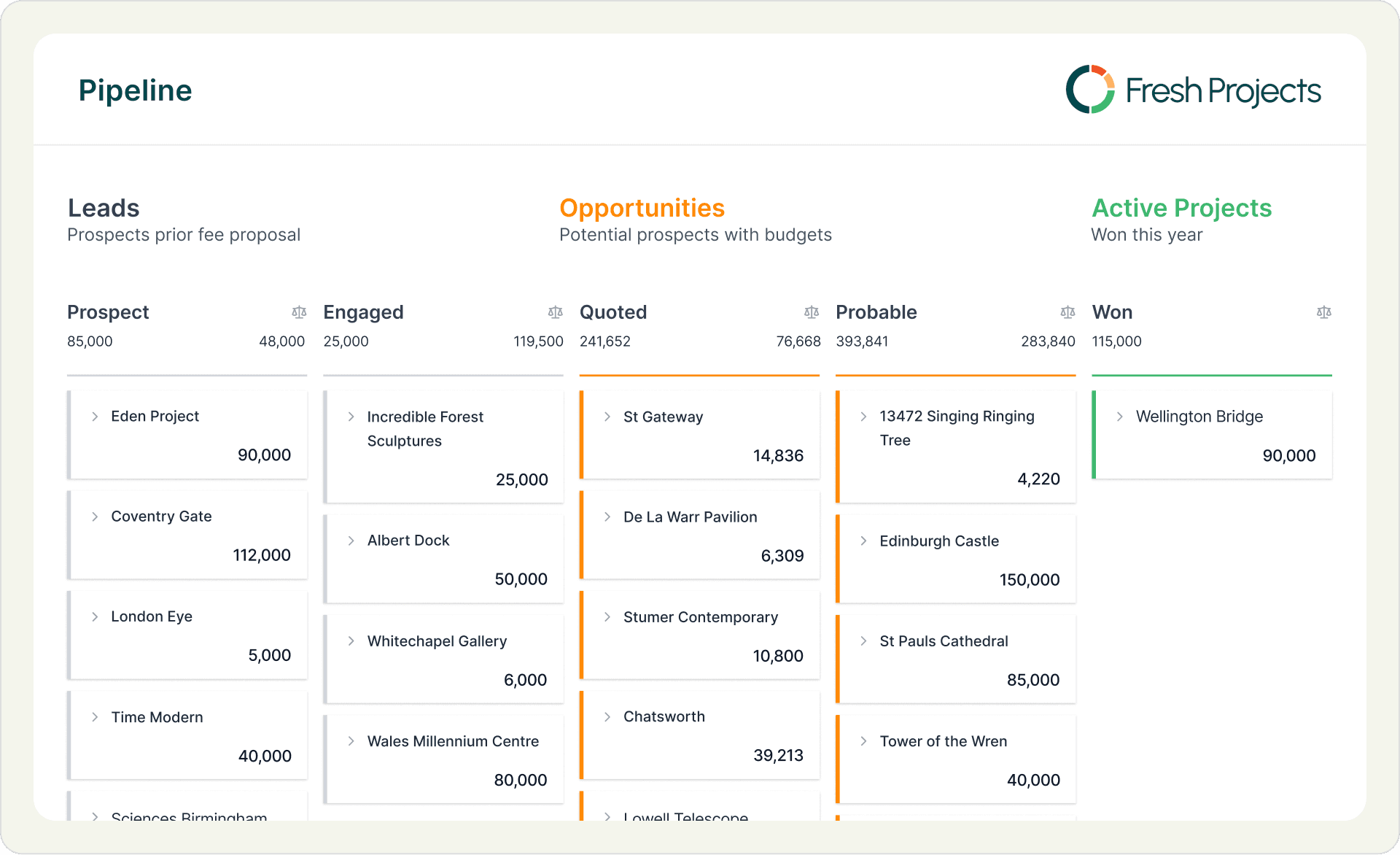
What good pipeline management looks like in a 50–100 person practice
A pipeline management system gives leadership teams a clear, shared view of future work, without spreadsheets or fragmented reports.
At a minimum, every architecture or engineering practice pipeline should:
Capture all potential work
Every lead and opportunity should sit in one place, not in inboxes or individual spreadsheets.
Track the information that actually matters
For each lead or opportunity, capture:
Estimated fee
Expected start date
Likely project duration
Probability of winning
This is the foundation of reliable architecture fee forecasting.
Use clear, agreed pipeline stages
Stages should reflect how your firm works, for example:
Prospect
Engaged
Proposal sent
Probable
Won
The key is consistency across offices and teams.
Define the next action
Every opportunity should have a clear next step, whether that’s a follow-up call, scope clarification or internal review.
Classify opportunities to reveal patterns
Classification is where insight starts to emerge. Common categories include:
Project size
Client type (private, public, developer)
Project type (commercial, healthcare, residential)
Lead owner
Lead source
Over time, this shows which work your firm is actually good at winning and which work drains time and margin.
Managing leads vs opportunities effectively
In larger A&E firms, not every enquiry deserves the same attention.
Leads
Leads are lightweight placeholders. They exist to ensure opportunities aren’t forgotten, not to justify heavy investment of time.
Before a lead becomes an opportunity, it should be qualified.
Opportunities
Opportunities are qualified, realistic prospects.
At this stage, firms should:
Prepare an outline project budget
Track bid time and pursuit costs
Carry those costs through into project profitability analysis if the job is won
This level of discipline prevents teams from overspending on bids that were never right for the practice.
How to qualify the right projects (the go / no-go process)
Before committing meaningful time, senior teams should be able to answer five questions:
Is the client right for us?
Credit checks, references, or simply past experience.Is the scope clear?
Just as important as what you will do is what you won’t.Can we realistically win?
Do we have the right experience and competitive position?What will it cost to deliver?
A simple, honest delivery budget.Does the fee support a healthy margin?
If not, the decision should be clear.
This process protects both profitability and senior capacity.
Using pipeline data to improve profitability
Once opportunities are consistently classified, patterns emerge quickly:
Certain project types convert more reliably
Mid-sized fees may outperform smaller ones due to reduced competition
Some team members close work more effectively than others
Certain lead sources consistently underperform
This insight allows leadership teams to:
Disqualify poor-fit opportunities earlier
Focus energy on the work most likely to convert
Improve profitability visibility across the firm
Forecasting future income with confidence
A well-managed pipeline enables reliable architecture sales forecasting.
Because every opportunity has:
A fee value
A probability
A start date
Practices can build a weighted fee forecast that leadership teams trust.
For example:
A £100k fee at 10% probability contributes £10k
A £20k fee at 75% probability contributes £15k
At scale, this creates a clear, forward-looking view of future income, essential for resourcing, hiring and cash flow planning.
How Fresh Projects helps firms win the right work
Fresh Projects is built specifically for architecture and engineering practices.
It makes pipeline management:
Easy to adopt across teams
Simple to maintain consistently
Directly connected to project budgets, resourcing and forecasting
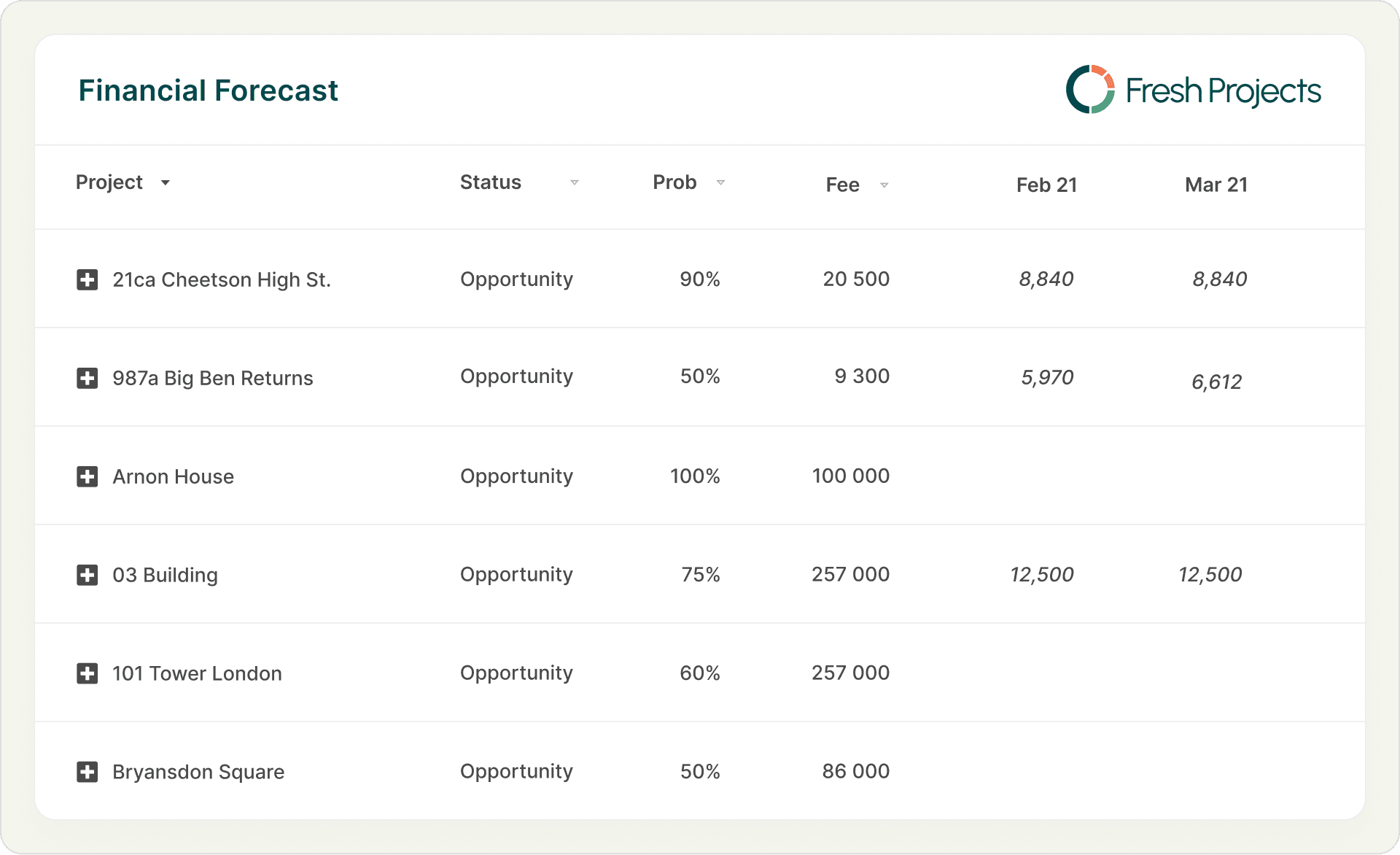
Instead of isolated spreadsheets or complex ERPs, firms get clear insight into what work is coming, what’s worth pursuing, and what will actually be profitable.
Winning the right jobs is the first step towards predictable, confident practice performance.
Frequently Asked Questions
1. How do architecture and engineering firms win more profitable work?
By focusing on winning the right jobs rather than more jobs - qualifying opportunities properly, tracking which project types actually convert and make money, and disqualifying poor-fit work early. We frmae this as the first of three growth fundamentals, alongside covering delivery costs and invoicing/collecting quickly.
2. What is a go/no-go process for bidding on projects, and what questions should you ask?
Before committing senior time, answer five questions: Is the client right for us? Is the scope clear (including what you won't do)? Can we realistically win? What will it cost to deliver? Does the fee support a healthy margin?
3. What should an architecture or engineering firm track in its sales pipeline?
For every opportunity: estimated fee, expected start date, likely project duration, and probability of winning. Plus agreed pipeline stages (Prospect, Engaged, Proposal sent, Probable, Won), a defined next action, and classification by project size, client type, project type, lead owner, and lead source.
4. What's the difference between a lead and an opportunity in a pipeline?
Leads are lightweight placeholders that ensure enquiries aren't forgotten and should be qualified before progressing. Opportunities are qualified, realistic prospects that warrant an outline budget, bid-time/pursuit-cost tracking, and carry-through into profitability analysis if won.
5. How do you forecast future income (fee forecasting) for an A&E practice?
Build a weighted forecast by multiplying each opportunity's fee value by its win probability - e.g. a £100k fee at 10% contributes £10k; a £20k fee at 75% contributes £15k. At scale this gives leadership a reliable forward view for resourcing, hiring, and cash flow.
For most 50–100 person architecture and engineering practices, growth doesn’t come from winning more work.
It comes from winning the right work.
Earlier in my career, I worked in the finance team of a large AEC firm. We had more than twenty people running accounting and reporting alone. Despite that scale, the practices that performed best didn’t rely on complex systems or heroic effort. They focused on three fundamentals:
Winning the right jobs
Making sure project fees covered delivery costs
Invoicing early and collecting debt quickly
This article focuses on the first, because if you get this wrong, the rest rarely works.
Why winning the right jobs matters in larger A&E firms
Not all projects are created equal. And as practices grow beyond 50 staff, this becomes harder to manage.
Different offices pursue different opportunities.
Partners have different views on what “good work” looks like.
Bid decisions are often made on instinct, not evidence.
The result is familiar:
Senior time spent chasing low-quality opportunities
Projects that look attractive on paper but underperform financially
Little visibility of what types of work actually convert and make money
Winning more of the right jobs starts with better visibility and discipline in your sales pipeline.
What good pipeline management looks like in a 50–100 person practice
A pipeline management system gives leadership teams a clear, shared view of future work, without spreadsheets or fragmented reports.
At a minimum, every architecture or engineering practice pipeline should:
Capture all potential work
Every lead and opportunity should sit in one place, not in inboxes or individual spreadsheets.
Track the information that actually matters
For each lead or opportunity, capture:
Estimated fee
Expected start date
Likely project duration
Probability of winning
This is the foundation of reliable architecture fee forecasting.
Use clear, agreed pipeline stages
Stages should reflect how your firm works, for example:
Prospect
Engaged
Proposal sent
Probable
Won
The key is consistency across offices and teams.
Define the next action
Every opportunity should have a clear next step, whether that’s a follow-up call, scope clarification or internal review.
Classify opportunities to reveal patterns
Classification is where insight starts to emerge. Common categories include:
Project size
Client type (private, public, developer)
Project type (commercial, healthcare, residential)
Lead owner
Lead source
Over time, this shows which work your firm is actually good at winning and which work drains time and margin.
Managing leads vs opportunities effectively
In larger A&E firms, not every enquiry deserves the same attention.
Leads
Leads are lightweight placeholders. They exist to ensure opportunities aren’t forgotten, not to justify heavy investment of time.
Before a lead becomes an opportunity, it should be qualified.
Opportunities
Opportunities are qualified, realistic prospects.
At this stage, firms should:
Prepare an outline project budget
Track bid time and pursuit costs
Carry those costs through into project profitability analysis if the job is won
This level of discipline prevents teams from overspending on bids that were never right for the practice.
How to qualify the right projects (the go / no-go process)
Before committing meaningful time, senior teams should be able to answer five questions:
Is the client right for us?
Credit checks, references, or simply past experience.Is the scope clear?
Just as important as what you will do is what you won’t.Can we realistically win?
Do we have the right experience and competitive position?What will it cost to deliver?
A simple, honest delivery budget.Does the fee support a healthy margin?
If not, the decision should be clear.
This process protects both profitability and senior capacity.
Using pipeline data to improve profitability
Once opportunities are consistently classified, patterns emerge quickly:
Certain project types convert more reliably
Mid-sized fees may outperform smaller ones due to reduced competition
Some team members close work more effectively than others
Certain lead sources consistently underperform
This insight allows leadership teams to:
Disqualify poor-fit opportunities earlier
Focus energy on the work most likely to convert
Improve profitability visibility across the firm
Forecasting future income with confidence
A well-managed pipeline enables reliable architecture sales forecasting.
Because every opportunity has:
A fee value
A probability
A start date
Practices can build a weighted fee forecast that leadership teams trust.
For example:
A £100k fee at 10% probability contributes £10k
A £20k fee at 75% probability contributes £15k
At scale, this creates a clear, forward-looking view of future income, essential for resourcing, hiring and cash flow planning.
How Fresh Projects helps firms win the right work
Fresh Projects is built specifically for architecture and engineering practices.
It makes pipeline management:
Easy to adopt across teams
Simple to maintain consistently
Directly connected to project budgets, resourcing and forecasting
Instead of isolated spreadsheets or complex ERPs, firms get clear insight into what work is coming, what’s worth pursuing, and what will actually be profitable.
Winning the right jobs is the first step towards predictable, confident practice performance.
Frequently Asked Questions
1. How do architecture and engineering firms win more profitable work?
By focusing on winning the right jobs rather than more jobs - qualifying opportunities properly, tracking which project types actually convert and make money, and disqualifying poor-fit work early. We frmae this as the first of three growth fundamentals, alongside covering delivery costs and invoicing/collecting quickly.
2. What is a go/no-go process for bidding on projects, and what questions should you ask?
Before committing senior time, answer five questions: Is the client right for us? Is the scope clear (including what you won't do)? Can we realistically win? What will it cost to deliver? Does the fee support a healthy margin?
3. What should an architecture or engineering firm track in its sales pipeline?
For every opportunity: estimated fee, expected start date, likely project duration, and probability of winning. Plus agreed pipeline stages (Prospect, Engaged, Proposal sent, Probable, Won), a defined next action, and classification by project size, client type, project type, lead owner, and lead source.
4. What's the difference between a lead and an opportunity in a pipeline?
Leads are lightweight placeholders that ensure enquiries aren't forgotten and should be qualified before progressing. Opportunities are qualified, realistic prospects that warrant an outline budget, bid-time/pursuit-cost tracking, and carry-through into profitability analysis if won.
5. How do you forecast future income (fee forecasting) for an A&E practice?
Build a weighted forecast by multiplying each opportunity's fee value by its win probability - e.g. a £100k fee at 10% contributes £10k; a £20k fee at 75% contributes £15k. At scale this gives leadership a reliable forward view for resourcing, hiring, and cash flow.
Published:
Published:


Practice Performance Management & Project Information Management: Why Growing AEC Firms Need Both
Practice Performance Management & Project Information Management: Why Growing AEC Firms Need Both
Practice Performance Management & Project Information Management: Why Growing AEC Firms Need Both
Growing architecture and engineering firms need two kinds of visibility: how the practice is performing, and what the project knows. This piece explores why both matter as teams, projects and complexity grow.
Growing architecture and engineering firms need two kinds of visibility: how the practice is performing, and what the project knows. This piece explores why both matter as teams, projects and complexity grow.

Five ways to build commercial confidence across your project teams
Five ways to build commercial confidence across your project teams
Five ways to build commercial confidence across your project teams
How architecture, engineering, quantity surveying and other built-environment firms can help project teams understand fees, time and performance without turning everyone into finance specialists.
How architecture, engineering, quantity surveying and other built-environment firms can help project teams understand fees, time and performance without turning everyone into finance specialists.

Can your project record stand up when it matters? 5 practical tests for AEC firms.
Can your project record stand up when it matters? 5 practical tests for AEC firms.
Can your project record stand up when it matters? 5 practical tests for AEC firms.
Five simple tests to uncover gaps in your project information before they become commercial, compliance or delivery risks.
Five simple tests to uncover gaps in your project information before they become commercial, compliance or delivery risks.

7 Signs Your A&E Practice Management Software Isn’t Fully Adopted
7 Signs Your A&E Practice Management Software Isn’t Fully Adopted
7 Signs Your A&E Practice Management Software Isn’t Fully Adopted
How growing A&E firms can close the gap between software implementation and whole-team commercial value
How growing A&E firms can close the gap between software implementation and whole-team commercial value
When Teams Stop Speaking The Same Operational Language
When Teams Stop Speaking The Same Operational Language
When Teams Stop Speaking The Same Operational Language
Why growing architecture practices often lose reporting confidence gradually, long before anyone formally identifies a systems problem.
Why growing architecture practices often lose reporting confidence gradually, long before anyone formally identifies a systems problem.

What It Really Means When a Client Recommends You
What It Really Means When a Client Recommends You
What It Really Means When a Client Recommends You
Why the built environment has always grown through trust, and what that means for the firms that do it well.
Why the built environment has always grown through trust, and what that means for the firms that do it well.
Why Reporting Leaves Firms Guessing
Why Reporting Leaves Firms Guessing
Why Reporting Leaves Firms Guessing
Inside many built environment firms, meetings meant for decisions quietly turn into debates about the numbers on the page.
Inside many built environment firms, meetings meant for decisions quietly turn into debates about the numbers on the page.

Why Multi-Office Firms Lack Visibility
Why Multi-Office Firms Lack Visibility
Why Multi-Office Firms Lack Visibility
In many built environment consultancies, reporting technically works. The challenge is that clarity often arrives after the moment when it would have influenced action.
In many built environment consultancies, reporting technically works. The challenge is that clarity often arrives after the moment when it would have influenced action.

Why Reporting Slows Firms Down
Why Reporting Slows Firms Down
Why Reporting Slows Firms Down
Even with reporting systems in place, many architecture, engineering and quantity surveying firms find that insight arrives too late to influence decisions during delivery.
Even with reporting systems in place, many architecture, engineering and quantity surveying firms find that insight arrives too late to influence decisions during delivery.

Compare A&E Management Tools
Compare A&E Management Tools
Compare A&E Management Tools
Choosing a practice management system is no longer about feature lists. This guide explains how architecture and engineering firms should compare tools in 2026, focusing on adoption, usability and decision-making rather than complexity.
Choosing a practice management system is no longer about feature lists. This guide explains how architecture and engineering firms should compare tools in 2026, focusing on adoption, usability and decision-making rather than complexity.


Spreadsheets in A&E Firms: What Works
Spreadsheets in A&E Firms: What Works
Spreadsheets in A&E Firms: What Works
A practical guide to using Excel and Sheets well, and knowing when to graduate to purpose-built systems without losing the flexibility you love.
A practical guide to using Excel and Sheets well, and knowing when to graduate to purpose-built systems without losing the flexibility you love.

Women in AEC at Fresh Projects
Women in AEC at Fresh Projects
Women in AEC at Fresh Projects
Why representation, visibility and better systems matter for the future of architecture and engineering
Why representation, visibility and better systems matter for the future of architecture and engineering

Architecture Leadership Challenges
Architecture Leadership Challenges
Architecture Leadership Challenges
How firm leaders can protect margin, prepare successors and modernise delivery without losing what made them successful
How firm leaders can protect margin, prepare successors and modernise delivery without losing what made them successful

5 Ways to Outgrow Spreadsheets Profitably
5 Ways to Outgrow Spreadsheets Profitably
5 Ways to Outgrow Spreadsheets Profitably
How architecture and engineering practices protect margin as teams and project complexity increase
How architecture and engineering practices protect margin as teams and project complexity increase

The Profitability Pyramid Explained
The Profitability Pyramid Explained
The Profitability Pyramid Explained
Understanding the real drivers of financial performance for medium and large practices over the past year
Understanding the real drivers of financial performance for medium and large practices over the past year

3 Lessons to Help You Run a More Profitable Practice
3 Lessons to Help You Run a More Profitable Practice
3 Lessons to Help You Run a More Profitable Practice
Practical insights from A&E leaders on spotting profit risks early, communicating value, and protecting margins
Practical insights from A&E leaders on spotting profit risks early, communicating value, and protecting margins

Embracing Neurodiversity in Architecture
Embracing Neurodiversity in Architecture
Embracing Neurodiversity in Architecture
How inclusive practice design can unlock creativity, innovation and operational clarity
How inclusive practice design can unlock creativity, innovation and operational clarity

Profitable Projects: Winning the Right Projects in AEC
Profitable Projects: Winning the Right Projects in AEC
Profitable Projects: Winning the Right Projects in AEC
How to qualify leads, focus your pipeline and forecast success more confidently
How to qualify leads, focus your pipeline and forecast success more confidently

Profitable Projects: The Art of Cashflow Alchemy in AEC
Profitable Projects: The Art of Cashflow Alchemy in AEC
Profitable Projects: The Art of Cashflow Alchemy in AEC
How architecture and engineering firms can turn unpredictable cash flow into a strategic advantage
How architecture and engineering firms can turn unpredictable cash flow into a strategic advantage

Setting Fees for Profitable Projects
Setting Fees for Profitable Projects
Setting Fees for Profitable Projects
Why bottom-up fee setting, clear scope and real-time cost visibility underpin profitable projects
Why bottom-up fee setting, clear scope and real-time cost visibility underpin profitable projects

Tools That Improve A&E Profitability
Tools That Improve A&E Profitability
Tools That Improve A&E Profitability
Why better visibility across projects, people and finances is now essential for sustainable practice performance
Why better visibility across projects, people and finances is now essential for sustainable practice performance

How to Manage Inflation on Architecture Projects
How to Manage Inflation on Architecture Projects
How to Manage Inflation on Architecture Projects
Practical ways to protect fees and margins when costs change mid-project
Practical ways to protect fees and margins when costs change mid-project

An Architect’s Guide to Project Budgeting
An Architect’s Guide to Project Budgeting
An Architect’s Guide to Project Budgeting
How to build realistic, profitable project budgets that support better pricing and delivery
How to build realistic, profitable project budgets that support better pricing and delivery


Improve Project Profitability: An Architect’s Guide
Improve Project Profitability: An Architect’s Guide
Improve Project Profitability: An Architect’s Guide
Practical ways architecture practices can protect margins and make better commercial decisions
Practical ways architecture practices can protect margins and make better commercial decisions


Calculate Your Cost Rate in 3 Simple Steps
Calculate Your Cost Rate in 3 Simple Steps
Calculate Your Cost Rate in 3 Simple Steps
Why understanding your true cost rate is the foundation of profitable fees, resourcing and decision-making
Why understanding your true cost rate is the foundation of profitable fees, resourcing and decision-making

When to Hire: Key Decisions
When to Hire: Key Decisions
When to Hire: Key Decisions
Why workload visibility and forecasting matter more than instinct in mid-sized architecture practices
Why workload visibility and forecasting matter more than instinct in mid-sized architecture practices

5 Basics to Improve Profitability
5 Basics to Improve Profitability
5 Basics to Improve Profitability
Five practical habits that help architecture practices improve profitability without adding complexity
Five practical habits that help architecture practices improve profitability without adding complexity

3 Questions for Profitable Firms
3 Questions for Profitable Firms
3 Questions for Profitable Firms
How clear insight into projects, clients and utilisation drives better decisions in mid-sized A&E firms
How clear insight into projects, clients and utilisation drives better decisions in mid-sized A&E firms

What Makes Firms More Profitable?
What Makes Firms More Profitable?
What Makes Firms More Profitable?
Why the most profitable firms spend less time on financial management and still make better decisions
Why the most profitable firms spend less time on financial management and still make better decisions

A-Team Approach to Profitability
A-Team Approach to Profitability
A-Team Approach to Profitability
Why reallocating work across roles can dramatically improve utilisation and margins in 50–100 person A&E practices
Why reallocating work across roles can dramatically improve utilisation and margins in 50–100 person A&E practices

I Love Excel. I Hate Excel.
I Love Excel. I Hate Excel.
I Love Excel. I Hate Excel.
Why spreadsheets break down in 50–100 person architecture and engineering practices, and what works better
Why spreadsheets break down in 50–100 person architecture and engineering practices, and what works better

Getting Project Fees Right
Getting Project Fees Right
Getting Project Fees Right
How accurate budgeting and disciplined scope control protect profitability in 50–100 person A&E practices
How accurate budgeting and disciplined scope control protect profitability in 50–100 person A&E practices

Working Capital Risks in A&E Firms
Working Capital Risks in A&E Firms
Working Capital Risks in A&E Firms
The financial blind spot that catches even well-run architecture and engineering practices
The financial blind spot that catches even well-run architecture and engineering practices
We Run Our Business on Referrals
Fresh Projects is a UK-based software platform designed for architects, engineers, and other built-environment professionals to manage financial aspects of their projects. It helps teams track fees, timesheets, expenses, billing, and overall profitability to keep projects on budget and profitable. The platform also centralises project data, streamlines administrative tasks, and offers mobile app support for easy access and updates.
1a Colinette Road
London
SW15 6QG
© 2026 Fresh Projects
Product
