
We Run Our Business on Referrals
Fresh Projects is a UK-based software platform designed for architects, engineers, and other built-environment professionals to manage financial aspects of their projects. It helps teams track fees, timesheets, expenses, billing, and overall profitability to keep projects on budget and profitable. The platform also centralises project data, streamlines administrative tasks, and offers mobile app support for easy access and updates.
1a Colinette Road
London
SW15 6QG
© 2026 Fresh Projects
Product
We Run Our Business on Referrals
Fresh Projects is a UK-based software platform designed for architects, engineers, and other built-environment professionals to manage financial aspects of their projects. It helps teams track fees, timesheets, expenses, billing, and overall profitability to keep projects on budget and profitable. The platform also centralises project data, streamlines administrative tasks, and offers mobile app support for easy access and updates.
1a Colinette Road
London
SW15 6QG
© 2026 Fresh Projects
Product
A-Team Approach to Profitability
A-Team Approach to Profitability
A-Team Approach to Profitability
Reading Time:
Reading Time:
6
6
minute(s)
minute(s)

In every professional services firm, there are different types of roles performing very different kinds of work.
What many architecture and engineering practices overlook is that who does which work has a direct and measurable impact on profitability.
By reallocating work between roles, often without changing headcount, practices can significantly improve margins, utilisation and financial visibility.
To explain how, we are going to borrow from the classic 1980s TV show, The A Team.
If you have a problem, if no one else can help, and if you can find them, maybe you can hire The A Team.
The four types of A Team players
For this analysis, we reviewed several million anonymised timesheets from architecture and engineering practices. Each employee was plotted based on two factors:
Their cost
The percentage of time spent on fee-earning project work
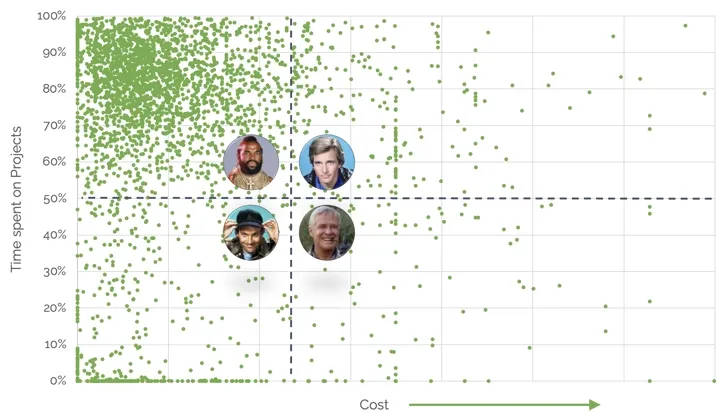
Each dot represents one employee. Higher cost moves the dot to the right. Higher utilisation moves it upwards.
From this, four clear role profiles consistently emerge.
Murdock

“If it’s got wings, I can fly it.”
Murdock was the A Team’s pilot. Without him, the team could not get to their jobs or escape trouble.
In an architecture or engineering practice, Murdocks sit in the bottom left quadrant. These are administrative and support roles such as:
Bookkeepers
Practice or office managers
Receptionists
Assistants
They typically:
Spend less than 50 percent of their time on project work
Sit in the lower third of the cost range
Around 15 percent of staff fall into this category.
These roles are often underestimated, but without them the business would quickly grind to a halt. They bring consistency, process discipline and operational stability.
B.A. Baracus

“I ain’t gettin’ on no airplane.”
B.A. was the muscle of the team. He did the heavy lifting.
In your practice, this cohort sits in the top left quadrant. These are the technical delivery team:
Junior and mid-level architects and engineers
Project managers
Cost consultants
They:
Spend more than 50 percent of their time on projects
Sit in the lower third of the cost range
Roughly 70 percent of staff fall into this category.
Like B.A., they want to focus on delivery. They are not yet interested in business administration or leadership responsibilities. They are the engine of project delivery.
Faceman

“Hello ladies.”
Faceman was the smooth operator. He sourced equipment, gathered intelligence and kept everyone aligned.
In architecture and engineering practices, Faces sit in the top right quadrant. These are:
Project leaders
Senior architects or engineers
Client-facing delivery leads
They:
Spend more than 50 percent of their time on projects
Sit in the top two-thirds of the cost range
Around 10 percent of staff fall into this group.
Faces are expensive, but rightly so. They deliver the services clients are paying for and play a critical role in client retention and winning new work.
Hannibal

“I love it when a plan comes together.”
Hannibal was the strategist and leader.
In practices, Hannibals sit in the bottom right quadrant. These are:
Owners
Partners
Directors
Principals
They:
Sit in the top two-thirds of the cost range
Spend less than 50 percent of their time on project work
Typically only 5 percent of staff fall into this category.
They are often the reason clients choose the firm. Ironically, they are also the people most pulled away from fee-earning work by the burden of running the business.
Why this matters
This framework may feel light-hearted, but the implications are serious.
If people are doing the wrong type of work for their role, profitability suffers.
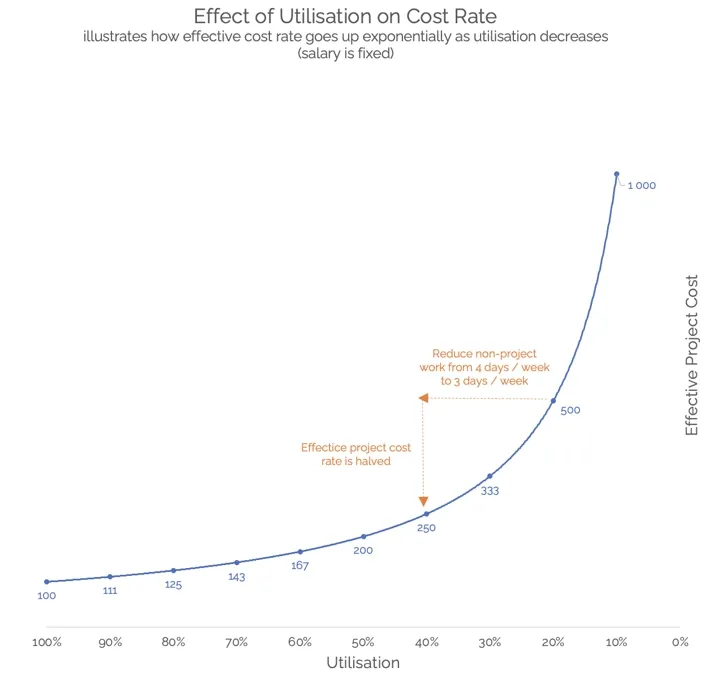
For example, if a highly paid project leader spends too much time on administrative tasks, their effective cost rate on projects increases sharply and margins disappear.
To illustrate this, let’s look at two common career paths for B.A.
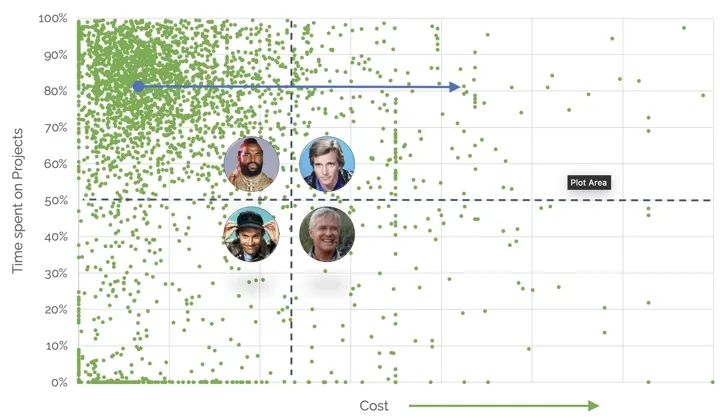
Option 1: Promoting B.A. to Faceman
As technical staff gain experience, their salary increases. This is necessary to retain talent and reward expertise.
In this scenario:
Salary increases sixfold over time
Project utilisation remains at 80 percent
The effective project cost increases by 6x. This is sustainable because the individual continues delivering high-value project work.
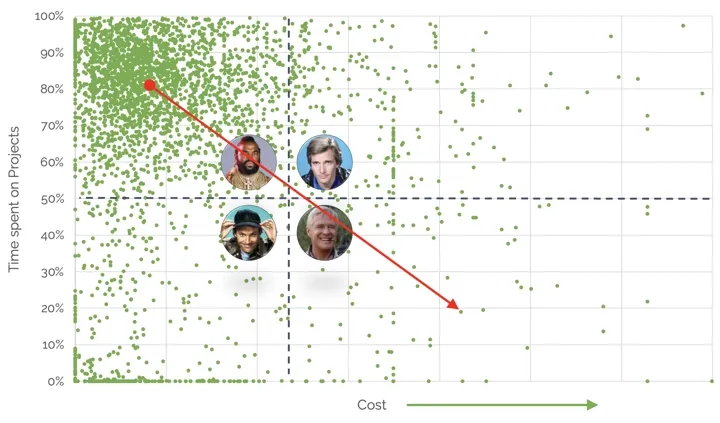
Option 2: Promoting B.A. to Hannibal
In many firms, promotion is equated with management responsibility.
Here:
Salary increases by the same amount
Project utilisation drops from 80 percent to 20 percent
The result is not a 6x increase in effective project cost, but a 24x increase once reduced utilisation is factored in.
This is one of the most misunderstood drivers of declining profitability in growing A&E firms.
The solution: Improve profitability by offloading to Murdock
Firms do need Hannibals. Leadership is essential.
The issue arises when senior, expensive staff perform procedural, administrative work that could be handled elsewhere.
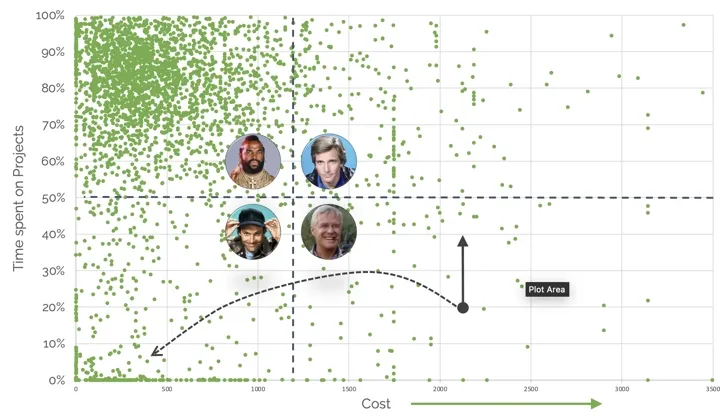
By identifying non-project tasks through time tracking and reallocating them to Murdocks, firms can dramatically reduce project cost rates.
For example:
If a director spends 20 percent of their time on invoicing, forecasting and chasing payments, reallocating that work could:
Increase their project time by one day per week
Reduce their effective project cost rate by up to 50 percent
This is not linear. Utilisation impacts cost exponentially.
In simple terms, it is far cheaper to pay a Murdock to do one hour of admin than a Hannibal. That same hour allows the Hannibal to deliver high-value project work instead.
Tracking utilisation is critical, and easier than most firms think
Projects generate income. All staff costs must ultimately be funded by project income.
That means:
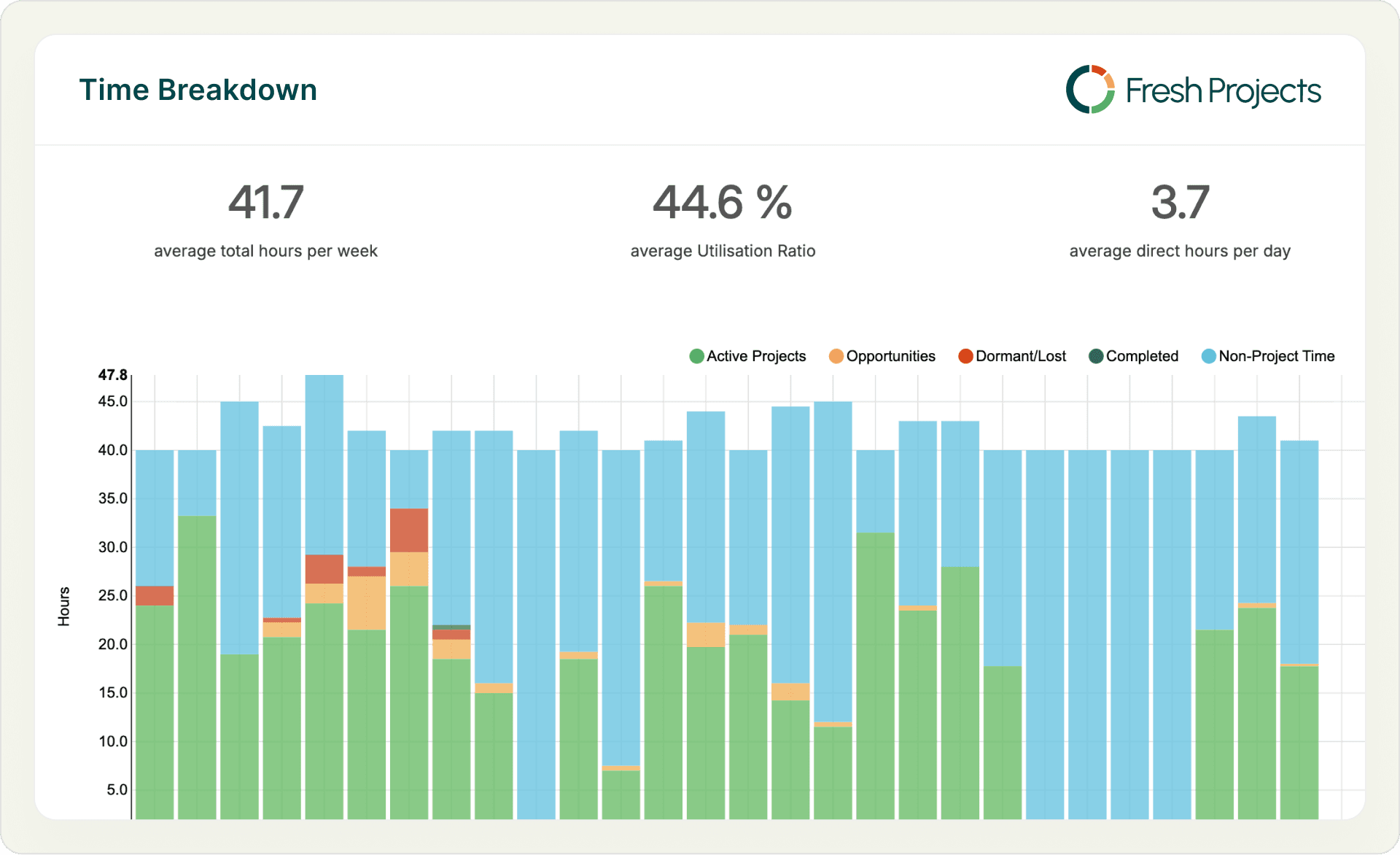
Non-project time must be visible
Utilisation rates must be monitored
Cost rates must reflect reality
A small change, such as reallocating administrative tasks, can significantly improve overall profitability without increasing workload or headcount.
How Fresh Projects helps
Fresh Projects is built specifically for architecture and engineering practices.
It makes it easy to:
Track staff utilisation accurately
See how work is distributed across roles
Identify where expensive time is being spent on non-project activity
This visibility allows leadership teams to rebalance work, improve utilisation and protect margins without adding complexity.
In every professional services firm, there are different types of roles performing very different kinds of work.
What many architecture and engineering practices overlook is that who does which work has a direct and measurable impact on profitability.
By reallocating work between roles, often without changing headcount, practices can significantly improve margins, utilisation and financial visibility.
To explain how, we are going to borrow from the classic 1980s TV show, The A Team.
If you have a problem, if no one else can help, and if you can find them, maybe you can hire The A Team.
The four types of A Team players
For this analysis, we reviewed several million anonymised timesheets from architecture and engineering practices. Each employee was plotted based on two factors:
Their cost
The percentage of time spent on fee-earning project work
Each dot represents one employee. Higher cost moves the dot to the right. Higher utilisation moves it upwards.
From this, four clear role profiles consistently emerge.
Murdock
“If it’s got wings, I can fly it.”
Murdock was the A Team’s pilot. Without him, the team could not get to their jobs or escape trouble.
In an architecture or engineering practice, Murdocks sit in the bottom left quadrant. These are administrative and support roles such as:
Bookkeepers
Practice or office managers
Receptionists
Assistants
They typically:
Spend less than 50 percent of their time on project work
Sit in the lower third of the cost range
Around 15 percent of staff fall into this category.
These roles are often underestimated, but without them the business would quickly grind to a halt. They bring consistency, process discipline and operational stability.
B.A. Baracus
“I ain’t gettin’ on no airplane.”
B.A. was the muscle of the team. He did the heavy lifting.
In your practice, this cohort sits in the top left quadrant. These are the technical delivery team:
Junior and mid-level architects and engineers
Project managers
Cost consultants
They:
Spend more than 50 percent of their time on projects
Sit in the lower third of the cost range
Roughly 70 percent of staff fall into this category.
Like B.A., they want to focus on delivery. They are not yet interested in business administration or leadership responsibilities. They are the engine of project delivery.
Faceman
“Hello ladies.”
Faceman was the smooth operator. He sourced equipment, gathered intelligence and kept everyone aligned.
In architecture and engineering practices, Faces sit in the top right quadrant. These are:
Project leaders
Senior architects or engineers
Client-facing delivery leads
They:
Spend more than 50 percent of their time on projects
Sit in the top two-thirds of the cost range
Around 10 percent of staff fall into this group.
Faces are expensive, but rightly so. They deliver the services clients are paying for and play a critical role in client retention and winning new work.
Hannibal
“I love it when a plan comes together.”
Hannibal was the strategist and leader.
In practices, Hannibals sit in the bottom right quadrant. These are:
Owners
Partners
Directors
Principals
They:
Sit in the top two-thirds of the cost range
Spend less than 50 percent of their time on project work
Typically only 5 percent of staff fall into this category.
They are often the reason clients choose the firm. Ironically, they are also the people most pulled away from fee-earning work by the burden of running the business.
Why this matters
This framework may feel light-hearted, but the implications are serious.
If people are doing the wrong type of work for their role, profitability suffers.
For example, if a highly paid project leader spends too much time on administrative tasks, their effective cost rate on projects increases sharply and margins disappear.
To illustrate this, let’s look at two common career paths for B.A.
Option 1: Promoting B.A. to Faceman
As technical staff gain experience, their salary increases. This is necessary to retain talent and reward expertise.
In this scenario:
Salary increases sixfold over time
Project utilisation remains at 80 percent
The effective project cost increases by 6x. This is sustainable because the individual continues delivering high-value project work.
Option 2: Promoting B.A. to Hannibal
In many firms, promotion is equated with management responsibility.
Here:
Salary increases by the same amount
Project utilisation drops from 80 percent to 20 percent
The result is not a 6x increase in effective project cost, but a 24x increase once reduced utilisation is factored in.
This is one of the most misunderstood drivers of declining profitability in growing A&E firms.
The solution: Improve profitability by offloading to Murdock
Firms do need Hannibals. Leadership is essential.
The issue arises when senior, expensive staff perform procedural, administrative work that could be handled elsewhere.
By identifying non-project tasks through time tracking and reallocating them to Murdocks, firms can dramatically reduce project cost rates.
For example:
If a director spends 20 percent of their time on invoicing, forecasting and chasing payments, reallocating that work could:
Increase their project time by one day per week
Reduce their effective project cost rate by up to 50 percent
This is not linear. Utilisation impacts cost exponentially.
In simple terms, it is far cheaper to pay a Murdock to do one hour of admin than a Hannibal. That same hour allows the Hannibal to deliver high-value project work instead.
Tracking utilisation is critical, and easier than most firms think
Projects generate income. All staff costs must ultimately be funded by project income.
That means:
Non-project time must be visible
Utilisation rates must be monitored
Cost rates must reflect reality
A small change, such as reallocating administrative tasks, can significantly improve overall profitability without increasing workload or headcount.
How Fresh Projects helps
Fresh Projects is built specifically for architecture and engineering practices.
It makes it easy to:
Track staff utilisation accurately
See how work is distributed across roles
Identify where expensive time is being spent on non-project activity
This visibility allows leadership teams to rebalance work, improve utilisation and protect margins without adding complexity.
Published:
Published:


Practice Performance Management & Project Information Management: Why Growing AEC Firms Need Both
Practice Performance Management & Project Information Management: Why Growing AEC Firms Need Both
Practice Performance Management & Project Information Management: Why Growing AEC Firms Need Both
Growing architecture and engineering firms need two kinds of visibility: how the practice is performing, and what the project knows. This piece explores why both matter as teams, projects and complexity grow.
Growing architecture and engineering firms need two kinds of visibility: how the practice is performing, and what the project knows. This piece explores why both matter as teams, projects and complexity grow.

Five ways to build commercial confidence across your project teams
Five ways to build commercial confidence across your project teams
Five ways to build commercial confidence across your project teams
How architecture, engineering, quantity surveying and other built-environment firms can help project teams understand fees, time and performance without turning everyone into finance specialists.
How architecture, engineering, quantity surveying and other built-environment firms can help project teams understand fees, time and performance without turning everyone into finance specialists.

Can your project record stand up when it matters? 5 practical tests for AEC firms.
Can your project record stand up when it matters? 5 practical tests for AEC firms.
Can your project record stand up when it matters? 5 practical tests for AEC firms.
Five simple tests to uncover gaps in your project information before they become commercial, compliance or delivery risks.
Five simple tests to uncover gaps in your project information before they become commercial, compliance or delivery risks.

7 Signs Your A&E Practice Management Software Isn’t Fully Adopted
7 Signs Your A&E Practice Management Software Isn’t Fully Adopted
7 Signs Your A&E Practice Management Software Isn’t Fully Adopted
How growing A&E firms can close the gap between software implementation and whole-team commercial value
How growing A&E firms can close the gap between software implementation and whole-team commercial value

When Teams Stop Speaking The Same Operational Language
When Teams Stop Speaking The Same Operational Language
When Teams Stop Speaking The Same Operational Language
Why growing architecture practices often lose reporting confidence gradually, long before anyone formally identifies a systems problem.
Why growing architecture practices often lose reporting confidence gradually, long before anyone formally identifies a systems problem.

What It Really Means When a Client Recommends You
What It Really Means When a Client Recommends You
What It Really Means When a Client Recommends You
Why the built environment has always grown through trust, and what that means for the firms that do it well.
Why the built environment has always grown through trust, and what that means for the firms that do it well.

Why Reporting Leaves Firms Guessing
Why Reporting Leaves Firms Guessing
Why Reporting Leaves Firms Guessing
Inside many built environment firms, meetings meant for decisions quietly turn into debates about the numbers on the page.
Inside many built environment firms, meetings meant for decisions quietly turn into debates about the numbers on the page.

Why Multi-Office Firms Lack Visibility
Why Multi-Office Firms Lack Visibility
Why Multi-Office Firms Lack Visibility
In many built environment consultancies, reporting technically works. The challenge is that clarity often arrives after the moment when it would have influenced action.
In many built environment consultancies, reporting technically works. The challenge is that clarity often arrives after the moment when it would have influenced action.

Why Reporting Slows Firms Down
Why Reporting Slows Firms Down
Why Reporting Slows Firms Down
Even with reporting systems in place, many architecture, engineering and quantity surveying firms find that insight arrives too late to influence decisions during delivery.
Even with reporting systems in place, many architecture, engineering and quantity surveying firms find that insight arrives too late to influence decisions during delivery.

Compare A&E Management Tools
Compare A&E Management Tools
Compare A&E Management Tools
Choosing a practice management system is no longer about feature lists. This guide explains how architecture and engineering firms should compare tools in 2026, focusing on adoption, usability and decision-making rather than complexity.
Choosing a practice management system is no longer about feature lists. This guide explains how architecture and engineering firms should compare tools in 2026, focusing on adoption, usability and decision-making rather than complexity.


Spreadsheets in A&E Firms: What Works
Spreadsheets in A&E Firms: What Works
Spreadsheets in A&E Firms: What Works
A practical guide to using Excel and Sheets well, and knowing when to graduate to purpose-built systems without losing the flexibility you love.
A practical guide to using Excel and Sheets well, and knowing when to graduate to purpose-built systems without losing the flexibility you love.

Women in AEC at Fresh Projects
Women in AEC at Fresh Projects
Women in AEC at Fresh Projects
Why representation, visibility and better systems matter for the future of architecture and engineering
Why representation, visibility and better systems matter for the future of architecture and engineering

Architecture Leadership Challenges
Architecture Leadership Challenges
Architecture Leadership Challenges
How firm leaders can protect margin, prepare successors and modernise delivery without losing what made them successful
How firm leaders can protect margin, prepare successors and modernise delivery without losing what made them successful

5 Ways to Outgrow Spreadsheets Profitably
5 Ways to Outgrow Spreadsheets Profitably
5 Ways to Outgrow Spreadsheets Profitably
How architecture and engineering practices protect margin as teams and project complexity increase
How architecture and engineering practices protect margin as teams and project complexity increase

The Profitability Pyramid Explained
The Profitability Pyramid Explained
The Profitability Pyramid Explained
Understanding the real drivers of financial performance for medium and large practices over the past year
Understanding the real drivers of financial performance for medium and large practices over the past year

3 Lessons to Help You Run a More Profitable Practice
3 Lessons to Help You Run a More Profitable Practice
3 Lessons to Help You Run a More Profitable Practice
Practical insights from A&E leaders on spotting profit risks early, communicating value, and protecting margins
Practical insights from A&E leaders on spotting profit risks early, communicating value, and protecting margins

Embracing Neurodiversity in Architecture
Embracing Neurodiversity in Architecture
Embracing Neurodiversity in Architecture
How inclusive practice design can unlock creativity, innovation and operational clarity
How inclusive practice design can unlock creativity, innovation and operational clarity

Profitable Projects: Winning the Right Projects in AEC
Profitable Projects: Winning the Right Projects in AEC
Profitable Projects: Winning the Right Projects in AEC
How to qualify leads, focus your pipeline and forecast success more confidently
How to qualify leads, focus your pipeline and forecast success more confidently

Profitable Projects: The Art of Cashflow Alchemy in AEC
Profitable Projects: The Art of Cashflow Alchemy in AEC
Profitable Projects: The Art of Cashflow Alchemy in AEC
How architecture and engineering firms can turn unpredictable cash flow into a strategic advantage
How architecture and engineering firms can turn unpredictable cash flow into a strategic advantage

Setting Fees for Profitable Projects
Setting Fees for Profitable Projects
Setting Fees for Profitable Projects
Why bottom-up fee setting, clear scope and real-time cost visibility underpin profitable projects
Why bottom-up fee setting, clear scope and real-time cost visibility underpin profitable projects

Tools That Improve A&E Profitability
Tools That Improve A&E Profitability
Tools That Improve A&E Profitability
Why better visibility across projects, people and finances is now essential for sustainable practice performance
Why better visibility across projects, people and finances is now essential for sustainable practice performance

How to Manage Inflation on Architecture Projects
How to Manage Inflation on Architecture Projects
How to Manage Inflation on Architecture Projects
Practical ways to protect fees and margins when costs change mid-project
Practical ways to protect fees and margins when costs change mid-project

An Architect’s Guide to Project Budgeting
An Architect’s Guide to Project Budgeting
An Architect’s Guide to Project Budgeting
How to build realistic, profitable project budgets that support better pricing and delivery
How to build realistic, profitable project budgets that support better pricing and delivery


Improve Project Profitability: An Architect’s Guide
Improve Project Profitability: An Architect’s Guide
Improve Project Profitability: An Architect’s Guide
Practical ways architecture practices can protect margins and make better commercial decisions
Practical ways architecture practices can protect margins and make better commercial decisions


Calculate Your Cost Rate in 3 Simple Steps
Calculate Your Cost Rate in 3 Simple Steps
Calculate Your Cost Rate in 3 Simple Steps
Why understanding your true cost rate is the foundation of profitable fees, resourcing and decision-making
Why understanding your true cost rate is the foundation of profitable fees, resourcing and decision-making

When to Hire: Key Decisions
When to Hire: Key Decisions
When to Hire: Key Decisions
Why workload visibility and forecasting matter more than instinct in mid-sized architecture practices
Why workload visibility and forecasting matter more than instinct in mid-sized architecture practices

5 Basics to Improve Profitability
5 Basics to Improve Profitability
5 Basics to Improve Profitability
Five practical habits that help architecture practices improve profitability without adding complexity
Five practical habits that help architecture practices improve profitability without adding complexity

3 Questions for Profitable Firms
3 Questions for Profitable Firms
3 Questions for Profitable Firms
How clear insight into projects, clients and utilisation drives better decisions in mid-sized A&E firms
How clear insight into projects, clients and utilisation drives better decisions in mid-sized A&E firms

What Makes Firms More Profitable?
What Makes Firms More Profitable?
What Makes Firms More Profitable?
Why the most profitable firms spend less time on financial management and still make better decisions
Why the most profitable firms spend less time on financial management and still make better decisions
A-Team Approach to Profitability
A-Team Approach to Profitability
A-Team Approach to Profitability
Why reallocating work across roles can dramatically improve utilisation and margins in 50–100 person A&E practices
Why reallocating work across roles can dramatically improve utilisation and margins in 50–100 person A&E practices

I Love Excel. I Hate Excel.
I Love Excel. I Hate Excel.
I Love Excel. I Hate Excel.
Why spreadsheets break down in 50–100 person architecture and engineering practices, and what works better
Why spreadsheets break down in 50–100 person architecture and engineering practices, and what works better

Getting Project Fees Right
Getting Project Fees Right
Getting Project Fees Right
How accurate budgeting and disciplined scope control protect profitability in 50–100 person A&E practices
How accurate budgeting and disciplined scope control protect profitability in 50–100 person A&E practices

Working Capital Risks in A&E Firms
Working Capital Risks in A&E Firms
Working Capital Risks in A&E Firms
The financial blind spot that catches even well-run architecture and engineering practices
The financial blind spot that catches even well-run architecture and engineering practices

We Run Our Business on Referrals
Fresh Projects is a UK-based software platform designed for architects, engineers, and other built-environment professionals to manage financial aspects of their projects. It helps teams track fees, timesheets, expenses, billing, and overall profitability to keep projects on budget and profitable. The platform also centralises project data, streamlines administrative tasks, and offers mobile app support for easy access and updates.
1a Colinette Road
London
SW15 6QG
© 2026 Fresh Projects
Product
