
We Run Our Business on Referrals
Fresh Projects is a UK-based software platform designed for architects, engineers, and other built-environment professionals to manage financial aspects of their projects. It helps teams track fees, timesheets, expenses, billing, and overall profitability to keep projects on budget and profitable. The platform also centralises project data, streamlines administrative tasks, and offers mobile app support for easy access and updates.
1a Colinette Road
London
SW15 6QG
© 2026 Fresh Projects
Product
We Run Our Business on Referrals
Fresh Projects is a UK-based software platform designed for architects, engineers, and other built-environment professionals to manage financial aspects of their projects. It helps teams track fees, timesheets, expenses, billing, and overall profitability to keep projects on budget and profitable. The platform also centralises project data, streamlines administrative tasks, and offers mobile app support for easy access and updates.
1a Colinette Road
London
SW15 6QG
© 2026 Fresh Projects
Product
7 Signs Your A&E Practice Management Software Isn’t Fully Adopted
7 Signs Your A&E Practice Management Software Isn’t Fully Adopted
7 Signs Your A&E Practice Management Software Isn’t Fully Adopted
Reading Time:
Reading Time:
11
11
minute(s)
minute(s)

The Adoption Advantage: A three-part series for architecture, engineering and built-environment practices
Welcome to The Adoption Advantage, a three-part series exploring how architecture, engineering, quantity surveying and other built-environment consultancies can turn practice management software into better everyday decisions.
Across the series, we will explore:
Seven signs your A&E practice management software is not fully adopted — you are here
Five ways to build commercial confidence across your project teams
A 30-day plan for better practice management software adoption
Each article provides practical ways to make project and commercial information useful across the whole business, rather than leaving it solely with finance, operations or senior leadership.
What is a software adoption gap?
A software adoption gap exists when a system has been purchased and technically implemented, but the people expected to benefit from it are not using it consistently or meaningfully.
Timesheets may be submitted. Invoices may be raised. Monthly reports may be produced.
Yet project managers continue to maintain separate spreadsheets, finance has to interpret every report and commercial problems are discovered after the opportunity to correct them has passed.
Successful software adoption means that people across the firm can:
Find the information relevant to their role
Understand what that information means
Trust that it is current
Use it to make better decisions
In other words, implementation gets the software running. Adoption makes it valuable.
Why software adoption matters for growing A&E firms
For a small firm, it may still be possible for a director, finance lead or operations manager to hold much of the commercial picture personally.
That becomes increasingly difficult as the firm grows.
At around 20–75 employees, practices often have:
More project managers making independent decisions
Several disciplines, teams or locations
More complicated fee structures and project stages
A larger and more changeable resource plan
Greater separation between finance and project delivery
More new employees to onboard
Less director visibility over every live project
Greater pressure to standardise how information is recorded
At this size, processes that once worked through personal knowledge, informal conversations and carefully maintained spreadsheets can begin to break down.
The issue is not simply having more people. It is that commercial information must travel reliably across more people, projects and functions.
Current market conditions make that especially important.
RIBA’s June 2026 Future Trends Survey found that architecture practices’ average workloads were 11% lower than a year earlier. Respondents reported weak enquiries, delayed project progress, projects being placed on hold and rising costs threatening project viability.
However, the outlook varied significantly by practice size. While smaller practices remained pessimistic, practices with 11 or more employees recorded a much stronger combined workload outlook, with half expecting workloads to increase over the following three months.
Although this research focuses on architecture, the operational challenge will be familiar across engineering, surveying and other built-environment consultancies:
How do you respond to uncertain project programmes while remaining ready to deliver growth?
Firms need to know:
Which projects are moving forward
Which have slowed down or paused
What those changes mean for income
Where capacity is emerging
Where teams are becoming overloaded
Whether the remaining fee supports the delivery plan
Whether new work can be accepted confidently
At the same time, architecture and engineering firms are adopting more sophisticated technology.
RIBA reports that 74% of surveyed architecture practices now use AI in at least some projects. Engineering organisations are also exploring AI for project information, forecasting, design, asset management and operational decision-making.
The potential is significant. ONS research has associated the adoption of advanced technology with higher turnover per worker, while also finding that firms with stronger management practices are more likely to adopt technology successfully.
The technology alone is not the differentiator. What matters is how effectively it becomes part of the organisation.
That makes one question increasingly important:
Is your underlying project information reliable enough for your people, reports and increasingly intelligent systems to use?
AI can retrieve, summarise and interpret the information available to it. It cannot make missing timesheets complete, reconcile two conflicting project budgets or identify a client variation that was never recorded.
Before asking what more your technology could do, it is worth asking whether the firm is consistently using what it already has.
Here are seven signs that your practice may have a software adoption gap, along with practical steps for beginning to close it.
1. Project changes take too long to reach your forecast

Built-environment projects rarely progress exactly as expected.
A client pauses the work. Planning or approvals take longer than anticipated. A construction programme moves by three months. A design stage begins earlier than expected. The appointment is extended, or changing costs threaten the project’s viability.
These changes affect more than the individual project. They can alter:
When fee income will be earned
When invoices can be raised
Which people and disciplines are required
Where spare capacity is likely to emerge
Whether the remaining fee still supports the delivery plan
The firm’s wider revenue and cash-flow forecast
If a project manager updates a private programme but the change does not reach finance, resourcing and leadership until the next reporting cycle, the system is not supporting the firm’s real operational needs.
For a growing multidisciplinary consultancy, the consequences can spread quickly.
An engineering project that moves may release specialists needed elsewhere. A delayed planning stage may change an architect’s short-term capacity. A postponed construction programme may affect the expected income and resource demand of a surveying team.
What to do
Create a straightforward process for recording material project changes.
When a project is paused, delayed or significantly altered, the project manager should review:
Expected stage or phase dates
Resource requirements by role or discipline
Fee and invoicing schedules
Forecast completion
Additional work and variations
Forecast project performance
This information should feed into the wider practice view without requiring finance, operations and project teams to update several separate reports.
Ask your practice
When a project changes today, how long does it take before the financial forecast and resource plan reflect that change?
If the answer is several weeks, or “it depends who knows about it”, there is a process or adoption gap to address.
2. Project managers maintain a second version of the truth
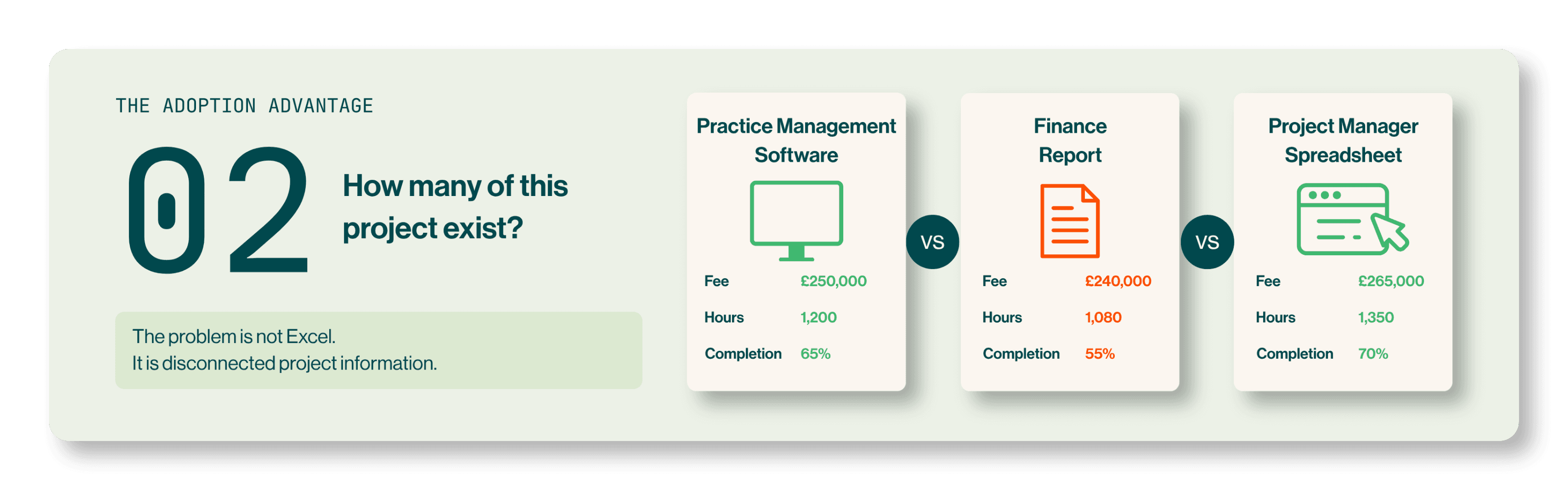
A separate spreadsheet is often one of the clearest signs that the official platform is not answering an important question.
Project managers may use private trackers to monitor:
Hours remaining
Stage or phase budgets
Team allocations
Variations and additional services
Invoicing milestones
Deliverables
Forecast completion dates
The spreadsheet itself is not necessarily the problem.
Excel remains useful for flexible analysis, modelling and presenting information. The problem begins when the spreadsheet becomes a parallel operational system.
The same project information then has to be entered twice, reconciled manually and explained whenever the two versions disagree. Finance may be reporting one figure, the project manager another and leadership a third.
This can create a vicious circle.
People maintain their own spreadsheets because they do not trust the official data, but the official data becomes less reliable because important changes are only being recorded in private spreadsheets.
In a 20–75-person practice, the problem multiplies. One spreadsheet maintained by one experienced project manager may be manageable. Twenty different spreadsheets, each using slightly different definitions and assumptions, create a significant reporting and continuity risk.
What to do
Do not begin by banning the spreadsheet.
Ask the project manager what their spreadsheet gives them that the main platform does not.
The answer may reveal:
Information they cannot find
A report that is difficult to interpret
A workflow that takes too long
Missing permissions
Lack of confidence in the data
Insufficient training
A genuine type of analysis the platform does not provide
Resolve the reason for the workaround before attempting to remove it.
Where teams genuinely need Excel’s flexibility, explore whether it can work from live project data rather than becoming another manually maintained information source.
Ask your practice
Which spreadsheets would your project managers refuse to stop using, and what does each one tell them that the main system does not?
The answer is likely to reveal more about adoption than a login report.
3. Financial information is weeks behind project reality

A monthly report can explain what happened.
It is less useful when it arrives after the team has already:
Used the available time budget
Completed unapproved additional work
Missed an invoicing point
Continued delivering against an outdated scope
Allocated more resource than the remaining fee can support
This is the difference between retrospective reporting and active project management.
Reporting records an outcome. Management uses information early enough to influence it.
The wider finance profession is experiencing the same issue. ACCA research published in July 2026 found that data quality problems and a lack of appropriate skills were each cited by 42% of respondents as barriers to making better use of data. A further 40% identified difficulty integrating multiple data sources.
In a built-environment consultancy, those sources may include:
Timesheets
Project budgets
Fee proposals
Accounting software
Resource plans
Invoicing schedules
CRM and pipeline forecasts
Project managers’ spreadsheets
Producing more reports does not necessarily solve the problem if those sources are incomplete, disconnected or updated at different times.
What to do
Introduce clear intervention points into regular project reviews.
For example:
A stage or phase has consumed 75% of its available time
The remaining resource plan exceeds the remaining fee
Additional client requests have not been approved
Delivery is progressing faster than invoicing
A key programme date has moved
Forecast margin has fallen below an agreed threshold
The exact measures will vary between firms. What matters is that project managers understand:
What they should monitor
When something requires attention
Who needs to be involved
What action should follow
Ask your practice
What is the earliest point at which a project manager can see that a stage or phase is likely to exceed its budget?
If the answer is “when finance produces the monthly report”, the information is arriving too late.
4. Employees enter information but receive nothing useful back
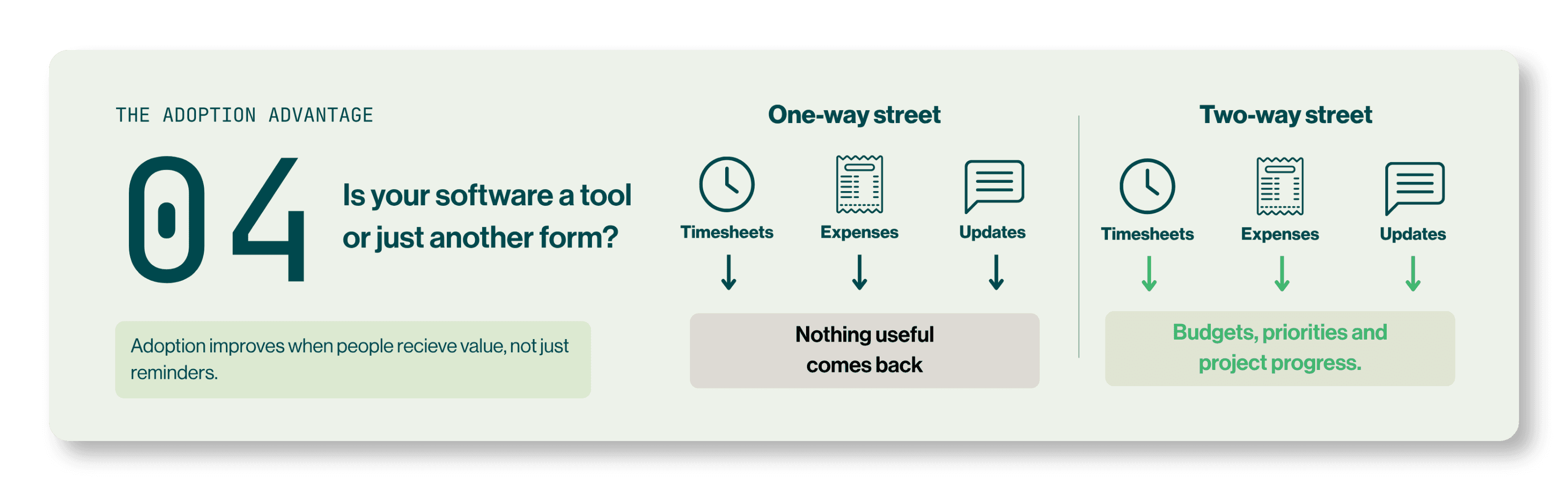
Timesheet completion matters.
Without accurate time information, it is difficult to understand delivery costs, project progress or profitability.
But timesheet submission alone is not evidence that practice management software has been meaningfully adopted.
A person may use the platform every day while treating it as little more than a compulsory administrative form.
Successful adoption should create a useful exchange.
Employees contribute accurate information to the system, and the system gives relevant information back.
Depending on their role, team members should be able to understand:
Which projects, stages or workstreams they are allocated to
How much time has been allowed
How delivery is progressing
Whether additional work has been recognised
What has changed
Where attention is required
Project managers need a more detailed view of fee progress, cost, resources, variations, invoicing and forecast performance.
A structural engineer does not need the same view as a finance manager. A quantity surveyor managing a package does not need every practice-level KPI. A director does not need to inspect every individual timesheet.
Adoption improves when each person can quickly reach the information they can actually use.
What to do
Define one useful outcome for each role.
For example:
Project team members: Understand their allocated work and available time.
Project managers: Monitor project and stage performance and recognise changes early.
Discipline or team leaders: Balance workload, skills and commercial priorities.
Finance: Prepare invoices and reports using current project information.
Directors: Identify risks and opportunities across the portfolio.
Training should then focus on helping each role achieve those outcomes, rather than taking every employee through every feature.
Ask your practice
Apart from submitting timesheets and expenses, what useful reason does the average employee have to open your practice management system?
If there is no clear answer, adoption will always depend on reminders and enforcement.
5. Staffing and resourcing decisions are based on assumptions
RIBA’s June 2026 Staffing Index indicated cautious expectations across the architecture profession. However, practices with 11 or more employees reported a considerably stronger staffing outlook than smaller firms.
That is relevant to growing A&E consultancies.
Many firms are trying to prepare for additional work while remaining cautious about employment costs and long-term commitments. They may be competing for specialist skills while also dealing with projects that are delayed, rephased or uncertain.
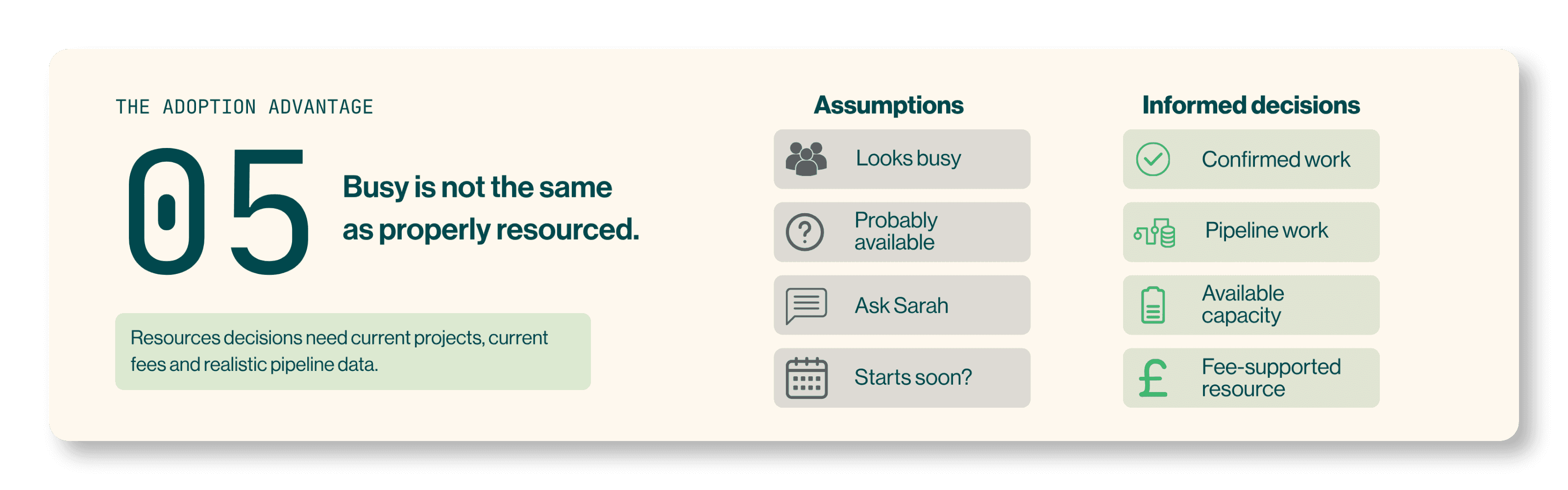
In this environment, resourcing decisions cannot rely solely on who appears busy, who asks for help or which project is making the most noise.
Without current project and pipeline information, firms risk:
Recruiting before work is sufficiently certain
Delaying recruitment until teams are already overloaded
Moving people onto projects that cannot support their cost
Missing available capacity created by delayed work
Overloading senior or specialist employees
Failing to account for supervision and development time
Confusing high activity with profitable utilisation
This is particularly important for multidisciplinary firms.
A project may have sufficient overall fee remaining but insufficient fee within a particular discipline or phase. A specialist may appear available across the practice while already committed to several short, overlapping project requirements.
What to do
Connect project delivery, resource planning and future opportunities.
A useful resourcing view should help leaders answer:
What work is currently committed?
Which projects are likely to move or pause?
What additional work is realistically expected?
Which skills and disciplines will be required?
Which employees have capacity?
What fee is available to support the proposed resource?
Where will pressure points emerge over the next three to six months?
Resource planning should not be maintained as a static schedule. It should change as projects, fees and opportunities change.
Ask your practice
When a project is delayed, can you immediately see who has become available and how the delay affects future income?
If resource and financial forecasts are maintained separately, the answer is likely to require manual investigation.
6. Your AI ambitions are ahead of your operational data
AI has rapidly become part of everyday architecture and engineering conversations.
Architecture practices are using it for design, visualisation, specification, information retrieval and operational tasks. Engineering firms are exploring applications in design assurance, project controls, asset management, forecasting and knowledge management.
The Institution of Civil Engineers has highlighted a fundamental limitation: AI will struggle to reach its potential without access to relevant, high-quality data.
The opportunity extends far beyond image generation.
AI could potentially help firms:
Retrieve project information
Summarise performance
Identify financial risks
Forecast resource requirements
Highlight missing information
Analyse historical project outcomes
Support fee and pipeline decisions
Find relevant knowledge across teams and projects
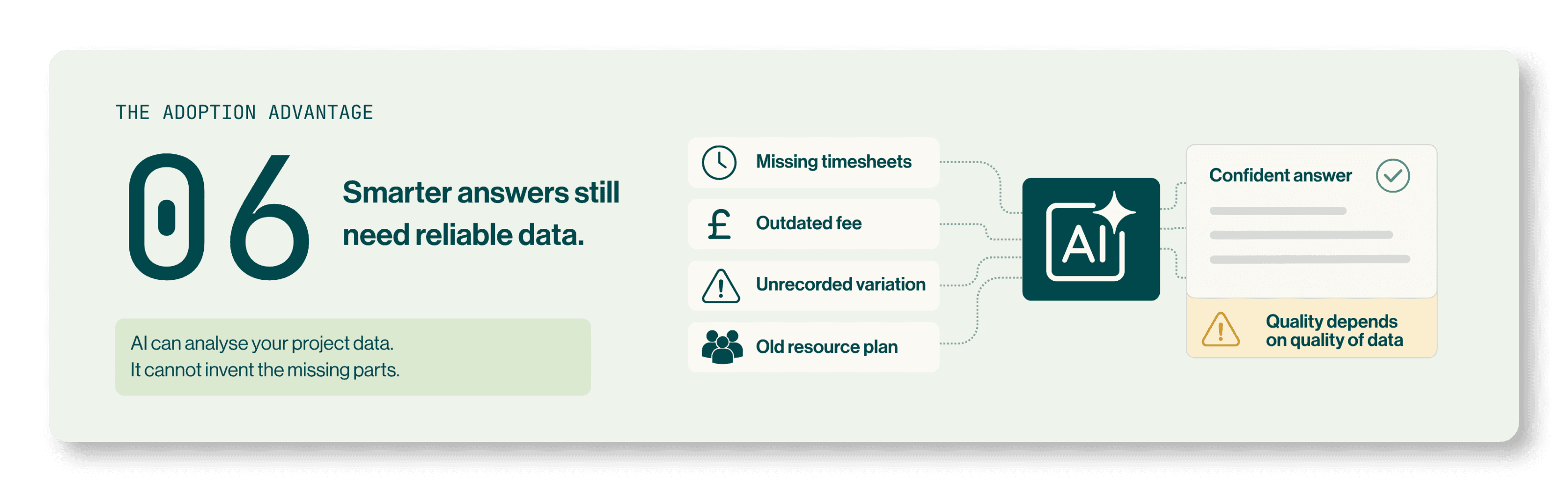
But the quality of an AI-supported answer still depends on the quality of the source information.
Before asking AI to forecast project performance, consider whether the firm consistently records:
Current project status
Agreed fees
Scope changes and variations
Time spent
Remaining resource requirements
Invoicing progress
Stage or phase completion
Pipeline probabilities
AI may produce an answer quickly. That does not make the answer reliable if its source information is incomplete or outdated.
What to do
Assess data readiness alongside AI readiness.
For each type of intelligence you want AI to provide, identify:
What underlying information is required?
Where is that information currently stored?
Who is responsible for maintaining it?
How frequently is it updated?
Do different teams use consistent definitions?
How will the answer be checked?
This is not an argument against investing in AI.
It is an argument for building the operational foundations that allow AI investment to create value.
Ask your practice
Could an AI tool answer a question about project profitability using information your project managers would recognise as accurate today?
If not, better adoption and data discipline may be the more immediate priority.
7. You cannot demonstrate whether the platform has created value
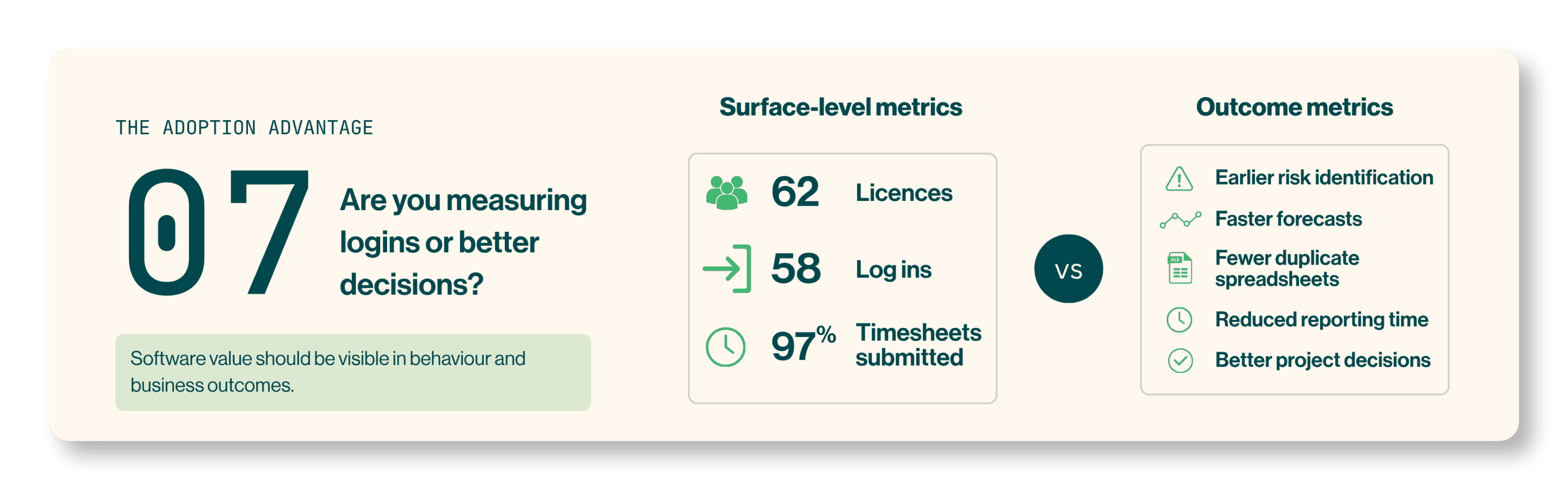
Many firms measure a software implementation through:
Licences purchased
Training sessions completed
The official launch date
Total logins
Timesheets submitted
These measures are useful, but they do not show whether the system has improved how the business operates.
A user could log in every day and still use the platform only to complete one compulsory task.
Meaningful adoption should be visible in both behaviour and outcomes.
What to do
Measure a small number of practical indicators across different roles.
These might include:
Percentage of project managers reviewing budgets each week
Percentage of live projects with current forecasts
Timesheets completed accurately without repeated chasing
Number of duplicate project trackers still in use
Frequency with which live information is used in project meetings
Time taken to prepare monthly reports
Time taken for a new employee to become self-sufficient
Number of variations recorded and approved
Commercial issues identified before month-end
Time between a project change and an updated forecast
Confidence in the data among finance and project teams
Use of the system across different disciplines or offices
Avoid treating one practice-wide login percentage as the definitive measure.
A team may demonstrate excellent timesheet participation while project managers rarely review project performance. That is successful time collection, but incomplete practice management adoption.
Ask your practice
Can you identify three decisions your teams now make better or faster because of your practice management software?
If the value cannot be described clearly, it will be difficult to demonstrate ROI or maintain long-term engagement.
Why software adoption is harder than buying software
The adoption challenge is not unique to the built environment.
UK government research involving 2,000 SMEs found that:
32% said software was too expensive
21% lacked the time or capacity to explore the available options
17% believed adoption would require too much time, money and effort
16% lacked the capacity to manage the change involved
Businesses also identified implementation, training, integration, ongoing management and support as substantial demands on limited time and resources.
For a 20–75-person architecture, engineering or surveying firm, that effort is rarely absorbed by a dedicated digital transformation department.
It falls to directors, finance employees, operations leaders and fee-earning project professionals who are already responsible for live work.
This is why implementation speed, relevant training and direct supplier support matter.
The system, configuration, data migration, training and ongoing support collectively determine whether a firm adopts the software.
They should not be considered separate from the product experience.
How should an A&E firm assess software adoption?
A practical adoption review should examine four stages.
1. Access
Is the technology available to the people who need it?
2. Usage
Are employees completing the required tasks?
3. Adoption
Has the system become part of normal project and business routines?
4. Value
Is the information changing decisions or producing measurable improvements?
A firm may perform well at one stage and poorly at another.
For example, access and usage may be high because everyone has a licence and submits a timesheet. Adoption and value may remain low if project managers cannot understand budgets or use the information to influence delivery.
The strongest implementations progress through all four stages.
What whole-firm adoption looks like
Space Zero experienced the difference between technical reporting and shared commercial understanding.
Before introducing Fresh Projects, financial insight was fragmented, forecasting relied heavily on spreadsheets and junior team members had limited visibility of how their time affected project outcomes.
After implementation, teams at every level could see how much time had been allocated, used and remained. Project teams could manage their own work more actively, while leaders gained earlier warning when projects began to drift.
As Associate Director Ryan McGarrie described it:
“From the bottom of the business up, we’re getting it right now.”
Profitability became something the wider firm could understand, rather than information held solely by finance.
David Jarvis Associates faced a similar challenge.
The 25-person multidisciplinary consultancy was working across disconnected systems, spreadsheets and manual processes. Information was duplicated or delayed, and confidence in the figures had deteriorated.
Following its move to Fresh Projects, the firm reported reduced duplication, simpler reporting and a platform used and trusted across the team.
These examples illustrate the practical objective of adoption:
Project teams understand the impact of their work
Project managers recognise drift earlier
Discipline leaders can see changing demands
Finance works from more complete information
Leadership can trust firm-wide reporting
Fewer decisions depend on manually reconciled spreadsheets
From software implementation to software adoption
Implementation describes the technical process of configuring and launching a platform.
Adoption describes what happens when the people expected to use it can confidently complete real work.
A successful rollout therefore needs to consider:
Familiar project data
Role-based configuration
Relevant training
Everyday project routines
Simple information capture
Measurement of user behaviour
Support after launch
Fresh Projects configures customer projects, employees, fee structures, accounting connections and permissions as part of onboarding.
Most firms complete training and begin raising live invoices within 30 days, with an initial walkthrough available within three days of receiving and validating the required data.
Data migration, account configuration and team training are included within Fresh Projects plans.
Speed alone does not guarantee adoption.
However, reducing the time between kick-off and useful, recognisable project information gives teams a clearer reason to engage and reduces the opportunity for unofficial processes to take hold.
For a growing 20+ person practice, that speed also reduces disruption for the directors, project leaders and finance employees responsible for managing the implementation alongside client work.
Conclusion: software creates value when it changes decisions
The best practice management software for an architecture, engineering or built-environment consultancy is not necessarily the platform with the longest feature list.
It is the system that helps the firm make better decisions consistently.
Private spreadsheets, delayed forecasts, finance-only reporting and timesheet-only usage are not isolated employee problems. They are signals that the platform has not yet become part of how the firm manages projects.
For growing practices, the risk increases as more people, projects, disciplines and offices become dependent on the same information.
In a market shaped by changing workloads, cautious staffing decisions and rapid AI adoption, built-environment firms cannot afford operational information that is incomplete, inconsistent or understood by only a handful of people.
Addressing the adoption gap begins with a simple question:
What does each person need to understand or accomplish, and how easy does the software make that task?
In the next article in The Adoption Advantage, we will explore five ways to build commercial confidence across your project teams, without expecting architects, engineers, surveyors or other technical professionals to become finance specialists.
Frequently asked questions
What is A&E practice management software adoption?
Practice management software adoption means employees consistently use the platform to complete relevant work, understand project information and make decisions. It is broader than technical implementation, purchasing licences or recording login activity.
What is the difference between software implementation and adoption?
Implementation is the process of configuring, integrating and launching the software. Adoption occurs when people confidently use it as part of their everyday responsibilities and the information changes how the firm operates.
Is timesheet completion proof that software has been adopted?
No. Timesheet completion shows that time is being recorded. Wider adoption requires project managers, finance and leaders to use that information to manage fees, resources, invoicing and project performance.
Why do project managers keep using spreadsheets after implementation?
Project managers often retain spreadsheets because they cannot find the required information, do not trust the system data, find a workflow too slow or need an analysis the main platform does not provide. The reason for the workaround should be understood before the spreadsheet is removed.
How can an A&E consultancy improve software adoption?
Configure the system around real projects, define useful outcomes for each role, provide role-specific training, use live information in regular meetings and measure useful behaviours rather than licences or logins alone.
How should built-environment firms measure software adoption?
Measure active use by role, data completeness, project-manager budget reviews, use of live information in meetings, remaining duplicate processes, new-starter independence and whether commercial problems are identified early enough to act.
Can AI compensate for incomplete project information?
AI can retrieve, summarise and analyse available information, but it cannot reliably compensate for missing, inconsistent or outdated source data. Firms need to improve data ownership and everyday system use alongside AI adoption.
What should project managers see in practice management software?
Project managers should be able to see the agreed fee, delivery budget, time and cost used, remaining resource requirements, scope changes, invoicing progress and forecast performance in a format relevant to how the project is delivered.
How long should A&E practice management software onboarding take?
The appropriate timeframe depends on the firm’s size, data, integrations and requirements. The more important measure is how quickly each role can use the platform confidently for real work. Most Fresh Projects customers complete training and begin raising live invoices within 30 days.
How can firms manage delayed or paused projects more effectively?
Update the project programme, resource requirements, fee schedule and forecast as soon as the change is confirmed. These updates should feed into firm-wide resourcing, income and capacity planning rather than being maintained in separate reports.
Is your current system being used to its full potential?
See how Fresh Projects makes live project, fee, time and resource information useful across your whole firm.
The Adoption Advantage: A three-part series for architecture, engineering and built-environment practices
Welcome to The Adoption Advantage, a three-part series exploring how architecture, engineering, quantity surveying and other built-environment consultancies can turn practice management software into better everyday decisions.
Across the series, we will explore:
Seven signs your A&E practice management software is not fully adopted — you are here
Five ways to build commercial confidence across your project teams
A 30-day plan for better practice management software adoption
Each article provides practical ways to make project and commercial information useful across the whole business, rather than leaving it solely with finance, operations or senior leadership.
What is a software adoption gap?
A software adoption gap exists when a system has been purchased and technically implemented, but the people expected to benefit from it are not using it consistently or meaningfully.
Timesheets may be submitted. Invoices may be raised. Monthly reports may be produced.
Yet project managers continue to maintain separate spreadsheets, finance has to interpret every report and commercial problems are discovered after the opportunity to correct them has passed.
Successful software adoption means that people across the firm can:
Find the information relevant to their role
Understand what that information means
Trust that it is current
Use it to make better decisions
In other words, implementation gets the software running. Adoption makes it valuable.
Why software adoption matters for growing A&E firms
For a small firm, it may still be possible for a director, finance lead or operations manager to hold much of the commercial picture personally.
That becomes increasingly difficult as the firm grows.
At around 20–75 employees, practices often have:
More project managers making independent decisions
Several disciplines, teams or locations
More complicated fee structures and project stages
A larger and more changeable resource plan
Greater separation between finance and project delivery
More new employees to onboard
Less director visibility over every live project
Greater pressure to standardise how information is recorded
At this size, processes that once worked through personal knowledge, informal conversations and carefully maintained spreadsheets can begin to break down.
The issue is not simply having more people. It is that commercial information must travel reliably across more people, projects and functions.
Current market conditions make that especially important.
RIBA’s June 2026 Future Trends Survey found that architecture practices’ average workloads were 11% lower than a year earlier. Respondents reported weak enquiries, delayed project progress, projects being placed on hold and rising costs threatening project viability.
However, the outlook varied significantly by practice size. While smaller practices remained pessimistic, practices with 11 or more employees recorded a much stronger combined workload outlook, with half expecting workloads to increase over the following three months.
Although this research focuses on architecture, the operational challenge will be familiar across engineering, surveying and other built-environment consultancies:
How do you respond to uncertain project programmes while remaining ready to deliver growth?
Firms need to know:
Which projects are moving forward
Which have slowed down or paused
What those changes mean for income
Where capacity is emerging
Where teams are becoming overloaded
Whether the remaining fee supports the delivery plan
Whether new work can be accepted confidently
At the same time, architecture and engineering firms are adopting more sophisticated technology.
RIBA reports that 74% of surveyed architecture practices now use AI in at least some projects. Engineering organisations are also exploring AI for project information, forecasting, design, asset management and operational decision-making.
The potential is significant. ONS research has associated the adoption of advanced technology with higher turnover per worker, while also finding that firms with stronger management practices are more likely to adopt technology successfully.
The technology alone is not the differentiator. What matters is how effectively it becomes part of the organisation.
That makes one question increasingly important:
Is your underlying project information reliable enough for your people, reports and increasingly intelligent systems to use?
AI can retrieve, summarise and interpret the information available to it. It cannot make missing timesheets complete, reconcile two conflicting project budgets or identify a client variation that was never recorded.
Before asking what more your technology could do, it is worth asking whether the firm is consistently using what it already has.
Here are seven signs that your practice may have a software adoption gap, along with practical steps for beginning to close it.
1. Project changes take too long to reach your forecast
Built-environment projects rarely progress exactly as expected.
A client pauses the work. Planning or approvals take longer than anticipated. A construction programme moves by three months. A design stage begins earlier than expected. The appointment is extended, or changing costs threaten the project’s viability.
These changes affect more than the individual project. They can alter:
When fee income will be earned
When invoices can be raised
Which people and disciplines are required
Where spare capacity is likely to emerge
Whether the remaining fee still supports the delivery plan
The firm’s wider revenue and cash-flow forecast
If a project manager updates a private programme but the change does not reach finance, resourcing and leadership until the next reporting cycle, the system is not supporting the firm’s real operational needs.
For a growing multidisciplinary consultancy, the consequences can spread quickly.
An engineering project that moves may release specialists needed elsewhere. A delayed planning stage may change an architect’s short-term capacity. A postponed construction programme may affect the expected income and resource demand of a surveying team.
What to do
Create a straightforward process for recording material project changes.
When a project is paused, delayed or significantly altered, the project manager should review:
Expected stage or phase dates
Resource requirements by role or discipline
Fee and invoicing schedules
Forecast completion
Additional work and variations
Forecast project performance
This information should feed into the wider practice view without requiring finance, operations and project teams to update several separate reports.
Ask your practice
When a project changes today, how long does it take before the financial forecast and resource plan reflect that change?
If the answer is several weeks, or “it depends who knows about it”, there is a process or adoption gap to address.
2. Project managers maintain a second version of the truth
A separate spreadsheet is often one of the clearest signs that the official platform is not answering an important question.
Project managers may use private trackers to monitor:
Hours remaining
Stage or phase budgets
Team allocations
Variations and additional services
Invoicing milestones
Deliverables
Forecast completion dates
The spreadsheet itself is not necessarily the problem.
Excel remains useful for flexible analysis, modelling and presenting information. The problem begins when the spreadsheet becomes a parallel operational system.
The same project information then has to be entered twice, reconciled manually and explained whenever the two versions disagree. Finance may be reporting one figure, the project manager another and leadership a third.
This can create a vicious circle.
People maintain their own spreadsheets because they do not trust the official data, but the official data becomes less reliable because important changes are only being recorded in private spreadsheets.
In a 20–75-person practice, the problem multiplies. One spreadsheet maintained by one experienced project manager may be manageable. Twenty different spreadsheets, each using slightly different definitions and assumptions, create a significant reporting and continuity risk.
What to do
Do not begin by banning the spreadsheet.
Ask the project manager what their spreadsheet gives them that the main platform does not.
The answer may reveal:
Information they cannot find
A report that is difficult to interpret
A workflow that takes too long
Missing permissions
Lack of confidence in the data
Insufficient training
A genuine type of analysis the platform does not provide
Resolve the reason for the workaround before attempting to remove it.
Where teams genuinely need Excel’s flexibility, explore whether it can work from live project data rather than becoming another manually maintained information source.
Ask your practice
Which spreadsheets would your project managers refuse to stop using, and what does each one tell them that the main system does not?
The answer is likely to reveal more about adoption than a login report.
3. Financial information is weeks behind project reality
A monthly report can explain what happened.
It is less useful when it arrives after the team has already:
Used the available time budget
Completed unapproved additional work
Missed an invoicing point
Continued delivering against an outdated scope
Allocated more resource than the remaining fee can support
This is the difference between retrospective reporting and active project management.
Reporting records an outcome. Management uses information early enough to influence it.
The wider finance profession is experiencing the same issue. ACCA research published in July 2026 found that data quality problems and a lack of appropriate skills were each cited by 42% of respondents as barriers to making better use of data. A further 40% identified difficulty integrating multiple data sources.
In a built-environment consultancy, those sources may include:
Timesheets
Project budgets
Fee proposals
Accounting software
Resource plans
Invoicing schedules
CRM and pipeline forecasts
Project managers’ spreadsheets
Producing more reports does not necessarily solve the problem if those sources are incomplete, disconnected or updated at different times.
What to do
Introduce clear intervention points into regular project reviews.
For example:
A stage or phase has consumed 75% of its available time
The remaining resource plan exceeds the remaining fee
Additional client requests have not been approved
Delivery is progressing faster than invoicing
A key programme date has moved
Forecast margin has fallen below an agreed threshold
The exact measures will vary between firms. What matters is that project managers understand:
What they should monitor
When something requires attention
Who needs to be involved
What action should follow
Ask your practice
What is the earliest point at which a project manager can see that a stage or phase is likely to exceed its budget?
If the answer is “when finance produces the monthly report”, the information is arriving too late.
4. Employees enter information but receive nothing useful back
Timesheet completion matters.
Without accurate time information, it is difficult to understand delivery costs, project progress or profitability.
But timesheet submission alone is not evidence that practice management software has been meaningfully adopted.
A person may use the platform every day while treating it as little more than a compulsory administrative form.
Successful adoption should create a useful exchange.
Employees contribute accurate information to the system, and the system gives relevant information back.
Depending on their role, team members should be able to understand:
Which projects, stages or workstreams they are allocated to
How much time has been allowed
How delivery is progressing
Whether additional work has been recognised
What has changed
Where attention is required
Project managers need a more detailed view of fee progress, cost, resources, variations, invoicing and forecast performance.
A structural engineer does not need the same view as a finance manager. A quantity surveyor managing a package does not need every practice-level KPI. A director does not need to inspect every individual timesheet.
Adoption improves when each person can quickly reach the information they can actually use.
What to do
Define one useful outcome for each role.
For example:
Project team members: Understand their allocated work and available time.
Project managers: Monitor project and stage performance and recognise changes early.
Discipline or team leaders: Balance workload, skills and commercial priorities.
Finance: Prepare invoices and reports using current project information.
Directors: Identify risks and opportunities across the portfolio.
Training should then focus on helping each role achieve those outcomes, rather than taking every employee through every feature.
Ask your practice
Apart from submitting timesheets and expenses, what useful reason does the average employee have to open your practice management system?
If there is no clear answer, adoption will always depend on reminders and enforcement.
5. Staffing and resourcing decisions are based on assumptions
RIBA’s June 2026 Staffing Index indicated cautious expectations across the architecture profession. However, practices with 11 or more employees reported a considerably stronger staffing outlook than smaller firms.
That is relevant to growing A&E consultancies.
Many firms are trying to prepare for additional work while remaining cautious about employment costs and long-term commitments. They may be competing for specialist skills while also dealing with projects that are delayed, rephased or uncertain.
In this environment, resourcing decisions cannot rely solely on who appears busy, who asks for help or which project is making the most noise.
Without current project and pipeline information, firms risk:
Recruiting before work is sufficiently certain
Delaying recruitment until teams are already overloaded
Moving people onto projects that cannot support their cost
Missing available capacity created by delayed work
Overloading senior or specialist employees
Failing to account for supervision and development time
Confusing high activity with profitable utilisation
This is particularly important for multidisciplinary firms.
A project may have sufficient overall fee remaining but insufficient fee within a particular discipline or phase. A specialist may appear available across the practice while already committed to several short, overlapping project requirements.
What to do
Connect project delivery, resource planning and future opportunities.
A useful resourcing view should help leaders answer:
What work is currently committed?
Which projects are likely to move or pause?
What additional work is realistically expected?
Which skills and disciplines will be required?
Which employees have capacity?
What fee is available to support the proposed resource?
Where will pressure points emerge over the next three to six months?
Resource planning should not be maintained as a static schedule. It should change as projects, fees and opportunities change.
Ask your practice
When a project is delayed, can you immediately see who has become available and how the delay affects future income?
If resource and financial forecasts are maintained separately, the answer is likely to require manual investigation.
6. Your AI ambitions are ahead of your operational data
AI has rapidly become part of everyday architecture and engineering conversations.
Architecture practices are using it for design, visualisation, specification, information retrieval and operational tasks. Engineering firms are exploring applications in design assurance, project controls, asset management, forecasting and knowledge management.
The Institution of Civil Engineers has highlighted a fundamental limitation: AI will struggle to reach its potential without access to relevant, high-quality data.
The opportunity extends far beyond image generation.
AI could potentially help firms:
Retrieve project information
Summarise performance
Identify financial risks
Forecast resource requirements
Highlight missing information
Analyse historical project outcomes
Support fee and pipeline decisions
Find relevant knowledge across teams and projects
But the quality of an AI-supported answer still depends on the quality of the source information.
Before asking AI to forecast project performance, consider whether the firm consistently records:
Current project status
Agreed fees
Scope changes and variations
Time spent
Remaining resource requirements
Invoicing progress
Stage or phase completion
Pipeline probabilities
AI may produce an answer quickly. That does not make the answer reliable if its source information is incomplete or outdated.
What to do
Assess data readiness alongside AI readiness.
For each type of intelligence you want AI to provide, identify:
What underlying information is required?
Where is that information currently stored?
Who is responsible for maintaining it?
How frequently is it updated?
Do different teams use consistent definitions?
How will the answer be checked?
This is not an argument against investing in AI.
It is an argument for building the operational foundations that allow AI investment to create value.
Ask your practice
Could an AI tool answer a question about project profitability using information your project managers would recognise as accurate today?
If not, better adoption and data discipline may be the more immediate priority.
7. You cannot demonstrate whether the platform has created value
Many firms measure a software implementation through:
Licences purchased
Training sessions completed
The official launch date
Total logins
Timesheets submitted
These measures are useful, but they do not show whether the system has improved how the business operates.
A user could log in every day and still use the platform only to complete one compulsory task.
Meaningful adoption should be visible in both behaviour and outcomes.
What to do
Measure a small number of practical indicators across different roles.
These might include:
Percentage of project managers reviewing budgets each week
Percentage of live projects with current forecasts
Timesheets completed accurately without repeated chasing
Number of duplicate project trackers still in use
Frequency with which live information is used in project meetings
Time taken to prepare monthly reports
Time taken for a new employee to become self-sufficient
Number of variations recorded and approved
Commercial issues identified before month-end
Time between a project change and an updated forecast
Confidence in the data among finance and project teams
Use of the system across different disciplines or offices
Avoid treating one practice-wide login percentage as the definitive measure.
A team may demonstrate excellent timesheet participation while project managers rarely review project performance. That is successful time collection, but incomplete practice management adoption.
Ask your practice
Can you identify three decisions your teams now make better or faster because of your practice management software?
If the value cannot be described clearly, it will be difficult to demonstrate ROI or maintain long-term engagement.
Why software adoption is harder than buying software
The adoption challenge is not unique to the built environment.
UK government research involving 2,000 SMEs found that:
32% said software was too expensive
21% lacked the time or capacity to explore the available options
17% believed adoption would require too much time, money and effort
16% lacked the capacity to manage the change involved
Businesses also identified implementation, training, integration, ongoing management and support as substantial demands on limited time and resources.
For a 20–75-person architecture, engineering or surveying firm, that effort is rarely absorbed by a dedicated digital transformation department.
It falls to directors, finance employees, operations leaders and fee-earning project professionals who are already responsible for live work.
This is why implementation speed, relevant training and direct supplier support matter.
The system, configuration, data migration, training and ongoing support collectively determine whether a firm adopts the software.
They should not be considered separate from the product experience.
How should an A&E firm assess software adoption?
A practical adoption review should examine four stages.
1. Access
Is the technology available to the people who need it?
2. Usage
Are employees completing the required tasks?
3. Adoption
Has the system become part of normal project and business routines?
4. Value
Is the information changing decisions or producing measurable improvements?
A firm may perform well at one stage and poorly at another.
For example, access and usage may be high because everyone has a licence and submits a timesheet. Adoption and value may remain low if project managers cannot understand budgets or use the information to influence delivery.
The strongest implementations progress through all four stages.
What whole-firm adoption looks like
Space Zero experienced the difference between technical reporting and shared commercial understanding.
Before introducing Fresh Projects, financial insight was fragmented, forecasting relied heavily on spreadsheets and junior team members had limited visibility of how their time affected project outcomes.
After implementation, teams at every level could see how much time had been allocated, used and remained. Project teams could manage their own work more actively, while leaders gained earlier warning when projects began to drift.
As Associate Director Ryan McGarrie described it:
“From the bottom of the business up, we’re getting it right now.”
Profitability became something the wider firm could understand, rather than information held solely by finance.
David Jarvis Associates faced a similar challenge.
The 25-person multidisciplinary consultancy was working across disconnected systems, spreadsheets and manual processes. Information was duplicated or delayed, and confidence in the figures had deteriorated.
Following its move to Fresh Projects, the firm reported reduced duplication, simpler reporting and a platform used and trusted across the team.
These examples illustrate the practical objective of adoption:
Project teams understand the impact of their work
Project managers recognise drift earlier
Discipline leaders can see changing demands
Finance works from more complete information
Leadership can trust firm-wide reporting
Fewer decisions depend on manually reconciled spreadsheets
From software implementation to software adoption
Implementation describes the technical process of configuring and launching a platform.
Adoption describes what happens when the people expected to use it can confidently complete real work.
A successful rollout therefore needs to consider:
Familiar project data
Role-based configuration
Relevant training
Everyday project routines
Simple information capture
Measurement of user behaviour
Support after launch
Fresh Projects configures customer projects, employees, fee structures, accounting connections and permissions as part of onboarding.
Most firms complete training and begin raising live invoices within 30 days, with an initial walkthrough available within three days of receiving and validating the required data.
Data migration, account configuration and team training are included within Fresh Projects plans.
Speed alone does not guarantee adoption.
However, reducing the time between kick-off and useful, recognisable project information gives teams a clearer reason to engage and reduces the opportunity for unofficial processes to take hold.
For a growing 20+ person practice, that speed also reduces disruption for the directors, project leaders and finance employees responsible for managing the implementation alongside client work.
Conclusion: software creates value when it changes decisions
The best practice management software for an architecture, engineering or built-environment consultancy is not necessarily the platform with the longest feature list.
It is the system that helps the firm make better decisions consistently.
Private spreadsheets, delayed forecasts, finance-only reporting and timesheet-only usage are not isolated employee problems. They are signals that the platform has not yet become part of how the firm manages projects.
For growing practices, the risk increases as more people, projects, disciplines and offices become dependent on the same information.
In a market shaped by changing workloads, cautious staffing decisions and rapid AI adoption, built-environment firms cannot afford operational information that is incomplete, inconsistent or understood by only a handful of people.
Addressing the adoption gap begins with a simple question:
What does each person need to understand or accomplish, and how easy does the software make that task?
In the next article in The Adoption Advantage, we will explore five ways to build commercial confidence across your project teams, without expecting architects, engineers, surveyors or other technical professionals to become finance specialists.
Frequently asked questions
What is A&E practice management software adoption?
Practice management software adoption means employees consistently use the platform to complete relevant work, understand project information and make decisions. It is broader than technical implementation, purchasing licences or recording login activity.
What is the difference between software implementation and adoption?
Implementation is the process of configuring, integrating and launching the software. Adoption occurs when people confidently use it as part of their everyday responsibilities and the information changes how the firm operates.
Is timesheet completion proof that software has been adopted?
No. Timesheet completion shows that time is being recorded. Wider adoption requires project managers, finance and leaders to use that information to manage fees, resources, invoicing and project performance.
Why do project managers keep using spreadsheets after implementation?
Project managers often retain spreadsheets because they cannot find the required information, do not trust the system data, find a workflow too slow or need an analysis the main platform does not provide. The reason for the workaround should be understood before the spreadsheet is removed.
How can an A&E consultancy improve software adoption?
Configure the system around real projects, define useful outcomes for each role, provide role-specific training, use live information in regular meetings and measure useful behaviours rather than licences or logins alone.
How should built-environment firms measure software adoption?
Measure active use by role, data completeness, project-manager budget reviews, use of live information in meetings, remaining duplicate processes, new-starter independence and whether commercial problems are identified early enough to act.
Can AI compensate for incomplete project information?
AI can retrieve, summarise and analyse available information, but it cannot reliably compensate for missing, inconsistent or outdated source data. Firms need to improve data ownership and everyday system use alongside AI adoption.
What should project managers see in practice management software?
Project managers should be able to see the agreed fee, delivery budget, time and cost used, remaining resource requirements, scope changes, invoicing progress and forecast performance in a format relevant to how the project is delivered.
How long should A&E practice management software onboarding take?
The appropriate timeframe depends on the firm’s size, data, integrations and requirements. The more important measure is how quickly each role can use the platform confidently for real work. Most Fresh Projects customers complete training and begin raising live invoices within 30 days.
How can firms manage delayed or paused projects more effectively?
Update the project programme, resource requirements, fee schedule and forecast as soon as the change is confirmed. These updates should feed into firm-wide resourcing, income and capacity planning rather than being maintained in separate reports.
Is your current system being used to its full potential?
See how Fresh Projects makes live project, fee, time and resource information useful across your whole firm.
The Adoption Advantage: A three-part series for architecture, engineering and built-environment practices
Welcome to The Adoption Advantage, a three-part series exploring how architecture, engineering, quantity surveying and other built-environment consultancies can turn practice management software into better everyday decisions.
Across the series, we will explore:
Seven signs your A&E practice management software is not fully adopted — you are here
Five ways to build commercial confidence across your project teams
A 30-day plan for better practice management software adoption
Each article provides practical ways to make project and commercial information useful across the whole business, rather than leaving it solely with finance, operations or senior leadership.
What is a software adoption gap?
A software adoption gap exists when a system has been purchased and technically implemented, but the people expected to benefit from it are not using it consistently or meaningfully.
Timesheets may be submitted. Invoices may be raised. Monthly reports may be produced.
Yet project managers continue to maintain separate spreadsheets, finance has to interpret every report and commercial problems are discovered after the opportunity to correct them has passed.
Successful software adoption means that people across the firm can:
Find the information relevant to their role
Understand what that information means
Trust that it is current
Use it to make better decisions
In other words, implementation gets the software running. Adoption makes it valuable.
Why software adoption matters for growing A&E firms
For a small firm, it may still be possible for a director, finance lead or operations manager to hold much of the commercial picture personally.
That becomes increasingly difficult as the firm grows.
At around 20–75 employees, practices often have:
More project managers making independent decisions
Several disciplines, teams or locations
More complicated fee structures and project stages
A larger and more changeable resource plan
Greater separation between finance and project delivery
More new employees to onboard
Less director visibility over every live project
Greater pressure to standardise how information is recorded
At this size, processes that once worked through personal knowledge, informal conversations and carefully maintained spreadsheets can begin to break down.
The issue is not simply having more people. It is that commercial information must travel reliably across more people, projects and functions.
Current market conditions make that especially important.
RIBA’s June 2026 Future Trends Survey found that architecture practices’ average workloads were 11% lower than a year earlier. Respondents reported weak enquiries, delayed project progress, projects being placed on hold and rising costs threatening project viability.
However, the outlook varied significantly by practice size. While smaller practices remained pessimistic, practices with 11 or more employees recorded a much stronger combined workload outlook, with half expecting workloads to increase over the following three months.
Although this research focuses on architecture, the operational challenge will be familiar across engineering, surveying and other built-environment consultancies:
How do you respond to uncertain project programmes while remaining ready to deliver growth?
Firms need to know:
Which projects are moving forward
Which have slowed down or paused
What those changes mean for income
Where capacity is emerging
Where teams are becoming overloaded
Whether the remaining fee supports the delivery plan
Whether new work can be accepted confidently
At the same time, architecture and engineering firms are adopting more sophisticated technology.
RIBA reports that 74% of surveyed architecture practices now use AI in at least some projects. Engineering organisations are also exploring AI for project information, forecasting, design, asset management and operational decision-making.
The potential is significant. ONS research has associated the adoption of advanced technology with higher turnover per worker, while also finding that firms with stronger management practices are more likely to adopt technology successfully.
The technology alone is not the differentiator. What matters is how effectively it becomes part of the organisation.
That makes one question increasingly important:
Is your underlying project information reliable enough for your people, reports and increasingly intelligent systems to use?
AI can retrieve, summarise and interpret the information available to it. It cannot make missing timesheets complete, reconcile two conflicting project budgets or identify a client variation that was never recorded.
Before asking what more your technology could do, it is worth asking whether the firm is consistently using what it already has.
Here are seven signs that your practice may have a software adoption gap, along with practical steps for beginning to close it.
1. Project changes take too long to reach your forecast
Built-environment projects rarely progress exactly as expected.
A client pauses the work. Planning or approvals take longer than anticipated. A construction programme moves by three months. A design stage begins earlier than expected. The appointment is extended, or changing costs threaten the project’s viability.
These changes affect more than the individual project. They can alter:
When fee income will be earned
When invoices can be raised
Which people and disciplines are required
Where spare capacity is likely to emerge
Whether the remaining fee still supports the delivery plan
The firm’s wider revenue and cash-flow forecast
If a project manager updates a private programme but the change does not reach finance, resourcing and leadership until the next reporting cycle, the system is not supporting the firm’s real operational needs.
For a growing multidisciplinary consultancy, the consequences can spread quickly.
An engineering project that moves may release specialists needed elsewhere. A delayed planning stage may change an architect’s short-term capacity. A postponed construction programme may affect the expected income and resource demand of a surveying team.
What to do
Create a straightforward process for recording material project changes.
When a project is paused, delayed or significantly altered, the project manager should review:
Expected stage or phase dates
Resource requirements by role or discipline
Fee and invoicing schedules
Forecast completion
Additional work and variations
Forecast project performance
This information should feed into the wider practice view without requiring finance, operations and project teams to update several separate reports.
Ask your practice
When a project changes today, how long does it take before the financial forecast and resource plan reflect that change?
If the answer is several weeks, or “it depends who knows about it”, there is a process or adoption gap to address.
2. Project managers maintain a second version of the truth
A separate spreadsheet is often one of the clearest signs that the official platform is not answering an important question.
Project managers may use private trackers to monitor:
Hours remaining
Stage or phase budgets
Team allocations
Variations and additional services
Invoicing milestones
Deliverables
Forecast completion dates
The spreadsheet itself is not necessarily the problem.
Excel remains useful for flexible analysis, modelling and presenting information. The problem begins when the spreadsheet becomes a parallel operational system.
The same project information then has to be entered twice, reconciled manually and explained whenever the two versions disagree. Finance may be reporting one figure, the project manager another and leadership a third.
This can create a vicious circle.
People maintain their own spreadsheets because they do not trust the official data, but the official data becomes less reliable because important changes are only being recorded in private spreadsheets.
In a 20–75-person practice, the problem multiplies. One spreadsheet maintained by one experienced project manager may be manageable. Twenty different spreadsheets, each using slightly different definitions and assumptions, create a significant reporting and continuity risk.
What to do
Do not begin by banning the spreadsheet.
Ask the project manager what their spreadsheet gives them that the main platform does not.
The answer may reveal:
Information they cannot find
A report that is difficult to interpret
A workflow that takes too long
Missing permissions
Lack of confidence in the data
Insufficient training
A genuine type of analysis the platform does not provide
Resolve the reason for the workaround before attempting to remove it.
Where teams genuinely need Excel’s flexibility, explore whether it can work from live project data rather than becoming another manually maintained information source.
Ask your practice
Which spreadsheets would your project managers refuse to stop using, and what does each one tell them that the main system does not?
The answer is likely to reveal more about adoption than a login report.
3. Financial information is weeks behind project reality
A monthly report can explain what happened.
It is less useful when it arrives after the team has already:
Used the available time budget
Completed unapproved additional work
Missed an invoicing point
Continued delivering against an outdated scope
Allocated more resource than the remaining fee can support
This is the difference between retrospective reporting and active project management.
Reporting records an outcome. Management uses information early enough to influence it.
The wider finance profession is experiencing the same issue. ACCA research published in July 2026 found that data quality problems and a lack of appropriate skills were each cited by 42% of respondents as barriers to making better use of data. A further 40% identified difficulty integrating multiple data sources.
In a built-environment consultancy, those sources may include:
Timesheets
Project budgets
Fee proposals
Accounting software
Resource plans
Invoicing schedules
CRM and pipeline forecasts
Project managers’ spreadsheets
Producing more reports does not necessarily solve the problem if those sources are incomplete, disconnected or updated at different times.
What to do
Introduce clear intervention points into regular project reviews.
For example:
A stage or phase has consumed 75% of its available time
The remaining resource plan exceeds the remaining fee
Additional client requests have not been approved
Delivery is progressing faster than invoicing
A key programme date has moved
Forecast margin has fallen below an agreed threshold
The exact measures will vary between firms. What matters is that project managers understand:
What they should monitor
When something requires attention
Who needs to be involved
What action should follow
Ask your practice
What is the earliest point at which a project manager can see that a stage or phase is likely to exceed its budget?
If the answer is “when finance produces the monthly report”, the information is arriving too late.
4. Employees enter information but receive nothing useful back
Timesheet completion matters.
Without accurate time information, it is difficult to understand delivery costs, project progress or profitability.
But timesheet submission alone is not evidence that practice management software has been meaningfully adopted.
A person may use the platform every day while treating it as little more than a compulsory administrative form.
Successful adoption should create a useful exchange.
Employees contribute accurate information to the system, and the system gives relevant information back.
Depending on their role, team members should be able to understand:
Which projects, stages or workstreams they are allocated to
How much time has been allowed
How delivery is progressing
Whether additional work has been recognised
What has changed
Where attention is required
Project managers need a more detailed view of fee progress, cost, resources, variations, invoicing and forecast performance.
A structural engineer does not need the same view as a finance manager. A quantity surveyor managing a package does not need every practice-level KPI. A director does not need to inspect every individual timesheet.
Adoption improves when each person can quickly reach the information they can actually use.
What to do
Define one useful outcome for each role.
For example:
Project team members: Understand their allocated work and available time.
Project managers: Monitor project and stage performance and recognise changes early.
Discipline or team leaders: Balance workload, skills and commercial priorities.
Finance: Prepare invoices and reports using current project information.
Directors: Identify risks and opportunities across the portfolio.
Training should then focus on helping each role achieve those outcomes, rather than taking every employee through every feature.
Ask your practice
Apart from submitting timesheets and expenses, what useful reason does the average employee have to open your practice management system?
If there is no clear answer, adoption will always depend on reminders and enforcement.
5. Staffing and resourcing decisions are based on assumptions
RIBA’s June 2026 Staffing Index indicated cautious expectations across the architecture profession. However, practices with 11 or more employees reported a considerably stronger staffing outlook than smaller firms.
That is relevant to growing A&E consultancies.
Many firms are trying to prepare for additional work while remaining cautious about employment costs and long-term commitments. They may be competing for specialist skills while also dealing with projects that are delayed, rephased or uncertain.
In this environment, resourcing decisions cannot rely solely on who appears busy, who asks for help or which project is making the most noise.
Without current project and pipeline information, firms risk:
Recruiting before work is sufficiently certain
Delaying recruitment until teams are already overloaded
Moving people onto projects that cannot support their cost
Missing available capacity created by delayed work
Overloading senior or specialist employees
Failing to account for supervision and development time
Confusing high activity with profitable utilisation
This is particularly important for multidisciplinary firms.
A project may have sufficient overall fee remaining but insufficient fee within a particular discipline or phase. A specialist may appear available across the practice while already committed to several short, overlapping project requirements.
What to do
Connect project delivery, resource planning and future opportunities.
A useful resourcing view should help leaders answer:
What work is currently committed?
Which projects are likely to move or pause?
What additional work is realistically expected?
Which skills and disciplines will be required?
Which employees have capacity?
What fee is available to support the proposed resource?
Where will pressure points emerge over the next three to six months?
Resource planning should not be maintained as a static schedule. It should change as projects, fees and opportunities change.
Ask your practice
When a project is delayed, can you immediately see who has become available and how the delay affects future income?
If resource and financial forecasts are maintained separately, the answer is likely to require manual investigation.
6. Your AI ambitions are ahead of your operational data
AI has rapidly become part of everyday architecture and engineering conversations.
Architecture practices are using it for design, visualisation, specification, information retrieval and operational tasks. Engineering firms are exploring applications in design assurance, project controls, asset management, forecasting and knowledge management.
The Institution of Civil Engineers has highlighted a fundamental limitation: AI will struggle to reach its potential without access to relevant, high-quality data.
The opportunity extends far beyond image generation.
AI could potentially help firms:
Retrieve project information
Summarise performance
Identify financial risks
Forecast resource requirements
Highlight missing information
Analyse historical project outcomes
Support fee and pipeline decisions
Find relevant knowledge across teams and projects
But the quality of an AI-supported answer still depends on the quality of the source information.
Before asking AI to forecast project performance, consider whether the firm consistently records:
Current project status
Agreed fees
Scope changes and variations
Time spent
Remaining resource requirements
Invoicing progress
Stage or phase completion
Pipeline probabilities
AI may produce an answer quickly. That does not make the answer reliable if its source information is incomplete or outdated.
What to do
Assess data readiness alongside AI readiness.
For each type of intelligence you want AI to provide, identify:
What underlying information is required?
Where is that information currently stored?
Who is responsible for maintaining it?
How frequently is it updated?
Do different teams use consistent definitions?
How will the answer be checked?
This is not an argument against investing in AI.
It is an argument for building the operational foundations that allow AI investment to create value.
Ask your practice
Could an AI tool answer a question about project profitability using information your project managers would recognise as accurate today?
If not, better adoption and data discipline may be the more immediate priority.
7. You cannot demonstrate whether the platform has created value
Many firms measure a software implementation through:
Licences purchased
Training sessions completed
The official launch date
Total logins
Timesheets submitted
These measures are useful, but they do not show whether the system has improved how the business operates.
A user could log in every day and still use the platform only to complete one compulsory task.
Meaningful adoption should be visible in both behaviour and outcomes.
What to do
Measure a small number of practical indicators across different roles.
These might include:
Percentage of project managers reviewing budgets each week
Percentage of live projects with current forecasts
Timesheets completed accurately without repeated chasing
Number of duplicate project trackers still in use
Frequency with which live information is used in project meetings
Time taken to prepare monthly reports
Time taken for a new employee to become self-sufficient
Number of variations recorded and approved
Commercial issues identified before month-end
Time between a project change and an updated forecast
Confidence in the data among finance and project teams
Use of the system across different disciplines or offices
Avoid treating one practice-wide login percentage as the definitive measure.
A team may demonstrate excellent timesheet participation while project managers rarely review project performance. That is successful time collection, but incomplete practice management adoption.
Ask your practice
Can you identify three decisions your teams now make better or faster because of your practice management software?
If the value cannot be described clearly, it will be difficult to demonstrate ROI or maintain long-term engagement.
Why software adoption is harder than buying software
The adoption challenge is not unique to the built environment.
UK government research involving 2,000 SMEs found that:
32% said software was too expensive
21% lacked the time or capacity to explore the available options
17% believed adoption would require too much time, money and effort
16% lacked the capacity to manage the change involved
Businesses also identified implementation, training, integration, ongoing management and support as substantial demands on limited time and resources.
For a 20–75-person architecture, engineering or surveying firm, that effort is rarely absorbed by a dedicated digital transformation department.
It falls to directors, finance employees, operations leaders and fee-earning project professionals who are already responsible for live work.
This is why implementation speed, relevant training and direct supplier support matter.
The system, configuration, data migration, training and ongoing support collectively determine whether a firm adopts the software.
They should not be considered separate from the product experience.
How should an A&E firm assess software adoption?
A practical adoption review should examine four stages.
1. Access
Is the technology available to the people who need it?
2. Usage
Are employees completing the required tasks?
3. Adoption
Has the system become part of normal project and business routines?
4. Value
Is the information changing decisions or producing measurable improvements?
A firm may perform well at one stage and poorly at another.
For example, access and usage may be high because everyone has a licence and submits a timesheet. Adoption and value may remain low if project managers cannot understand budgets or use the information to influence delivery.
The strongest implementations progress through all four stages.
What whole-firm adoption looks like
Space Zero experienced the difference between technical reporting and shared commercial understanding.
Before introducing Fresh Projects, financial insight was fragmented, forecasting relied heavily on spreadsheets and junior team members had limited visibility of how their time affected project outcomes.
After implementation, teams at every level could see how much time had been allocated, used and remained. Project teams could manage their own work more actively, while leaders gained earlier warning when projects began to drift.
As Associate Director Ryan McGarrie described it:
“From the bottom of the business up, we’re getting it right now.”
Profitability became something the wider firm could understand, rather than information held solely by finance.
David Jarvis Associates faced a similar challenge.
The 25-person multidisciplinary consultancy was working across disconnected systems, spreadsheets and manual processes. Information was duplicated or delayed, and confidence in the figures had deteriorated.
Following its move to Fresh Projects, the firm reported reduced duplication, simpler reporting and a platform used and trusted across the team.
These examples illustrate the practical objective of adoption:
Project teams understand the impact of their work
Project managers recognise drift earlier
Discipline leaders can see changing demands
Finance works from more complete information
Leadership can trust firm-wide reporting
Fewer decisions depend on manually reconciled spreadsheets
From software implementation to software adoption
Implementation describes the technical process of configuring and launching a platform.
Adoption describes what happens when the people expected to use it can confidently complete real work.
A successful rollout therefore needs to consider:
Familiar project data
Role-based configuration
Relevant training
Everyday project routines
Simple information capture
Measurement of user behaviour
Support after launch
Fresh Projects configures customer projects, employees, fee structures, accounting connections and permissions as part of onboarding.
Most firms complete training and begin raising live invoices within 30 days, with an initial walkthrough available within three days of receiving and validating the required data.
Data migration, account configuration and team training are included within Fresh Projects plans.
Speed alone does not guarantee adoption.
However, reducing the time between kick-off and useful, recognisable project information gives teams a clearer reason to engage and reduces the opportunity for unofficial processes to take hold.
For a growing 20+ person practice, that speed also reduces disruption for the directors, project leaders and finance employees responsible for managing the implementation alongside client work.
Conclusion: software creates value when it changes decisions
The best practice management software for an architecture, engineering or built-environment consultancy is not necessarily the platform with the longest feature list.
It is the system that helps the firm make better decisions consistently.
Private spreadsheets, delayed forecasts, finance-only reporting and timesheet-only usage are not isolated employee problems. They are signals that the platform has not yet become part of how the firm manages projects.
For growing practices, the risk increases as more people, projects, disciplines and offices become dependent on the same information.
In a market shaped by changing workloads, cautious staffing decisions and rapid AI adoption, built-environment firms cannot afford operational information that is incomplete, inconsistent or understood by only a handful of people.
Addressing the adoption gap begins with a simple question:
What does each person need to understand or accomplish, and how easy does the software make that task?
In the next article in The Adoption Advantage, we will explore five ways to build commercial confidence across your project teams, without expecting architects, engineers, surveyors or other technical professionals to become finance specialists.
Frequently asked questions
What is A&E practice management software adoption?
Practice management software adoption means employees consistently use the platform to complete relevant work, understand project information and make decisions. It is broader than technical implementation, purchasing licences or recording login activity.
What is the difference between software implementation and adoption?
Implementation is the process of configuring, integrating and launching the software. Adoption occurs when people confidently use it as part of their everyday responsibilities and the information changes how the firm operates.
Is timesheet completion proof that software has been adopted?
No. Timesheet completion shows that time is being recorded. Wider adoption requires project managers, finance and leaders to use that information to manage fees, resources, invoicing and project performance.
Why do project managers keep using spreadsheets after implementation?
Project managers often retain spreadsheets because they cannot find the required information, do not trust the system data, find a workflow too slow or need an analysis the main platform does not provide. The reason for the workaround should be understood before the spreadsheet is removed.
How can an A&E consultancy improve software adoption?
Configure the system around real projects, define useful outcomes for each role, provide role-specific training, use live information in regular meetings and measure useful behaviours rather than licences or logins alone.
How should built-environment firms measure software adoption?
Measure active use by role, data completeness, project-manager budget reviews, use of live information in meetings, remaining duplicate processes, new-starter independence and whether commercial problems are identified early enough to act.
Can AI compensate for incomplete project information?
AI can retrieve, summarise and analyse available information, but it cannot reliably compensate for missing, inconsistent or outdated source data. Firms need to improve data ownership and everyday system use alongside AI adoption.
What should project managers see in practice management software?
Project managers should be able to see the agreed fee, delivery budget, time and cost used, remaining resource requirements, scope changes, invoicing progress and forecast performance in a format relevant to how the project is delivered.
How long should A&E practice management software onboarding take?
The appropriate timeframe depends on the firm’s size, data, integrations and requirements. The more important measure is how quickly each role can use the platform confidently for real work. Most Fresh Projects customers complete training and begin raising live invoices within 30 days.
How can firms manage delayed or paused projects more effectively?
Update the project programme, resource requirements, fee schedule and forecast as soon as the change is confirmed. These updates should feed into firm-wide resourcing, income and capacity planning rather than being maintained in separate reports.
Is your current system being used to its full potential?
See how Fresh Projects makes live project, fee, time and resource information useful across your whole firm.
Published:
Published:


Practice Performance Management & Project Information Management: Why Growing AEC Firms Need Both
Practice Performance Management & Project Information Management: Why Growing AEC Firms Need Both
Practice Performance Management & Project Information Management: Why Growing AEC Firms Need Both
Growing architecture and engineering firms need two kinds of visibility: how the practice is performing, and what the project knows. This piece explores why both matter as teams, projects and complexity grow.
Growing architecture and engineering firms need two kinds of visibility: how the practice is performing, and what the project knows. This piece explores why both matter as teams, projects and complexity grow.

Five ways to build commercial confidence across your project teams
Five ways to build commercial confidence across your project teams
Five ways to build commercial confidence across your project teams
How architecture, engineering, quantity surveying and other built-environment firms can help project teams understand fees, time and performance without turning everyone into finance specialists.
How architecture, engineering, quantity surveying and other built-environment firms can help project teams understand fees, time and performance without turning everyone into finance specialists.

Can your project record stand up when it matters? 5 practical tests for AEC firms.
Can your project record stand up when it matters? 5 practical tests for AEC firms.
Can your project record stand up when it matters? 5 practical tests for AEC firms.
Five simple tests to uncover gaps in your project information before they become commercial, compliance or delivery risks.
Five simple tests to uncover gaps in your project information before they become commercial, compliance or delivery risks.
7 Signs Your A&E Practice Management Software Isn’t Fully Adopted
7 Signs Your A&E Practice Management Software Isn’t Fully Adopted
7 Signs Your A&E Practice Management Software Isn’t Fully Adopted
How growing A&E firms can close the gap between software implementation and whole-team commercial value
How growing A&E firms can close the gap between software implementation and whole-team commercial value

When Teams Stop Speaking The Same Operational Language
When Teams Stop Speaking The Same Operational Language
When Teams Stop Speaking The Same Operational Language
Why growing architecture practices often lose reporting confidence gradually, long before anyone formally identifies a systems problem.
Why growing architecture practices often lose reporting confidence gradually, long before anyone formally identifies a systems problem.

What It Really Means When a Client Recommends You
What It Really Means When a Client Recommends You
What It Really Means When a Client Recommends You
Why the built environment has always grown through trust, and what that means for the firms that do it well.
Why the built environment has always grown through trust, and what that means for the firms that do it well.

Why Reporting Leaves Firms Guessing
Why Reporting Leaves Firms Guessing
Why Reporting Leaves Firms Guessing
Inside many built environment firms, meetings meant for decisions quietly turn into debates about the numbers on the page.
Inside many built environment firms, meetings meant for decisions quietly turn into debates about the numbers on the page.

Why Multi-Office Firms Lack Visibility
Why Multi-Office Firms Lack Visibility
Why Multi-Office Firms Lack Visibility
In many built environment consultancies, reporting technically works. The challenge is that clarity often arrives after the moment when it would have influenced action.
In many built environment consultancies, reporting technically works. The challenge is that clarity often arrives after the moment when it would have influenced action.

Why Reporting Slows Firms Down
Why Reporting Slows Firms Down
Why Reporting Slows Firms Down
Even with reporting systems in place, many architecture, engineering and quantity surveying firms find that insight arrives too late to influence decisions during delivery.
Even with reporting systems in place, many architecture, engineering and quantity surveying firms find that insight arrives too late to influence decisions during delivery.

Compare A&E Management Tools
Compare A&E Management Tools
Compare A&E Management Tools
Choosing a practice management system is no longer about feature lists. This guide explains how architecture and engineering firms should compare tools in 2026, focusing on adoption, usability and decision-making rather than complexity.
Choosing a practice management system is no longer about feature lists. This guide explains how architecture and engineering firms should compare tools in 2026, focusing on adoption, usability and decision-making rather than complexity.


Spreadsheets in A&E Firms: What Works
Spreadsheets in A&E Firms: What Works
Spreadsheets in A&E Firms: What Works
A practical guide to using Excel and Sheets well, and knowing when to graduate to purpose-built systems without losing the flexibility you love.
A practical guide to using Excel and Sheets well, and knowing when to graduate to purpose-built systems without losing the flexibility you love.

Women in AEC at Fresh Projects
Women in AEC at Fresh Projects
Women in AEC at Fresh Projects
Why representation, visibility and better systems matter for the future of architecture and engineering
Why representation, visibility and better systems matter for the future of architecture and engineering

Architecture Leadership Challenges
Architecture Leadership Challenges
Architecture Leadership Challenges
How firm leaders can protect margin, prepare successors and modernise delivery without losing what made them successful
How firm leaders can protect margin, prepare successors and modernise delivery without losing what made them successful

5 Ways to Outgrow Spreadsheets Profitably
5 Ways to Outgrow Spreadsheets Profitably
5 Ways to Outgrow Spreadsheets Profitably
How architecture and engineering practices protect margin as teams and project complexity increase
How architecture and engineering practices protect margin as teams and project complexity increase

The Profitability Pyramid Explained
The Profitability Pyramid Explained
The Profitability Pyramid Explained
Understanding the real drivers of financial performance for medium and large practices over the past year
Understanding the real drivers of financial performance for medium and large practices over the past year

3 Lessons to Help You Run a More Profitable Practice
3 Lessons to Help You Run a More Profitable Practice
3 Lessons to Help You Run a More Profitable Practice
Practical insights from A&E leaders on spotting profit risks early, communicating value, and protecting margins
Practical insights from A&E leaders on spotting profit risks early, communicating value, and protecting margins

Embracing Neurodiversity in Architecture
Embracing Neurodiversity in Architecture
Embracing Neurodiversity in Architecture
How inclusive practice design can unlock creativity, innovation and operational clarity
How inclusive practice design can unlock creativity, innovation and operational clarity

Profitable Projects: Winning the Right Projects in AEC
Profitable Projects: Winning the Right Projects in AEC
Profitable Projects: Winning the Right Projects in AEC
How to qualify leads, focus your pipeline and forecast success more confidently
How to qualify leads, focus your pipeline and forecast success more confidently

Profitable Projects: The Art of Cashflow Alchemy in AEC
Profitable Projects: The Art of Cashflow Alchemy in AEC
Profitable Projects: The Art of Cashflow Alchemy in AEC
How architecture and engineering firms can turn unpredictable cash flow into a strategic advantage
How architecture and engineering firms can turn unpredictable cash flow into a strategic advantage

Setting Fees for Profitable Projects
Setting Fees for Profitable Projects
Setting Fees for Profitable Projects
Why bottom-up fee setting, clear scope and real-time cost visibility underpin profitable projects
Why bottom-up fee setting, clear scope and real-time cost visibility underpin profitable projects

Tools That Improve A&E Profitability
Tools That Improve A&E Profitability
Tools That Improve A&E Profitability
Why better visibility across projects, people and finances is now essential for sustainable practice performance
Why better visibility across projects, people and finances is now essential for sustainable practice performance

How to Manage Inflation on Architecture Projects
How to Manage Inflation on Architecture Projects
How to Manage Inflation on Architecture Projects
Practical ways to protect fees and margins when costs change mid-project
Practical ways to protect fees and margins when costs change mid-project

An Architect’s Guide to Project Budgeting
An Architect’s Guide to Project Budgeting
An Architect’s Guide to Project Budgeting
How to build realistic, profitable project budgets that support better pricing and delivery
How to build realistic, profitable project budgets that support better pricing and delivery


Improve Project Profitability: An Architect’s Guide
Improve Project Profitability: An Architect’s Guide
Improve Project Profitability: An Architect’s Guide
Practical ways architecture practices can protect margins and make better commercial decisions
Practical ways architecture practices can protect margins and make better commercial decisions


Calculate Your Cost Rate in 3 Simple Steps
Calculate Your Cost Rate in 3 Simple Steps
Calculate Your Cost Rate in 3 Simple Steps
Why understanding your true cost rate is the foundation of profitable fees, resourcing and decision-making
Why understanding your true cost rate is the foundation of profitable fees, resourcing and decision-making

When to Hire: Key Decisions
When to Hire: Key Decisions
When to Hire: Key Decisions
Why workload visibility and forecasting matter more than instinct in mid-sized architecture practices
Why workload visibility and forecasting matter more than instinct in mid-sized architecture practices

5 Basics to Improve Profitability
5 Basics to Improve Profitability
5 Basics to Improve Profitability
Five practical habits that help architecture practices improve profitability without adding complexity
Five practical habits that help architecture practices improve profitability without adding complexity

3 Questions for Profitable Firms
3 Questions for Profitable Firms
3 Questions for Profitable Firms
How clear insight into projects, clients and utilisation drives better decisions in mid-sized A&E firms
How clear insight into projects, clients and utilisation drives better decisions in mid-sized A&E firms

What Makes Firms More Profitable?
What Makes Firms More Profitable?
What Makes Firms More Profitable?
Why the most profitable firms spend less time on financial management and still make better decisions
Why the most profitable firms spend less time on financial management and still make better decisions

A-Team Approach to Profitability
A-Team Approach to Profitability
A-Team Approach to Profitability
Why reallocating work across roles can dramatically improve utilisation and margins in 50–100 person A&E practices
Why reallocating work across roles can dramatically improve utilisation and margins in 50–100 person A&E practices

I Love Excel. I Hate Excel.
I Love Excel. I Hate Excel.
I Love Excel. I Hate Excel.
Why spreadsheets break down in 50–100 person architecture and engineering practices, and what works better
Why spreadsheets break down in 50–100 person architecture and engineering practices, and what works better

Getting Project Fees Right
Getting Project Fees Right
Getting Project Fees Right
How accurate budgeting and disciplined scope control protect profitability in 50–100 person A&E practices
How accurate budgeting and disciplined scope control protect profitability in 50–100 person A&E practices

Working Capital Risks in A&E Firms
Working Capital Risks in A&E Firms
Working Capital Risks in A&E Firms
The financial blind spot that catches even well-run architecture and engineering practices
The financial blind spot that catches even well-run architecture and engineering practices

We Run Our Business on Referrals
Fresh Projects is a UK-based software platform designed for architects, engineers, and other built-environment professionals to manage financial aspects of their projects. It helps teams track fees, timesheets, expenses, billing, and overall profitability to keep projects on budget and profitable. The platform also centralises project data, streamlines administrative tasks, and offers mobile app support for easy access and updates.
1a Colinette Road
London
SW15 6QG
© 2026 Fresh Projects
Product
