
We Run Our Business on Referrals
Fresh Projects is a UK-based software platform designed for architects, engineers, and other built-environment professionals to manage financial aspects of their projects. It helps teams track fees, timesheets, expenses, billing, and overall profitability to keep projects on budget and profitable. The platform also centralises project data, streamlines administrative tasks, and offers mobile app support for easy access and updates.
1a Colinette Road
London
SW15 6QG
© 2026 Fresh Projects
Product
We Run Our Business on Referrals
Fresh Projects is a UK-based software platform designed for architects, engineers, and other built-environment professionals to manage financial aspects of their projects. It helps teams track fees, timesheets, expenses, billing, and overall profitability to keep projects on budget and profitable. The platform also centralises project data, streamlines administrative tasks, and offers mobile app support for easy access and updates.
1a Colinette Road
London
SW15 6QG
© 2026 Fresh Projects
Product
Can your project record stand up when it matters? 5 practical tests for AEC firms.
Can your project record stand up when it matters? 5 practical tests for AEC firms.
Can your project record stand up when it matters? 5 practical tests for AEC firms.
Reading Time:
Reading Time:
9
9
minute(s)
minute(s)

You can see your project slipping, but can you see why?
Five practical ways to test whether your project record can explain the decisions, changes and risks behind your project data
You’re reviewing a live project and something has moved in the wrong direction. The margin has fallen, more hours have been used than expected, or the latest forecast has shifted enough to warrant a closer look.
If you use Fresh Projects, you can see that movement while the project is still live. Fees, time, expenses, forecasts and project profitability give you a clear view of where commercial performance is changing.
Then someone asks the harder question: Why?
Perhaps the client requested a change that looked fairly minor at the time. Maybe an approval arrived later than expected, part of the design had to be revisited, or additional work started before the fee implications had been agreed. Someone on the project team probably remembers some of it, and the supporting correspondence probably still exists somewhere in Microsoft 365.
The difficulty is reconstructing the whole story quickly and confidently.
That distinction matters. You can have excellent visibility over project performance while still relying heavily on individual people to explain the decisions and conversations behind it. When that happens, a project review can quickly turn into an exercise in collective memory: someone remembers one conversation, somebody else searches Outlook, and the project lead fills in the rest from memory.
For AEC firms, that is increasingly more than an inconvenience. The industry is being asked to place much greater emphasis on traceable, accurate and usable information, particularly where building safety is concerned. The post-Grenfell Golden Thread reforms were developed specifically in response to problems with important building information not being effectively managed, or sometimes not remaining available throughout the building lifecycle.
So how well does your own project record stand up when somebody needs an answer?
Here are five practical ways to find out.
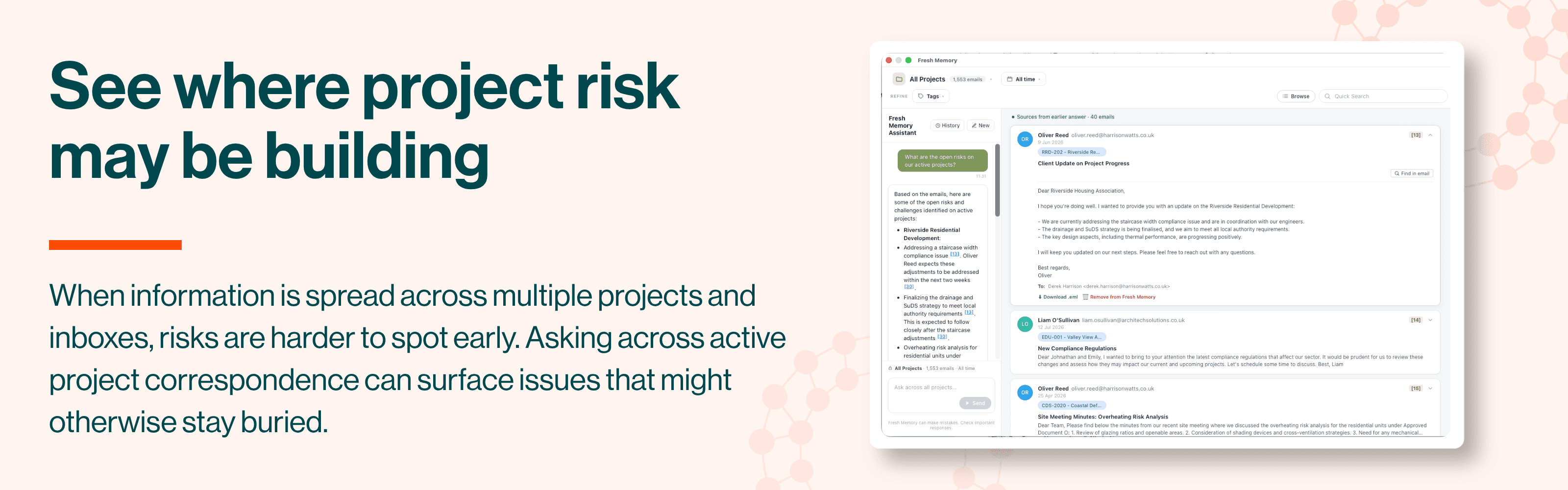
1. Start with a project where the numbers changed and follow the story behind them
Choose a live project where something noticeable has happened during the last six months. Perhaps margin has deteriorated, more hours have been consumed than planned, the forecast has changed, additional resources have been added or the fee position has shifted.
Now look at what was happening on the project during the same period.
Was there additional scope? Did the client take longer to approve something than expected? Was part of the design revisited? Did your team carry out work before a variation was agreed? Was a consultant decision holding up progress elsewhere?
Try to establish the explanation from the project record rather than asking the person who knows the job best.
This is a useful management test because knowing that a project consumed another 120 hours is not the same as knowing why. Your project data can tell you where to look, but the commercial story may sit in correspondence created weeks or months earlier.
At your next project review, choose one unexpected movement in the data and give yourself ten minutes to establish what was happening around it. If the explanation only becomes clear when the project lead joins the conversation, make a note of where the information trail became difficult to follow.
That is project knowledge currently residing in a person rather than being readily usable by the practice.
2. Ask a question without giving yourself the search terms
A lot of project information systems are good at finding correspondence when you already know enough about the answer to construct the search.
Real project questions are often much messier.
Imagine somebody asks why a particular cladding specification changed. You may not know when the discussion took place, which consultant raised the issue, whether the final approval happened in the same email thread, or even whether everyone involved used the word “cladding”.
The trail might start with an engineer raising a performance concern, continue through an architect suggesting an alternative, pick up programme or cost implications from elsewhere in the team, and eventually end with a client instruction.
Every email could be properly retained and searchable and the answer could still take time to reconstruct.
Choose an important decision from one of your completed projects and try finding the explanation without starting with a sender, date or carefully selected keyword. Can you get from the question to the answer, or do you first have to work out how to search for it?
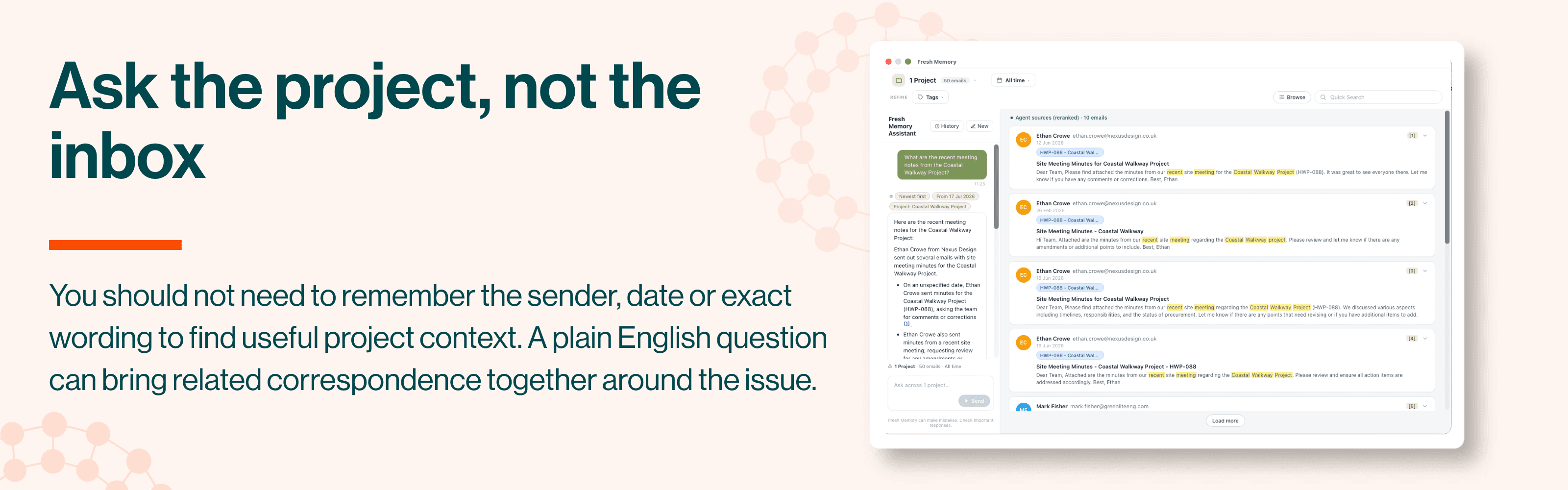
That is the difference between retrieving correspondence and retrieving project knowledge.
3. Find out whether the project record is as complete as it looks
A tidy project folder can be reassuring. It tells you what has been captured.
It does not necessarily tell you what has not.
Take a recent 90-day period on a live project and look beyond the correspondence already sitting in the shared record. How much project-related email was generated? How much was actually filed? Are gaps spread evenly, or are they concentrated around particular projects, teams or people?
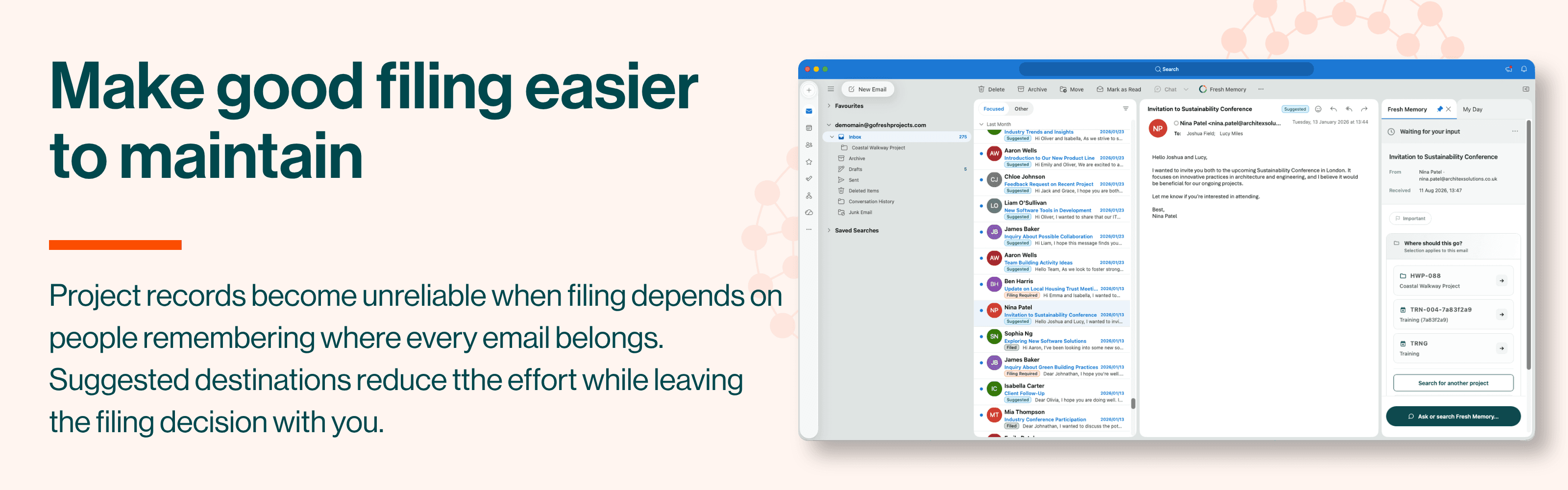
Then go one step further and consider the significance of what is missing. A routine diary message and the correspondence surrounding an important design change do not carry the same level of risk.
The useful question is therefore not simply whether your team is filing emails. It is whether you have enough visibility to judge how representative the shared record really is.
Fresh Memory’s Filing Health functionality is designed around this problem. It gives firms visibility into correspondence that has been considered, filed and left un-filed, helping managers identify potential blind spots rather than assuming the project record is complete because a folder exists.
A useful internal exercise is to pick three live projects and ask yourself one question about each:
How confident are you that the project record reflects what has actually happened?
If you cannot answer without asking the delivery team, that is useful information in itself.
4. Give the project to someone who wasn’t there
One of the easiest ways to test the quality of a project record is to temporarily remove the person who knows it best.
Choose a reasonably complex project and give another senior member of the practice half an hour to understand it. Ask them to establish what the client has approved, what significant changes have taken place, why those changes occurred, which matters remain unresolved and whether any commitments could affect delivery, fees, safety or professional liability.
They do not need to know every detail. They simply need to build a reliable picture from the information the practice already holds.
If several answers end with “you need to ask the project lead”, then the project lead is functioning as part of your information-management system.
That dependence can go unnoticed for years because, most of the time, the right people are available. It becomes much more obvious during annual leave, parental leave, internal handovers, promotions, project reassignment or staff turnover.
This is one of the practical reasons project knowledge needs to remain with the practice rather than only with the people who happened to create it.
5. Pick one important decision and trace it back to the evidence
Choose something meaningful enough to matter: a specification change, client instruction, variation, programme decision, design compromise or safety-related change.
Start with the final outcome and work backwards. Can you establish what prompted the decision, what information was considered, which people contributed, what was eventually agreed and where the supporting correspondence sits?
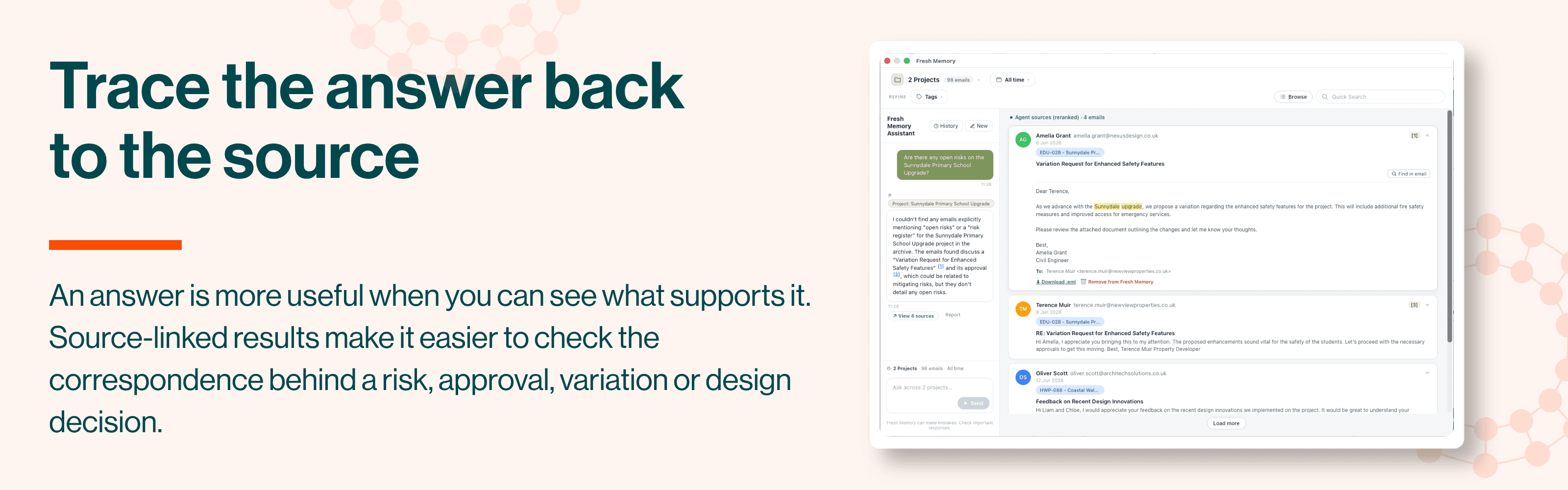
This is where a project record is often more complicated than its folder structure suggests. Important decisions rarely happen in one perfectly labelled email. They develop across conversations, revisions and responses.
For many projects, that is commercially important. On others, it can also become a safety and regulatory issue.
Why this matters for safety, risk and the Golden Thread
Following Grenfell, the industry's expectations around building information changed significantly. Dame Judith Hackitt's review identified problems with key information not being effectively managed or remaining available through a building's lifecycle, and the Golden Thread was proposed as a way of ensuring people can use reliable information to design, construct and manage buildings safely.
For higher-risk buildings in England, current Building Safety Regulator guidance requires Golden Thread information to be kept digitally, protected from unauthorised access, available when it is needed and presented in a form people can actually use. It must also operate as a building's single source of truth. During design and construction, principal designers are required to keep design information up to date and work with principal contractors to record and evidence the design work being carried out.
That matters particularly when a project changes.
BSR guidance includes a change control plan and change log among the records required during higher-risk building work, while the Golden Thread itself must remain current as design and construction progress.
For your practice, a useful question is therefore whether somebody who was not part of a safety-relevant decision could later reconstruct it from the project information available.
Suppose a specification changed. Could they understand what prompted the change, what options were considered, which consultants contributed, what was ultimately approved and what evidence supports that account?
If the information technically exists but is fragmented across several people's inboxes, difficult to retrieve without knowing the exact terminology, or understandable only once someone explains the backstory, that still creates practical risk.
The Golden Thread is not simply about retaining information. Government guidance describes it as both the information itself and the information-management process that keeps that information accurate, understandable, accessible and current.
That is an important distinction.
Architects are already carrying more compliance administration
None of this is happening in a vacuum. Practices are being asked to improve information quality while already absorbing additional administrative and professional responsibility.
A 2026 Wienerberger survey of 80 UK architects, reported by RIBA Journal, found that architects were spending an average of four hours each week verifying product information. Workloads had increased by an average of 16%, while 95% of respondents reported an increase in compliance-related administration. The same survey found that two-thirds had experienced a rise in professional indemnity claims either personally or within their practice since the Building Safety Act was introduced.
The research was commissioned by a building-products manufacturer, so it should not be treated as a census of the profession, but the pressure it describes is significant and recognisable: greater accountability is creating more work around checking, evidencing and documenting decisions.
There are also signs that leading practices are responding by changing their internal processes rather than treating compliance as something that can simply be added at the end of a project.
Pilbrow & Partners, for example, told RIBA Journal that it had adapted its ISO 9001 processes in response to the Building Safety Act and created a bespoke matrix for each stage of the RIBA Plan of Work. The aim is to demonstrate how designs comply with statutory requirements while feeding the information into the project's digital Golden Thread.
That is a useful example because it illustrates where the industry is heading. Information management is becoming more closely connected to project delivery, design decisions and professional accountability.
The answer cannot simply be to tell busy project teams to remember more, file more and search harder.
What to do if your project fails one of these tests
You do not necessarily need another system. Start by understanding where the failure occurs.
If correspondence is not being filed consistently, look at whether your process asks too much of the user. Complicated filing structures and repetitive administration create obvious opportunities for things to be missed.
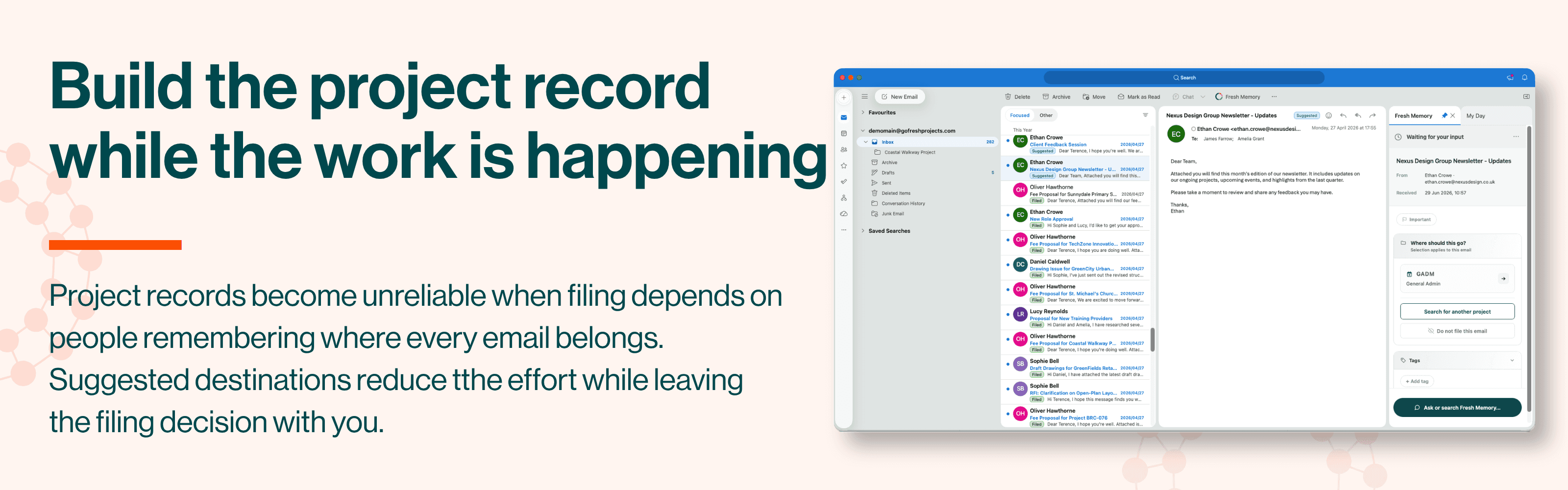
If information is retained but difficult to reconstruct, look at how your team searches. Finding a known email is a different task from answering a question such as “why did this decision change?”
If the project record depends heavily on individuals, introduce a simple record test into project reviews or handovers. Ask somebody outside the immediate team to retrieve a handful of important decisions. That exercise can expose weaknesses long before a resignation, dispute or regulatory request does.
And if your commercial data tells you a project has changed, make a habit of looking at the project information around the same period. Ask what the team, client and consultants were discussing when the numbers moved.
That connection is especially useful for firms already using Fresh Projects.
From project performance to project context
Fresh Projects gives you visibility over what is happening commercially and operationally across your projects, including time, fees, costs, forecasts, resources and profitability.
Fresh Memory adds another layer: the decisions, approvals and conversations behind that activity.
It starts with project correspondence in Microsoft 365, using intelligent filing to make capture easier, providing visibility into what has and has not been filed, and allowing you to ask questions about project history in plain English.
The purpose is not to replace professional judgement, and Fresh Memory is not a compliance system. Using it does not make a project compliant with the Building Safety Act or Golden Thread requirements.
What it can do is help you build a more usable project record, reduce dependence on individual memory and make it easier to retrieve the context behind decisions when that context matters.
That could be during a project review because your margin has changed. It could be during a handover because a senior team member is unavailable. Or it could be much later, when somebody needs to understand how a design decision was reached and what evidence sits behind it.
The project data can tell you that something happened.
Your project information should help you explain why.
Try the five tests on one project
Before you change anything, choose one live project and test your current process.
Can you explain a movement in performance from the project record? Can you answer an historic project question without knowing the sender or search term? Can you see where relevant correspondence has not been captured? Could somebody outside the delivery team understand the important decisions? Can you trace one significant decision from its final outcome back through the discussion and evidence behind it?
If those answers are readily available, your project information is doing a valuable job.
If several of them depend on finding the right person and asking what they remember, more of your practice's project knowledge may still be sitting in individual inboxes than you think.
Fresh Memory is currently rolling out to an early group of AEC firms. If you already use Fresh Projects and your practice could begin implementation within the next three months, you can register your interest for early access.
Want to see what stronger project information management looks like in practice?
Join us on 23 September, 11:00am–12:15pm BST for a practical Fresh Memory webinar exploring project information, risk, accountability and how AEC firms can build a more usable project record.
We’ll look at the wider industry challenge, demonstrate Fresh Memory in practice and hear directly from a firm about their experience.
Register for the webinar:
You can see your project slipping, but can you see why?
Five practical ways to test whether your project record can explain the decisions, changes and risks behind your project data
You’re reviewing a live project and something has moved in the wrong direction. The margin has fallen, more hours have been used than expected, or the latest forecast has shifted enough to warrant a closer look.
If you use Fresh Projects, you can see that movement while the project is still live. Fees, time, expenses, forecasts and project profitability give you a clear view of where commercial performance is changing.
Then someone asks the harder question: Why?
Perhaps the client requested a change that looked fairly minor at the time. Maybe an approval arrived later than expected, part of the design had to be revisited, or additional work started before the fee implications had been agreed. Someone on the project team probably remembers some of it, and the supporting correspondence probably still exists somewhere in Microsoft 365.
The difficulty is reconstructing the whole story quickly and confidently.
That distinction matters. You can have excellent visibility over project performance while still relying heavily on individual people to explain the decisions and conversations behind it. When that happens, a project review can quickly turn into an exercise in collective memory: someone remembers one conversation, somebody else searches Outlook, and the project lead fills in the rest from memory.
For AEC firms, that is increasingly more than an inconvenience. The industry is being asked to place much greater emphasis on traceable, accurate and usable information, particularly where building safety is concerned. The post-Grenfell Golden Thread reforms were developed specifically in response to problems with important building information not being effectively managed, or sometimes not remaining available throughout the building lifecycle.
So how well does your own project record stand up when somebody needs an answer?
Here are five practical ways to find out.
1. Start with a project where the numbers changed and follow the story behind them
Choose a live project where something noticeable has happened during the last six months. Perhaps margin has deteriorated, more hours have been consumed than planned, the forecast has changed, additional resources have been added or the fee position has shifted.
Now look at what was happening on the project during the same period.
Was there additional scope? Did the client take longer to approve something than expected? Was part of the design revisited? Did your team carry out work before a variation was agreed? Was a consultant decision holding up progress elsewhere?
Try to establish the explanation from the project record rather than asking the person who knows the job best.
This is a useful management test because knowing that a project consumed another 120 hours is not the same as knowing why. Your project data can tell you where to look, but the commercial story may sit in correspondence created weeks or months earlier.
At your next project review, choose one unexpected movement in the data and give yourself ten minutes to establish what was happening around it. If the explanation only becomes clear when the project lead joins the conversation, make a note of where the information trail became difficult to follow.
That is project knowledge currently residing in a person rather than being readily usable by the practice.
2. Ask a question without giving yourself the search terms
A lot of project information systems are good at finding correspondence when you already know enough about the answer to construct the search.
Real project questions are often much messier.
Imagine somebody asks why a particular cladding specification changed. You may not know when the discussion took place, which consultant raised the issue, whether the final approval happened in the same email thread, or even whether everyone involved used the word “cladding”.
The trail might start with an engineer raising a performance concern, continue through an architect suggesting an alternative, pick up programme or cost implications from elsewhere in the team, and eventually end with a client instruction.
Every email could be properly retained and searchable and the answer could still take time to reconstruct.
Choose an important decision from one of your completed projects and try finding the explanation without starting with a sender, date or carefully selected keyword. Can you get from the question to the answer, or do you first have to work out how to search for it?
That is the difference between retrieving correspondence and retrieving project knowledge.
3. Find out whether the project record is as complete as it looks
A tidy project folder can be reassuring. It tells you what has been captured.
It does not necessarily tell you what has not.
Take a recent 90-day period on a live project and look beyond the correspondence already sitting in the shared record. How much project-related email was generated? How much was actually filed? Are gaps spread evenly, or are they concentrated around particular projects, teams or people?
Then go one step further and consider the significance of what is missing. A routine diary message and the correspondence surrounding an important design change do not carry the same level of risk.
The useful question is therefore not simply whether your team is filing emails. It is whether you have enough visibility to judge how representative the shared record really is.
Fresh Memory’s Filing Health functionality is designed around this problem. It gives firms visibility into correspondence that has been considered, filed and left un-filed, helping managers identify potential blind spots rather than assuming the project record is complete because a folder exists.
A useful internal exercise is to pick three live projects and ask yourself one question about each:
How confident are you that the project record reflects what has actually happened?
If you cannot answer without asking the delivery team, that is useful information in itself.
4. Give the project to someone who wasn’t there
One of the easiest ways to test the quality of a project record is to temporarily remove the person who knows it best.
Choose a reasonably complex project and give another senior member of the practice half an hour to understand it. Ask them to establish what the client has approved, what significant changes have taken place, why those changes occurred, which matters remain unresolved and whether any commitments could affect delivery, fees, safety or professional liability.
They do not need to know every detail. They simply need to build a reliable picture from the information the practice already holds.
If several answers end with “you need to ask the project lead”, then the project lead is functioning as part of your information-management system.
That dependence can go unnoticed for years because, most of the time, the right people are available. It becomes much more obvious during annual leave, parental leave, internal handovers, promotions, project reassignment or staff turnover.
This is one of the practical reasons project knowledge needs to remain with the practice rather than only with the people who happened to create it.
5. Pick one important decision and trace it back to the evidence
Choose something meaningful enough to matter: a specification change, client instruction, variation, programme decision, design compromise or safety-related change.
Start with the final outcome and work backwards. Can you establish what prompted the decision, what information was considered, which people contributed, what was eventually agreed and where the supporting correspondence sits?
This is where a project record is often more complicated than its folder structure suggests. Important decisions rarely happen in one perfectly labelled email. They develop across conversations, revisions and responses.
For many projects, that is commercially important. On others, it can also become a safety and regulatory issue.
Why this matters for safety, risk and the Golden Thread
Following Grenfell, the industry's expectations around building information changed significantly. Dame Judith Hackitt's review identified problems with key information not being effectively managed or remaining available through a building's lifecycle, and the Golden Thread was proposed as a way of ensuring people can use reliable information to design, construct and manage buildings safely.
For higher-risk buildings in England, current Building Safety Regulator guidance requires Golden Thread information to be kept digitally, protected from unauthorised access, available when it is needed and presented in a form people can actually use. It must also operate as a building's single source of truth. During design and construction, principal designers are required to keep design information up to date and work with principal contractors to record and evidence the design work being carried out.
That matters particularly when a project changes.
BSR guidance includes a change control plan and change log among the records required during higher-risk building work, while the Golden Thread itself must remain current as design and construction progress.
For your practice, a useful question is therefore whether somebody who was not part of a safety-relevant decision could later reconstruct it from the project information available.
Suppose a specification changed. Could they understand what prompted the change, what options were considered, which consultants contributed, what was ultimately approved and what evidence supports that account?
If the information technically exists but is fragmented across several people's inboxes, difficult to retrieve without knowing the exact terminology, or understandable only once someone explains the backstory, that still creates practical risk.
The Golden Thread is not simply about retaining information. Government guidance describes it as both the information itself and the information-management process that keeps that information accurate, understandable, accessible and current.
That is an important distinction.
Architects are already carrying more compliance administration
None of this is happening in a vacuum. Practices are being asked to improve information quality while already absorbing additional administrative and professional responsibility.
A 2026 Wienerberger survey of 80 UK architects, reported by RIBA Journal, found that architects were spending an average of four hours each week verifying product information. Workloads had increased by an average of 16%, while 95% of respondents reported an increase in compliance-related administration. The same survey found that two-thirds had experienced a rise in professional indemnity claims either personally or within their practice since the Building Safety Act was introduced.
The research was commissioned by a building-products manufacturer, so it should not be treated as a census of the profession, but the pressure it describes is significant and recognisable: greater accountability is creating more work around checking, evidencing and documenting decisions.
There are also signs that leading practices are responding by changing their internal processes rather than treating compliance as something that can simply be added at the end of a project.
Pilbrow & Partners, for example, told RIBA Journal that it had adapted its ISO 9001 processes in response to the Building Safety Act and created a bespoke matrix for each stage of the RIBA Plan of Work. The aim is to demonstrate how designs comply with statutory requirements while feeding the information into the project's digital Golden Thread.
That is a useful example because it illustrates where the industry is heading. Information management is becoming more closely connected to project delivery, design decisions and professional accountability.
The answer cannot simply be to tell busy project teams to remember more, file more and search harder.
What to do if your project fails one of these tests
You do not necessarily need another system. Start by understanding where the failure occurs.
If correspondence is not being filed consistently, look at whether your process asks too much of the user. Complicated filing structures and repetitive administration create obvious opportunities for things to be missed.
If information is retained but difficult to reconstruct, look at how your team searches. Finding a known email is a different task from answering a question such as “why did this decision change?”
If the project record depends heavily on individuals, introduce a simple record test into project reviews or handovers. Ask somebody outside the immediate team to retrieve a handful of important decisions. That exercise can expose weaknesses long before a resignation, dispute or regulatory request does.
And if your commercial data tells you a project has changed, make a habit of looking at the project information around the same period. Ask what the team, client and consultants were discussing when the numbers moved.
That connection is especially useful for firms already using Fresh Projects.
From project performance to project context
Fresh Projects gives you visibility over what is happening commercially and operationally across your projects, including time, fees, costs, forecasts, resources and profitability.
Fresh Memory adds another layer: the decisions, approvals and conversations behind that activity.
It starts with project correspondence in Microsoft 365, using intelligent filing to make capture easier, providing visibility into what has and has not been filed, and allowing you to ask questions about project history in plain English.
The purpose is not to replace professional judgement, and Fresh Memory is not a compliance system. Using it does not make a project compliant with the Building Safety Act or Golden Thread requirements.
What it can do is help you build a more usable project record, reduce dependence on individual memory and make it easier to retrieve the context behind decisions when that context matters.
That could be during a project review because your margin has changed. It could be during a handover because a senior team member is unavailable. Or it could be much later, when somebody needs to understand how a design decision was reached and what evidence sits behind it.
The project data can tell you that something happened.
Your project information should help you explain why.
Try the five tests on one project
Before you change anything, choose one live project and test your current process.
Can you explain a movement in performance from the project record? Can you answer an historic project question without knowing the sender or search term? Can you see where relevant correspondence has not been captured? Could somebody outside the delivery team understand the important decisions? Can you trace one significant decision from its final outcome back through the discussion and evidence behind it?
If those answers are readily available, your project information is doing a valuable job.
If several of them depend on finding the right person and asking what they remember, more of your practice's project knowledge may still be sitting in individual inboxes than you think.
Fresh Memory is currently rolling out to an early group of AEC firms. If you already use Fresh Projects and your practice could begin implementation within the next three months, you can register your interest for early access.
Want to see what stronger project information management looks like in practice?
Join us on 23 September, 11:00am–12:15pm BST for a practical Fresh Memory webinar exploring project information, risk, accountability and how AEC firms can build a more usable project record.
We’ll look at the wider industry challenge, demonstrate Fresh Memory in practice and hear directly from a firm about their experience.
Register for the webinar:
You can see your project slipping, but can you see why?
Five practical ways to test whether your project record can explain the decisions, changes and risks behind your project data
You’re reviewing a live project and something has moved in the wrong direction. The margin has fallen, more hours have been used than expected, or the latest forecast has shifted enough to warrant a closer look.
If you use Fresh Projects, you can see that movement while the project is still live. Fees, time, expenses, forecasts and project profitability give you a clear view of where commercial performance is changing.
Then someone asks the harder question: Why?
Perhaps the client requested a change that looked fairly minor at the time. Maybe an approval arrived later than expected, part of the design had to be revisited, or additional work started before the fee implications had been agreed. Someone on the project team probably remembers some of it, and the supporting correspondence probably still exists somewhere in Microsoft 365.
The difficulty is reconstructing the whole story quickly and confidently.
That distinction matters. You can have excellent visibility over project performance while still relying heavily on individual people to explain the decisions and conversations behind it. When that happens, a project review can quickly turn into an exercise in collective memory: someone remembers one conversation, somebody else searches Outlook, and the project lead fills in the rest from memory.
For AEC firms, that is increasingly more than an inconvenience. The industry is being asked to place much greater emphasis on traceable, accurate and usable information, particularly where building safety is concerned. The post-Grenfell Golden Thread reforms were developed specifically in response to problems with important building information not being effectively managed, or sometimes not remaining available throughout the building lifecycle.
So how well does your own project record stand up when somebody needs an answer?
Here are five practical ways to find out.
1. Start with a project where the numbers changed and follow the story behind them
Choose a live project where something noticeable has happened during the last six months. Perhaps margin has deteriorated, more hours have been consumed than planned, the forecast has changed, additional resources have been added or the fee position has shifted.
Now look at what was happening on the project during the same period.
Was there additional scope? Did the client take longer to approve something than expected? Was part of the design revisited? Did your team carry out work before a variation was agreed? Was a consultant decision holding up progress elsewhere?
Try to establish the explanation from the project record rather than asking the person who knows the job best.
This is a useful management test because knowing that a project consumed another 120 hours is not the same as knowing why. Your project data can tell you where to look, but the commercial story may sit in correspondence created weeks or months earlier.
At your next project review, choose one unexpected movement in the data and give yourself ten minutes to establish what was happening around it. If the explanation only becomes clear when the project lead joins the conversation, make a note of where the information trail became difficult to follow.
That is project knowledge currently residing in a person rather than being readily usable by the practice.
2. Ask a question without giving yourself the search terms
A lot of project information systems are good at finding correspondence when you already know enough about the answer to construct the search.
Real project questions are often much messier.
Imagine somebody asks why a particular cladding specification changed. You may not know when the discussion took place, which consultant raised the issue, whether the final approval happened in the same email thread, or even whether everyone involved used the word “cladding”.
The trail might start with an engineer raising a performance concern, continue through an architect suggesting an alternative, pick up programme or cost implications from elsewhere in the team, and eventually end with a client instruction.
Every email could be properly retained and searchable and the answer could still take time to reconstruct.
Choose an important decision from one of your completed projects and try finding the explanation without starting with a sender, date or carefully selected keyword. Can you get from the question to the answer, or do you first have to work out how to search for it?
That is the difference between retrieving correspondence and retrieving project knowledge.
3. Find out whether the project record is as complete as it looks
A tidy project folder can be reassuring. It tells you what has been captured.
It does not necessarily tell you what has not.
Take a recent 90-day period on a live project and look beyond the correspondence already sitting in the shared record. How much project-related email was generated? How much was actually filed? Are gaps spread evenly, or are they concentrated around particular projects, teams or people?
Then go one step further and consider the significance of what is missing. A routine diary message and the correspondence surrounding an important design change do not carry the same level of risk.
The useful question is therefore not simply whether your team is filing emails. It is whether you have enough visibility to judge how representative the shared record really is.
Fresh Memory’s Filing Health functionality is designed around this problem. It gives firms visibility into correspondence that has been considered, filed and left un-filed, helping managers identify potential blind spots rather than assuming the project record is complete because a folder exists.
A useful internal exercise is to pick three live projects and ask yourself one question about each:
How confident are you that the project record reflects what has actually happened?
If you cannot answer without asking the delivery team, that is useful information in itself.
4. Give the project to someone who wasn’t there
One of the easiest ways to test the quality of a project record is to temporarily remove the person who knows it best.
Choose a reasonably complex project and give another senior member of the practice half an hour to understand it. Ask them to establish what the client has approved, what significant changes have taken place, why those changes occurred, which matters remain unresolved and whether any commitments could affect delivery, fees, safety or professional liability.
They do not need to know every detail. They simply need to build a reliable picture from the information the practice already holds.
If several answers end with “you need to ask the project lead”, then the project lead is functioning as part of your information-management system.
That dependence can go unnoticed for years because, most of the time, the right people are available. It becomes much more obvious during annual leave, parental leave, internal handovers, promotions, project reassignment or staff turnover.
This is one of the practical reasons project knowledge needs to remain with the practice rather than only with the people who happened to create it.
5. Pick one important decision and trace it back to the evidence
Choose something meaningful enough to matter: a specification change, client instruction, variation, programme decision, design compromise or safety-related change.
Start with the final outcome and work backwards. Can you establish what prompted the decision, what information was considered, which people contributed, what was eventually agreed and where the supporting correspondence sits?
This is where a project record is often more complicated than its folder structure suggests. Important decisions rarely happen in one perfectly labelled email. They develop across conversations, revisions and responses.
For many projects, that is commercially important. On others, it can also become a safety and regulatory issue.
Why this matters for safety, risk and the Golden Thread
Following Grenfell, the industry's expectations around building information changed significantly. Dame Judith Hackitt's review identified problems with key information not being effectively managed or remaining available through a building's lifecycle, and the Golden Thread was proposed as a way of ensuring people can use reliable information to design, construct and manage buildings safely.
For higher-risk buildings in England, current Building Safety Regulator guidance requires Golden Thread information to be kept digitally, protected from unauthorised access, available when it is needed and presented in a form people can actually use. It must also operate as a building's single source of truth. During design and construction, principal designers are required to keep design information up to date and work with principal contractors to record and evidence the design work being carried out.
That matters particularly when a project changes.
BSR guidance includes a change control plan and change log among the records required during higher-risk building work, while the Golden Thread itself must remain current as design and construction progress.
For your practice, a useful question is therefore whether somebody who was not part of a safety-relevant decision could later reconstruct it from the project information available.
Suppose a specification changed. Could they understand what prompted the change, what options were considered, which consultants contributed, what was ultimately approved and what evidence supports that account?
If the information technically exists but is fragmented across several people's inboxes, difficult to retrieve without knowing the exact terminology, or understandable only once someone explains the backstory, that still creates practical risk.
The Golden Thread is not simply about retaining information. Government guidance describes it as both the information itself and the information-management process that keeps that information accurate, understandable, accessible and current.
That is an important distinction.
Architects are already carrying more compliance administration
None of this is happening in a vacuum. Practices are being asked to improve information quality while already absorbing additional administrative and professional responsibility.
A 2026 Wienerberger survey of 80 UK architects, reported by RIBA Journal, found that architects were spending an average of four hours each week verifying product information. Workloads had increased by an average of 16%, while 95% of respondents reported an increase in compliance-related administration. The same survey found that two-thirds had experienced a rise in professional indemnity claims either personally or within their practice since the Building Safety Act was introduced.
The research was commissioned by a building-products manufacturer, so it should not be treated as a census of the profession, but the pressure it describes is significant and recognisable: greater accountability is creating more work around checking, evidencing and documenting decisions.
There are also signs that leading practices are responding by changing their internal processes rather than treating compliance as something that can simply be added at the end of a project.
Pilbrow & Partners, for example, told RIBA Journal that it had adapted its ISO 9001 processes in response to the Building Safety Act and created a bespoke matrix for each stage of the RIBA Plan of Work. The aim is to demonstrate how designs comply with statutory requirements while feeding the information into the project's digital Golden Thread.
That is a useful example because it illustrates where the industry is heading. Information management is becoming more closely connected to project delivery, design decisions and professional accountability.
The answer cannot simply be to tell busy project teams to remember more, file more and search harder.
What to do if your project fails one of these tests
You do not necessarily need another system. Start by understanding where the failure occurs.
If correspondence is not being filed consistently, look at whether your process asks too much of the user. Complicated filing structures and repetitive administration create obvious opportunities for things to be missed.
If information is retained but difficult to reconstruct, look at how your team searches. Finding a known email is a different task from answering a question such as “why did this decision change?”
If the project record depends heavily on individuals, introduce a simple record test into project reviews or handovers. Ask somebody outside the immediate team to retrieve a handful of important decisions. That exercise can expose weaknesses long before a resignation, dispute or regulatory request does.
And if your commercial data tells you a project has changed, make a habit of looking at the project information around the same period. Ask what the team, client and consultants were discussing when the numbers moved.
That connection is especially useful for firms already using Fresh Projects.
From project performance to project context
Fresh Projects gives you visibility over what is happening commercially and operationally across your projects, including time, fees, costs, forecasts, resources and profitability.
Fresh Memory adds another layer: the decisions, approvals and conversations behind that activity.
It starts with project correspondence in Microsoft 365, using intelligent filing to make capture easier, providing visibility into what has and has not been filed, and allowing you to ask questions about project history in plain English.
The purpose is not to replace professional judgement, and Fresh Memory is not a compliance system. Using it does not make a project compliant with the Building Safety Act or Golden Thread requirements.
What it can do is help you build a more usable project record, reduce dependence on individual memory and make it easier to retrieve the context behind decisions when that context matters.
That could be during a project review because your margin has changed. It could be during a handover because a senior team member is unavailable. Or it could be much later, when somebody needs to understand how a design decision was reached and what evidence sits behind it.
The project data can tell you that something happened.
Your project information should help you explain why.
Try the five tests on one project
Before you change anything, choose one live project and test your current process.
Can you explain a movement in performance from the project record? Can you answer an historic project question without knowing the sender or search term? Can you see where relevant correspondence has not been captured? Could somebody outside the delivery team understand the important decisions? Can you trace one significant decision from its final outcome back through the discussion and evidence behind it?
If those answers are readily available, your project information is doing a valuable job.
If several of them depend on finding the right person and asking what they remember, more of your practice's project knowledge may still be sitting in individual inboxes than you think.
Fresh Memory is currently rolling out to an early group of AEC firms. If you already use Fresh Projects and your practice could begin implementation within the next three months, you can register your interest for early access.
Want to see what stronger project information management looks like in practice?
Join us on 23 September, 11:00am–12:15pm BST for a practical Fresh Memory webinar exploring project information, risk, accountability and how AEC firms can build a more usable project record.
We’ll look at the wider industry challenge, demonstrate Fresh Memory in practice and hear directly from a firm about their experience.
Register for the webinar:
Published:
Published:


Five ways to build commercial confidence across your project teams
Five ways to build commercial confidence across your project teams
Five ways to build commercial confidence across your project teams
How architecture, engineering, quantity surveying and other built-environment firms can help project teams understand fees, time and performance without turning everyone into finance specialists.
How architecture, engineering, quantity surveying and other built-environment firms can help project teams understand fees, time and performance without turning everyone into finance specialists.
Can your project record stand up when it matters? 5 practical tests for AEC firms.
Can your project record stand up when it matters? 5 practical tests for AEC firms.
Can your project record stand up when it matters? 5 practical tests for AEC firms.
Five simple tests to uncover gaps in your project information before they become commercial, compliance or delivery risks.
Five simple tests to uncover gaps in your project information before they become commercial, compliance or delivery risks.

7 Signs Your A&E Practice Management Software Isn’t Fully Adopted
7 Signs Your A&E Practice Management Software Isn’t Fully Adopted
7 Signs Your A&E Practice Management Software Isn’t Fully Adopted
How growing A&E firms can close the gap between software implementation and whole-team commercial value
How growing A&E firms can close the gap between software implementation and whole-team commercial value

When Teams Stop Speaking The Same Operational Language
When Teams Stop Speaking The Same Operational Language
When Teams Stop Speaking The Same Operational Language
Why growing architecture practices often lose reporting confidence gradually, long before anyone formally identifies a systems problem.
Why growing architecture practices often lose reporting confidence gradually, long before anyone formally identifies a systems problem.

What It Really Means When a Client Recommends You
What It Really Means When a Client Recommends You
What It Really Means When a Client Recommends You
Why the built environment has always grown through trust, and what that means for the firms that do it well.
Why the built environment has always grown through trust, and what that means for the firms that do it well.
Why Reporting Leaves Firms Guessing
Why Reporting Leaves Firms Guessing
Why Reporting Leaves Firms Guessing
Inside many built environment firms, meetings meant for decisions quietly turn into debates about the numbers on the page.
Inside many built environment firms, meetings meant for decisions quietly turn into debates about the numbers on the page.

Why Multi-Office Firms Lack Visibility
Why Multi-Office Firms Lack Visibility
Why Multi-Office Firms Lack Visibility
In many built environment consultancies, reporting technically works. The challenge is that clarity often arrives after the moment when it would have influenced action.
In many built environment consultancies, reporting technically works. The challenge is that clarity often arrives after the moment when it would have influenced action.

Why Reporting Slows Firms Down
Why Reporting Slows Firms Down
Why Reporting Slows Firms Down
Even with reporting systems in place, many architecture, engineering and quantity surveying firms find that insight arrives too late to influence decisions during delivery.
Even with reporting systems in place, many architecture, engineering and quantity surveying firms find that insight arrives too late to influence decisions during delivery.

Compare A&E Management Tools
Compare A&E Management Tools
Compare A&E Management Tools
Choosing a practice management system is no longer about feature lists. This guide explains how architecture and engineering firms should compare tools in 2026, focusing on adoption, usability and decision-making rather than complexity.
Choosing a practice management system is no longer about feature lists. This guide explains how architecture and engineering firms should compare tools in 2026, focusing on adoption, usability and decision-making rather than complexity.


Spreadsheets in A&E Firms: What Works
Spreadsheets in A&E Firms: What Works
Spreadsheets in A&E Firms: What Works
A practical guide to using Excel and Sheets well, and knowing when to graduate to purpose-built systems without losing the flexibility you love.
A practical guide to using Excel and Sheets well, and knowing when to graduate to purpose-built systems without losing the flexibility you love.

Women in AEC at Fresh Projects
Women in AEC at Fresh Projects
Women in AEC at Fresh Projects
Why representation, visibility and better systems matter for the future of architecture and engineering
Why representation, visibility and better systems matter for the future of architecture and engineering

Architecture Leadership Challenges
Architecture Leadership Challenges
Architecture Leadership Challenges
How firm leaders can protect margin, prepare successors and modernise delivery without losing what made them successful
How firm leaders can protect margin, prepare successors and modernise delivery without losing what made them successful

5 Ways to Outgrow Spreadsheets Profitably
5 Ways to Outgrow Spreadsheets Profitably
5 Ways to Outgrow Spreadsheets Profitably
How architecture and engineering practices protect margin as teams and project complexity increase
How architecture and engineering practices protect margin as teams and project complexity increase

The Profitability Pyramid Explained
The Profitability Pyramid Explained
The Profitability Pyramid Explained
Understanding the real drivers of financial performance for medium and large practices over the past year
Understanding the real drivers of financial performance for medium and large practices over the past year

3 Lessons to Help You Run a More Profitable Practice
3 Lessons to Help You Run a More Profitable Practice
3 Lessons to Help You Run a More Profitable Practice
Practical insights from A&E leaders on spotting profit risks early, communicating value, and protecting margins
Practical insights from A&E leaders on spotting profit risks early, communicating value, and protecting margins

Embracing Neurodiversity in Architecture
Embracing Neurodiversity in Architecture
Embracing Neurodiversity in Architecture
How inclusive practice design can unlock creativity, innovation and operational clarity
How inclusive practice design can unlock creativity, innovation and operational clarity

Profitable Projects: Winning the Right Projects in AEC
Profitable Projects: Winning the Right Projects in AEC
Profitable Projects: Winning the Right Projects in AEC
How to qualify leads, focus your pipeline and forecast success more confidently
How to qualify leads, focus your pipeline and forecast success more confidently

Profitable Projects: The Art of Cashflow Alchemy in AEC
Profitable Projects: The Art of Cashflow Alchemy in AEC
Profitable Projects: The Art of Cashflow Alchemy in AEC
How architecture and engineering firms can turn unpredictable cash flow into a strategic advantage
How architecture and engineering firms can turn unpredictable cash flow into a strategic advantage

Setting Fees for Profitable Projects
Setting Fees for Profitable Projects
Setting Fees for Profitable Projects
Why bottom-up fee setting, clear scope and real-time cost visibility underpin profitable projects
Why bottom-up fee setting, clear scope and real-time cost visibility underpin profitable projects

Tools That Improve A&E Profitability
Tools That Improve A&E Profitability
Tools That Improve A&E Profitability
Why better visibility across projects, people and finances is now essential for sustainable practice performance
Why better visibility across projects, people and finances is now essential for sustainable practice performance

How to Manage Inflation on Architecture Projects
How to Manage Inflation on Architecture Projects
How to Manage Inflation on Architecture Projects
Practical ways to protect fees and margins when costs change mid-project
Practical ways to protect fees and margins when costs change mid-project

An Architect’s Guide to Project Budgeting
An Architect’s Guide to Project Budgeting
An Architect’s Guide to Project Budgeting
How to build realistic, profitable project budgets that support better pricing and delivery
How to build realistic, profitable project budgets that support better pricing and delivery


Improve Project Profitability: An Architect’s Guide
Improve Project Profitability: An Architect’s Guide
Improve Project Profitability: An Architect’s Guide
Practical ways architecture practices can protect margins and make better commercial decisions
Practical ways architecture practices can protect margins and make better commercial decisions


Calculate Your Cost Rate in 3 Simple Steps
Calculate Your Cost Rate in 3 Simple Steps
Calculate Your Cost Rate in 3 Simple Steps
Why understanding your true cost rate is the foundation of profitable fees, resourcing and decision-making
Why understanding your true cost rate is the foundation of profitable fees, resourcing and decision-making

When to Hire: Key Decisions
When to Hire: Key Decisions
When to Hire: Key Decisions
Why workload visibility and forecasting matter more than instinct in mid-sized architecture practices
Why workload visibility and forecasting matter more than instinct in mid-sized architecture practices

5 Basics to Improve Profitability
5 Basics to Improve Profitability
5 Basics to Improve Profitability
Five practical habits that help architecture practices improve profitability without adding complexity
Five practical habits that help architecture practices improve profitability without adding complexity

3 Questions for Profitable Firms
3 Questions for Profitable Firms
3 Questions for Profitable Firms
How clear insight into projects, clients and utilisation drives better decisions in mid-sized A&E firms
How clear insight into projects, clients and utilisation drives better decisions in mid-sized A&E firms

What Makes Firms More Profitable?
What Makes Firms More Profitable?
What Makes Firms More Profitable?
Why the most profitable firms spend less time on financial management and still make better decisions
Why the most profitable firms spend less time on financial management and still make better decisions

A-Team Approach to Profitability
A-Team Approach to Profitability
A-Team Approach to Profitability
Why reallocating work across roles can dramatically improve utilisation and margins in 50–100 person A&E practices
Why reallocating work across roles can dramatically improve utilisation and margins in 50–100 person A&E practices

I Love Excel. I Hate Excel.
I Love Excel. I Hate Excel.
I Love Excel. I Hate Excel.
Why spreadsheets break down in 50–100 person architecture and engineering practices, and what works better
Why spreadsheets break down in 50–100 person architecture and engineering practices, and what works better

Getting Project Fees Right
Getting Project Fees Right
Getting Project Fees Right
How accurate budgeting and disciplined scope control protect profitability in 50–100 person A&E practices
How accurate budgeting and disciplined scope control protect profitability in 50–100 person A&E practices

Working Capital Risks in A&E Firms
Working Capital Risks in A&E Firms
Working Capital Risks in A&E Firms
The financial blind spot that catches even well-run architecture and engineering practices
The financial blind spot that catches even well-run architecture and engineering practices

We Run Our Business on Referrals
Fresh Projects is a UK-based software platform designed for architects, engineers, and other built-environment professionals to manage financial aspects of their projects. It helps teams track fees, timesheets, expenses, billing, and overall profitability to keep projects on budget and profitable. The platform also centralises project data, streamlines administrative tasks, and offers mobile app support for easy access and updates.
1a Colinette Road
London
SW15 6QG
© 2026 Fresh Projects
Product
